
Research to help racehorses put their best foot forward
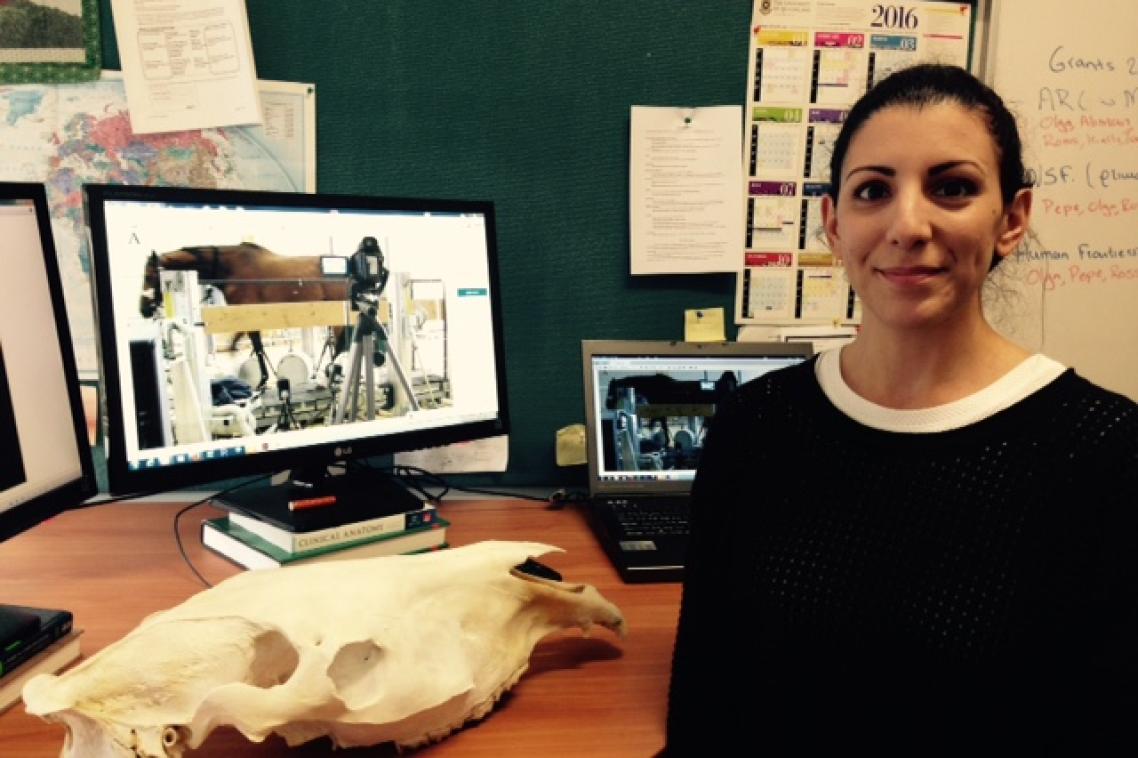
An international research team is working to understand how horseshoes affect foot skeleton stress in racehorses, in a project that is likely to benefit the racing industry and protect horses from injury.
University of Queensland School of Biomedical Sciences research team leader Dr Olga Panagiotopoulou said musculoskeletal injury was one of the main animal welfare concerns in the industry.
The research team, from UQ in Australia, The Royal Veterinary College in the UK and Brown University in the USA, is harnessing a new approach that combines 3D x-ray imaging technology with computer simulations and models of the forces exerted on bones.
“This novel combination has enabled us to study the effect of a stainless steel horseshoe on skeletal stresses within the forefoot in a live racehorse,” she said.
“This is the first time this combination of techniques has been used in large live animals such as horses.
“Future research using more animals will enhance our understanding of what regions of the horses’ feet are most at risk of damage.”
The method was used effectively in a preliminary case study at the Royal Veterinary College in London.
Royal Veterinary College vertebrate biomechanics and evolutionary anatomy researcher Professor John Hutchinson said further research was necessary.
“We need to undertake further studies with more horses moving at faster speeds and gaits and with a similar focus on the hind feet,” he said.
The research involved walking a thoroughbred between three dimensional radiographs, an imaging technique developed by Professor Stephen Gatesy and colleagues at Brown University and used previously to view bone interaction in small animals such as fish and birds.
Dr Panagiotopoulou used film industry animation techniques to transform the radiographic data into a life-size three-dimensional model.
“By combining the 3D model with other research data we were able to measure the force the horse’s foot bones generated when they hit the ground and develop comprehensive simulations,” she said.
“We believe this work could pave the way for new directions in research which will minimise foot injuries and improve animal health and welfare.”
The research is published in the PeerJ journal.
Video caption: The research techniques allowed researchers to zoom into the skin and hoof and measure the motion of the horse’s foot skeleton, which is not possible by other methods.
Media: Dr Olga Panagiotopoulou, o.panagiotopoulou@uq.edu.au, +61 7 3365 4443; Ms Lynda Flower, l.flower@uq.edu.au, +61 7 3346 9865.
Topics
Related articles

UQ researcher awarded international anti-doping grant
