
International collaboration charts function of human brain
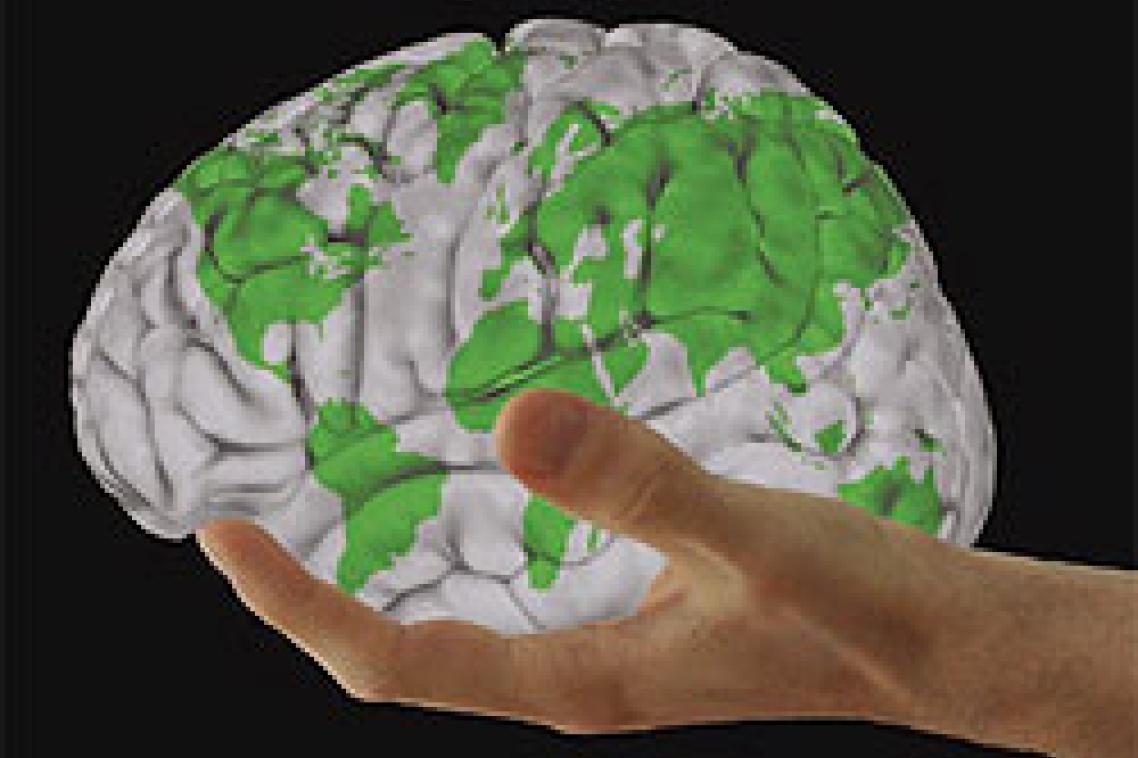
The human mind has deciphered the mechanics of infinite concepts. Yet, in all its time it has had trouble understanding how its own self works.
Such a limited understanding is what researchers at UQ’s Centre for Advanced Imaging (CAI) hoped to rectify as they recently collated their data with 35 international research centres in a bid to yield a detailed map of human brain function.
Reminiscent of the Human Genome Project’s collaborative nature, the 1000 Functional Connectomes Project gathered resting-state functional MRI (R-fMRI) data from 1414 scanned patients across 10 countries.
Functional MRI allows researchers to monitor the activity of certain groups of nerve cells in the brain network at any given moment, much as a telephone switchboard shows which phone lines are in use.
CAI physicist and contributor to the PNAS paper Dr Katie McMahon said by comparing levels of activity among different groups of brain cells, researchers can determine which areas are communicating with one another.
“Imaging the brain while people rest reveals correlations in functionality which can yield detailed maps of complex neural systems, collectively constituting an individual’s “functional connectome”,” Dr McMahon said.
“What we have seen is this study is that data is consistent across datasets and individuals, which suggests the functional connectome has a common architecture. Yet, each individual’s functional connectome still exhibits unique features.”
While the Project’s paper, published in the Proceedings of the National Academy of Sciences, showed that the combined data uncovered similar patterns of networks functioning in the brain between different groups of people in relation to age and sex, the study ultimately proved it was possible to combine data from over 1000 volunteers across the globe and pool it for all researchers to share.
This has in turn provided more comparative data to researchers like Dr McMahon’s team, whom originally submitted data from 30 participants.
Using this information, Dr McMahon is now working on two projects, which are looking at: the genes involved in the developmental and pathological process in the brain, and predictive techniques for the treatment of aphasia.
“While there have been a lot of genetic studies based on the brain, very few if any have focused on this functional activity measure," she said.
“It’s really hard to get genetic details as you need a massive sample population and lots of money to do the testing. This is why the Project will help with further studies, as fellow researchers will be able to feed their own data into the database and test their own hypotheses.
“In the case of our aphasia rehabilitation study, we are hoping to couple the data with our own to predict the best outcomes and treatment for sufferers.”
Media: Dr Katie McMahon (07 3365 4250 or katie.mcmahon@cai.uq.edu.au) or Robbie Mitchell (07 3365 2619)
Related articles

Time to tap into agriculture’s hidden genetic potential
