Skip to menu Skip to content Skip to footer
News

Rainforest research secures funding
28 May 2010
Decorative

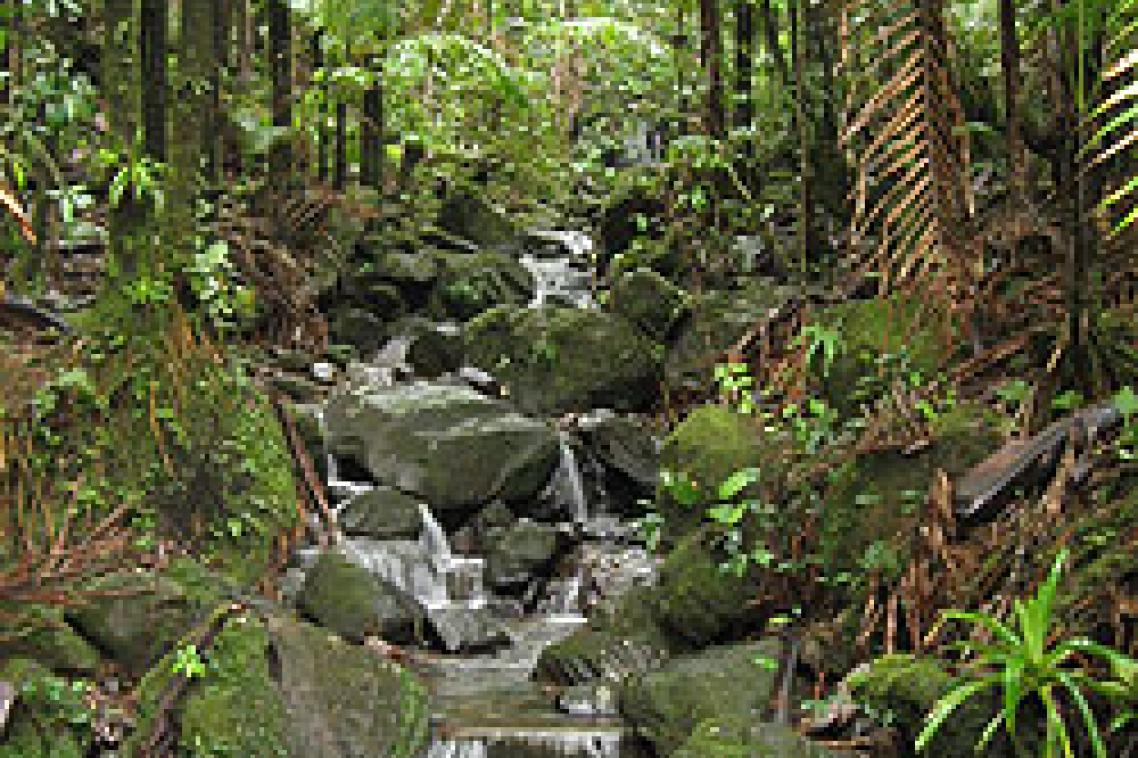
Two UQ postgraduates have been recognised by The National Climate Change Adaptation Research Facility (NCCARF) for their outstanding work in the area of biodiversity.

Lui Weber and Valerie Hagger, who study part-time while working as consultants for Sinclair Knight Merz, have each received $7000 funding in support of their research on sub-tropical rainforests.

Ms Hagger is completing a Master of Science (Conservation Biology), focusing her research on climate change adaptation of rainforest verterbrates in south-east Queensland.

A UQ environmental science graduate, Ms Hagger worked in London as an environmental consultant
before returning to Brisbane to pursue her passion for terrestrial ecology, and in particular, the animals that live in rainforest habitats.

“I'm particularly interested in wildlife planning and conservation as I have a soft spot for mammals, but love all native animals and enjoy the adventures my work sends me on to find them,” she said.

“The grant I received from the NCCARF will be used to collate empirical research on the resilience of vertebrate species to environmental change, as well as publishing and presenting my results to raise awareness of climate change adaptation.”

Fellow UQ graduate Mr Weber works as a botanist and ecologist and has returned to UQ to complete his honours degree analysing the distribution of common subtropical rainforest plant species.

“I grew up in the wet subtropical rainforests of northern NSW. The climate of these areas has allowed unique species to survive past climates that were less favourable for rainforest growth than today,” Mr Weber said.

“I will align current distribution of rainforest plants with models of past climate to better understand the potential impacts of future climate change and to inform conservation strategies for the rainforests.”

Mr Weber will use the grant to purchase modelling software and visit remote rainforest sites in the subtropics, and will present his findings at the 2011 NCCARF conference.

Media: Tracey Franchi, Communications Manager - School of Biological Sciences (3365 4831, t.franchi@uq.edu.au)

Related articles

A blonde woman in jeans and sneakers sits on a rock in the bush smiling.

Transforming communities: 2026 UQ Alumni Award winners

A Totally Wild legend, a leading parenting expert and a pioneer in Queensland’s community sector are among The University of Queensland’s 2026 Alumni Award winners.
16 October 2026
Three researchers wearing blue protective lab gowns stand among rows of potted chickpea plants inside a controlled-environment plant research facility.

Turning up the heat on chickpea yield

A University of Queensland study has outlined a practical pathway for accelerating the development of heat adapted chickpeas using data from new ‘omic’ technologies. PhD candidate Callum Jamie said the suite of technologies offered tremendous opportunities to understand how a complex trait like heat tolerance works. “The narrow genetic diversity in the elite chickpea gene pool has limited conventional breeding’s effectiveness for stress tolerance,” Mr Jamie said. “These technologies have improved our capacity to dissect trait architecture and phenotype secondary traits but their use in chickpeas has been limited.” The technologies include genomics, epigenomics, transcriptomics, proteomics, metabolomics, phenomics and enviromics, and help provide a comprehensive picture of biological systems. Epigenomics helps understand what controls gene activity; transcriptomics considers gene expression; proteomics protein production; metabolomics looks at biochemical processes; phenomics observes traits; and enviromics considers environmental factors influencing outcomes. Mr Jamie said previous studies had focused on just 1 to 2 -omic datasets, a small number of genotypes, and single tissues. This has meant it was hard to infer what results meant for trait architecture and mechanisms and the ability to extrapolate the information to breeding populations was limited. There have also been challenges around cost, scalability and integrating very different types of data to make the technologies useful. To overcome the hurdles, Mr Jamie’s research at the Queensland Alliance for Agriculture and Food Innovation has resulted in a proposed staged approach. It would start with genomic prediction and phenotyping, before adding -omic layers as costs fall and unknowns were resolved. “These technologies are novel and we still don’t know which information provides added value and how best to integrate all of this data to achieve an outcome,” Mr Jamie said. His PhD is supported by the Grains Research and Development Corporation (GRDC) and the International Research Training Group (IRTG) Accelerating Crop Genetic Gain and is aligned to a project which aims to fast-track the development of chickpea varieties adapted to high temperatures. Project leader Dr Millicent Smith said heat stress causes severe yield implications through flower and pod loss, reduced pollen viability and impaired grain filling. “Late sown chickpea is particularly in the firing line across most of Australia's crop in southern Queensland and northern New South Wales,” Dr Smith said. “We want to ensure that Australian growers maintain their competitive edge. “New varieties with improved genetics to cope with heat stress are essential for the future. “This work, suggesting a staged approach to utilising the new -omic technologies, is an exciting frontier.” The research was published by Food and Energy Security. Callum Jamie’s PhD is supported by the Grains Research and Development Corporation (GRDC) and the International Research Training Group (IRTG) Accelerating Crop Genetic Gain.
15 October 2026

Media contact

Subscribe to UQ News

Get the latest from our newsroom.