
Atomic art promotes sustainability
UQ scientists have earned their place alongside artists in a new exhibition that promotes sustainability through creative practice.
An animation and images created by Dr David Poger and Professor Alan Mark from the School of Chemistry & Molecular Biosciences are featured in the Bio-diverse-city exhibition at the Caloundra Regional Gallery until July 4.
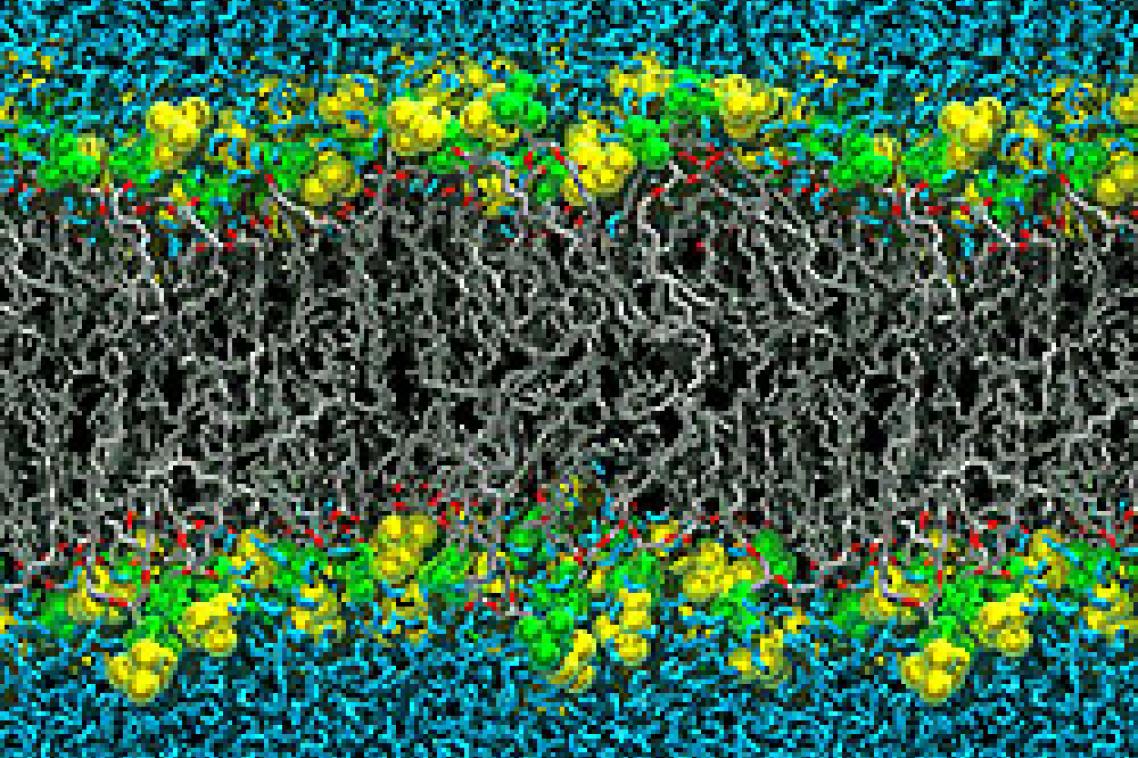
The animation shows how phospholipid molecules, the main component of cell membranes, will spontaneously self-assemble to form a well-ordered functional membrane from a random mixture in water.
The water molecules are depicted in blue, the lipid "tails" are drawn as grey sticks while the yellow and green balls represent the "head group" of the lipid molecules. The animation is the result of computer simulations that are being used by Professor Mark and his laboratory to understand how cells operate at an atomic level.
"Molecular self-assembly is one of the most fundamental properties of life," Professor Mark said.
"Understanding this process is not only a major scientific challenge but is also central to unravelling the origins of conditions such as Alzheimer's disease and the rational design of nano-materials modelled on biological systems.
"The great thing about the exhibition is that it can help convey the sense of amazement you get when studying life in atomic detail."
The Bio-diverse-city project aims to explore new concepts around building social and environmental resilience through diversity.
The work of Dr Poger and Professor Mark was selected for the exhibition not only because it is striking but also because it represents one of the most fundamental processes involved in building and sustaining life.
The Bio-diverse-city exhibition forms part of the Sunshine Coast Regional Council's Treeline Project – a series of environmentally focused art events being staged between January and July 2010.
Information about UQ's sustainability projects is available on a new website – www.uq.edu.au/sustainability
Media: Rosalind Boulton (07 3365 4043, rboulton@uq.edu.au)
Related articles

Want to help Nepal recover from its deadly floods? Here’s what tourists need to know
