
Striking photo sings for science
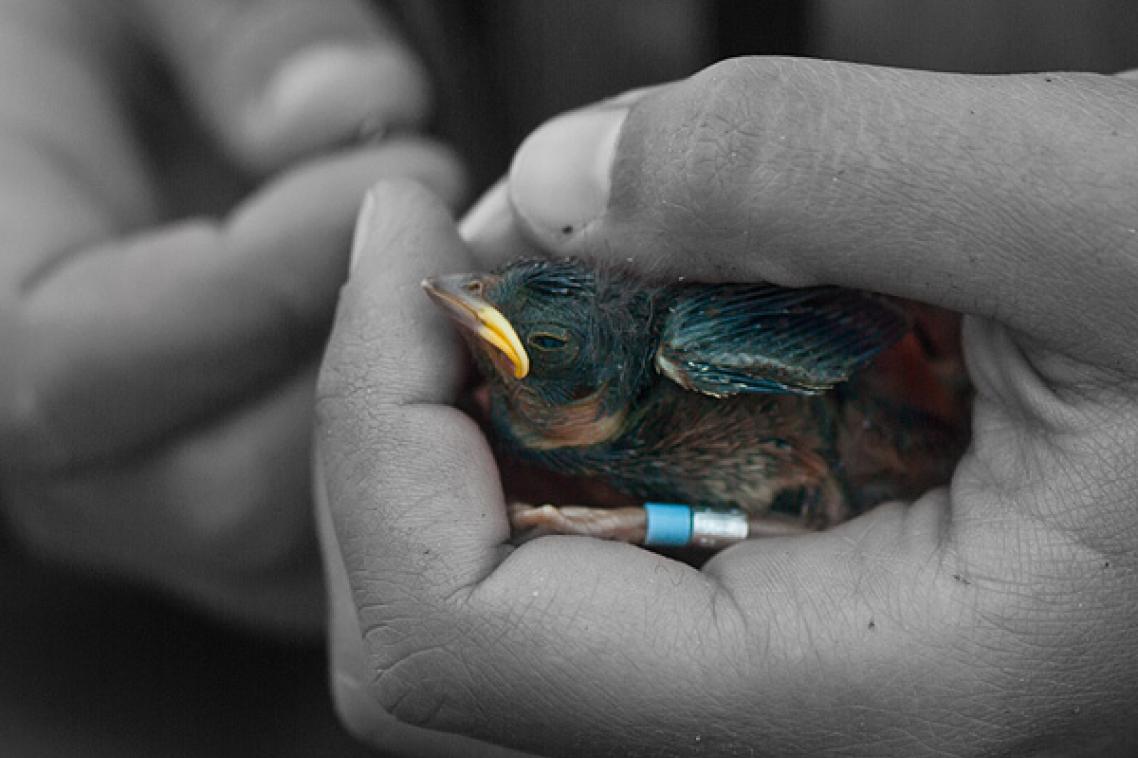
An image of a tiny bird from a remote island in British Columbia has seen a UQ researcher shortlisted for a top photography prize.
Environmental Science Honours student Karri Hartley has recently returned from spending a month studying the song sparrows of Mandarte Island, which sits in the waters of the Strait of Georgia northeast of Vancouver.
Ms Hartley’s image of a five-day-old chick fitted with a combination of coloured and metal ID tags is one of top 25 submissions in the Australian Museum Eureka Science Photography Prize, and is currently on display in Melbourne’s Federation Square.
On three-to-five day expeditions which lasted from dawn to dusk, Ms Hartley and her colleagues carefully worked out the location of each bird nest on the island. Once found, the team secured newborn chicks, outfitting them with tags and taking blood samples.
The 30-year study, led by Professor Peter Arcese of the University of British Columbia, is unique because each sparrow is essentially part of a giant family tree.
Each bird has been identified in a similar way since 1975, producing a complete social and genetic pedigree for the researchers to examine, a kind of ‘Who do you think you are?’ for the birds of the island.
“Due to the negative impact of humans on earth, many animal populations are being reduced, threatened or endangered with extinction; this research can help us understand the preservation needs of at risk animals,” Ms Hartley said.
“It’s important because the findings can point to management actions for other small populations that may be threatened with extinction.”
Ms Hartley said her photo captured her twin passions of conservation and communicating science to the wider community.
Through the photograph Hartley would like people to see there is art in science and even beauty in sometimes seemingly ordinary methods.
“Through photography we can bridge the gap between science and art and in doing so, show that the two aren’t irreconcilably disparate disciplines. Photography invokes emotion instantly, and it provides the public with an insight to science they may never have seen before.”
Other shortlisted entries include remarkable photographs of stars and nebulae, insects devouring their prey and life at a microscopic level.
After graduating at mid next year, Ms Hartley hopes to find a position that can harness both her research and photographic skills.
Karri Hartley: Karri.hartley@uqconnect.edu.au, or 04 397508111, Media: Allison Rock at UQ Communications (Allison.rock@uqconnect.edu.au, 07 3365 26189)
Related articles

Supercharged 'molecule highway' could transform industrial processing
