
Frog, reptile conservation highlighted at Steve Irwin Memorial Lecture
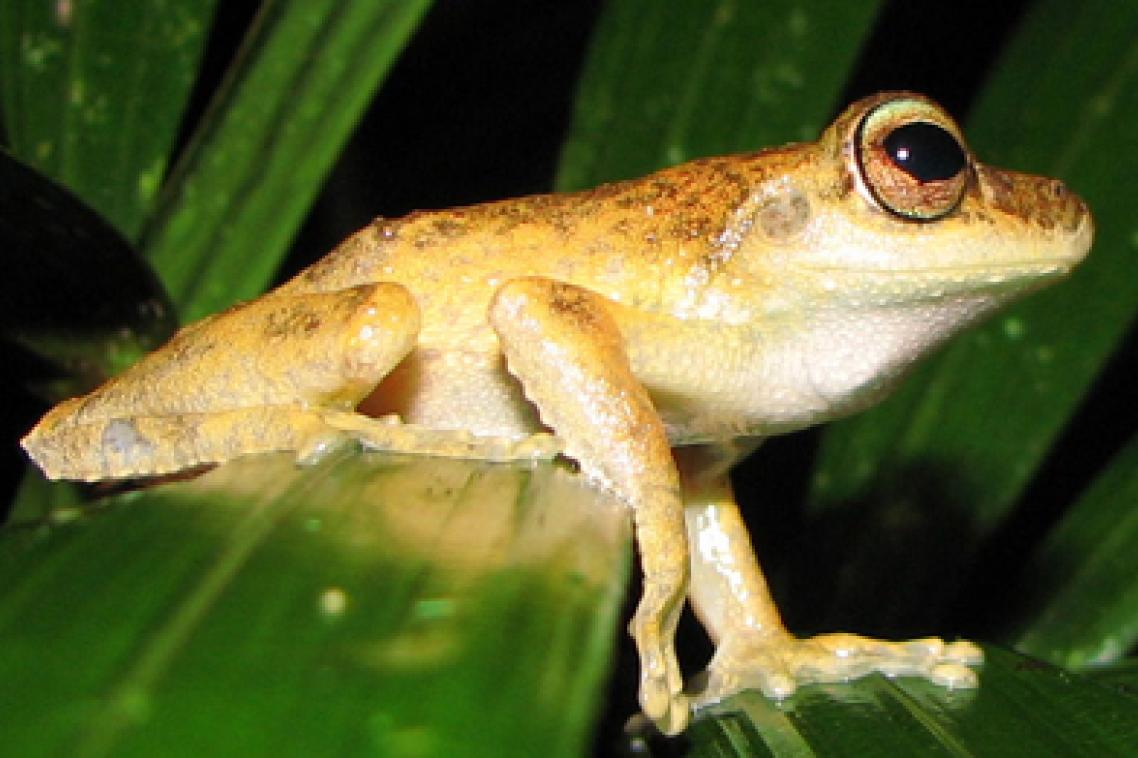
A Queensland biologist, who has spent the past 15 years studying frog and reptile evolution, is about to embark on one of his most ambitious projects to date - attempting to rediscover a species that "vanished'' almost 30 years ago.
Award-winning biologist and graduate of The University of Queensland, Dr Conrad Hoskin, is credited with co-discovering 13 new frog and reptile species over a decade.
His work has been integral to scientists across the world in understanding how populations arise, develop, and change.
“I study the genetic differences between populations and this gives insights into the populations’ histories, periods they were isolated from each other, when populations came back into contact, and what happens genetically when populations that were isolated for long periods coexist again,” Dr Hoskin said.
Dr Hoskin, now based at James Cook University in Townsville, is the keynote speaker at The University of Queensland’s fourth annual Steve Irwin Memorial Lecture on August 13.
The biologist, who grew up in both South Africa and Mt Crosby on Brisbane's western outskirts, will discuss his key findings, including the origins of the frog and reptile species he has discovered in remote Queensland locations, and their future conservation.
Searching for missing and endangered rainforest frogs will also be discussed – including his upcoming search for the elusive northern gastric brooding frog.
“From other frog rediscoveries we've learnt that finding the frogs - if they are indeed still alive - can be like finding a needle in a haystack,” Dr Hoskin said.
Scientists are fascinated by the species' unusual breeding techniques - the female frog swallows fertilised eggs and does not eat for two months as the tadpoles develop in her stomach.
She then regurgitates the tadpoles into the waterways.
The gastric brooding frog’s total world distribution was only ever a single mountain range west of Mackay, in the Eungella National Park’s remote rainforest creeks.
Rediscovering the species is unlikely, but would be groundbreaking.
“We will search at Eungella later this year and next year. It will involve a few trips, with each being a week or two. The places we visit will be very remote; [we’ll be] camping, drinking stream water, and not carrying very much. Getting to the sites involves long walks in remote areas.
Dr Hoskin completed a Bachelor of Science (Hons) degree at UQ in 1996, and continued studying there to complete a PhD examining processes by which new species arise.
“[I was] especially looking at processes that operate in hybrid zones - areas where similar lineages overlap. This work was on green-eyed tree frogs in the mountain rainforests behind Cairns. Studying the green-eyed tree frog in hybrid zones remains a big part of my research,” he said.
Dr Hoskin’s tireless pursuit of new frog and reptile discoveries has not gone unnoticed. In 2009 he was awarded a prestigious Australian Biological Resources Study (ABRS) Eureka Prize for Early Career Species Discovery. ABRS is now funding Dr Hoskin’s research for the next three years.
Media: Dr Hoskin, please contact Renée Mickelburgh at KT Journalism, phone (07) 3831 7500 or ktj@ktjournalism.com.
Related articles

Want to help Nepal recover from its deadly floods? Here’s what tourists need to know
