
Heaviest loads in history put soldiers at risk
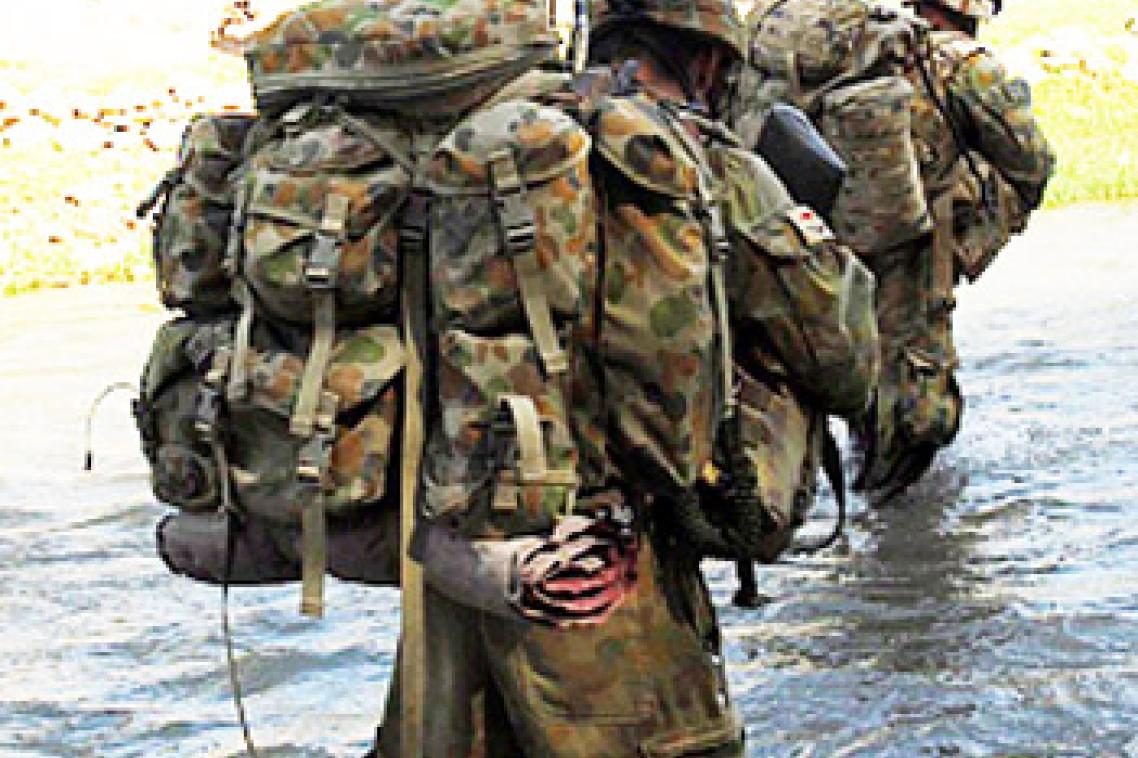
Over recent operations, Australian Army soldiers have carried the heaviest loads borne by soldiers in the past 3000 years.
PhD graduate Dr Robin Orr from The University of Queensland’s School of Health and Rehabiltation Sciences has found carrying loads of up to 58kg poses significant risk to the health and combat-effectiveness of Australian soldiers.
With experience in the Australian Regular Army as an infantry soldier, physical training instructor and uniformed physiotherapist, Dr Orr was able to identify a number of health risks for Australian soldiers in training or on overseas deployment.
He said recent operations had seen Australian soldiers carrying the heaviest absolute loads of soldiers over the past three millennia, resulting in adverse effects to a soldier’s health and potentially hindering their occupational performance.
“The impact of load carriage included injury to the feet, lower back and legs and reduction in military task performance, including soldier mobility, attention to task and general task performance,” Dr Orr said.
“Soldiers must carry military equipment and move on foot over various terrains for long and continuous periods.
“While the equipment carried is often crucial to mission success and survival, its weight may be a source of risk to the soldier.
“Furthermore, often forgotten are the impacts of marching speed, terrain type and terrain gradient, which can have a greater impact than load weight alone.”
Dr Orr surveyed 380 Australian Regular Army soldiers, and found operational loads were reported as 28kg in Patrol Order and 57kg in Marching Order, equal to allied nations.
“Developing an effective risk-management strategy to minimise the risks associated with load carriage was challenging.”
“It required strategies such as policies to manage load carriage limits, supporting research into technological advances, and optimising the physical conditioning of the soldier,” Dr Orr said.
He said the Australian Army was proactive in addressing load carriage concerns with strategies including the establishment of ‘diggerworks’ to manage and facilitate soldier equipment integration.
Dr Orr has been invited to present his findings at national and international conferences and seminars, and has expanded his field of research to look at similar load impacts on police officers and fire fighters.
He aims to take the risk-management strategies learnt during this research to other groups required to carry loads.
Media Contact: Kirsten Rogan, Communications and Media, University of Queensland Faculty of Health Sciences, 07 3346 4713, 0412307594 or k.rogan@uq.edu.au
Topics
Related articles

Archaeology’s assumptions about ancient diets challenged by new research
