
Climate change threatens unique Galápagos cormorant
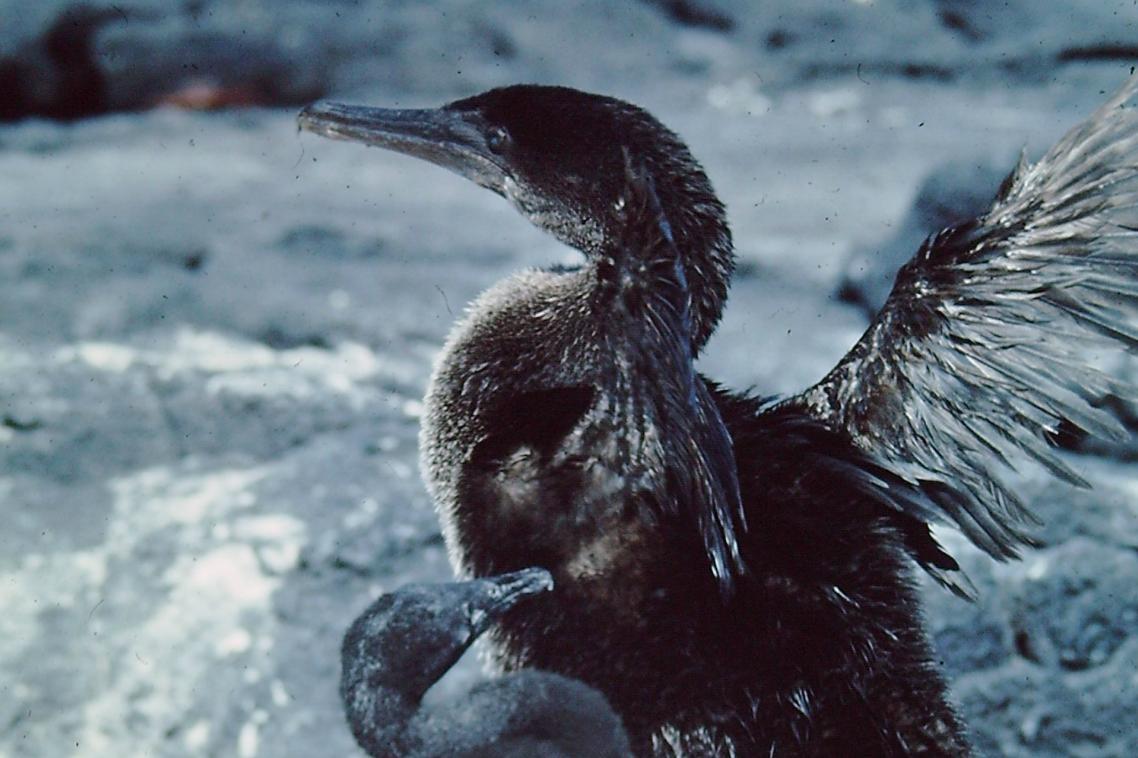
The effects of climate change in the Galápagos Islands are posing a severe threat to one of the world’s rarest seabirds, a decade-long historical study led by a University of Queensland researcher has revealed.
The unique flightless cormorant, Phalacrocorax harrisi, is found only on the coasts of two Islands in the Galápagos archipelago and relies on cold, nutrient-rich water provided by the Equatorial Undercurrent.
These heavy, flightless, diving birds evolved from a light, flying ancestor due to the absence of predators and abundance of in-shore sea food in the isolated Galápagos region.
UQ’s Emeritus Professor Robert Tindle, the lead author on the study, said the species was a striking example of evolution in the Galápagos which so intrigued 19th-century naturalist, Charles Darwin.
Emeritus Professor Tindle said the species’ sensitivity to changes in water temperature was now threatening its survival.
“The population of these birds is currently low at about 1000 adult pairs, and this number has dropped as low as 400 pairs after a period of warmer ocean temperatures around the islands,” he said.
“90% of breading occurs when ocean temperatures are between 18-23 degrees Celsius.
“An increase of just two degrees Celsius can significantly reduce breeding due to decreased availability of food.”
During the cold upwelling of the Equatorial Undercurrent there is an abundance of fish available to the flightless cormorants through shallow-water foraging within a few hundred meters of the colony.
During El Niño - Southern Oscillation events, which persist in the area for 11-18 months, the Equatorial Undercurrent weakens, leading to warmer, nutrient-poor water at the surface and a reduction in the abundance of prey.
“The frequency and severity of El Niño - Southern Oscillation events in Galápagos have increased and it has been shown that this is most likely a result of climate change,” Emeritus Professor Tindle said.
“During these periods when ocean surface temperatures range between 23-28 degrees Celsius, Flightless Cormorants lay fewer clutches of eggs and have fewer juveniles survive.
“These birds have evolved to breed when water temperatures are cold and food is abundant.
“Either long-term or frequent short-term rises of just a few degrees in local sea surface temperature could pose a catastrophic threat to this species.”
The research was carried out in Galápagos by scientists from The University of Queensland, Queensland University of Technology and the Centre for Ecology and Hydrology (UK) between 1970-1980, with annual checks conducted by scientists at the Charles Darwin Research Station, Galápagos, from 1980 to 2012.
The research was published in Marine Ornithology in October 2013.
Contact: Emeritus Professor Robert Tindle, PH: (07)3378 8530, M: 0417 756 892, E: r.tindle@uq.edu.au
Related articles

UQ lecturer among first AustLit Creative Writing Fellows
