
‘Make-or-break’ protein holds key to cancer spread
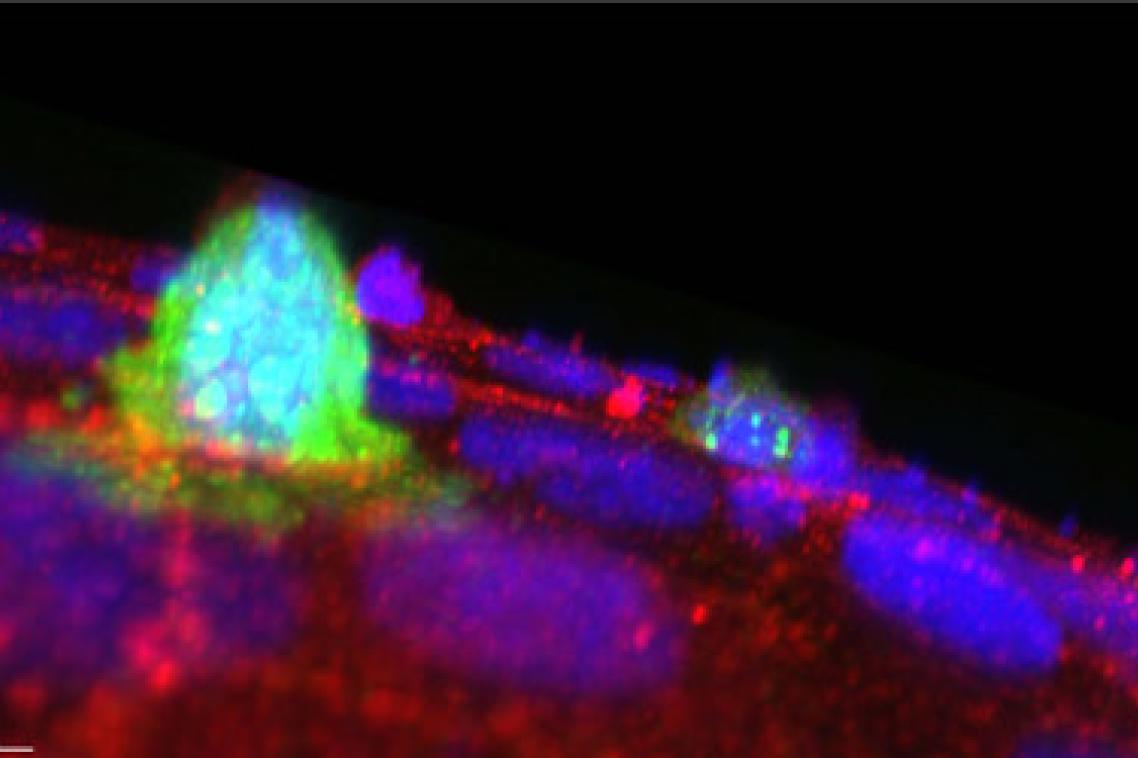
University of Queensland researchers have discovered a protein in cells that could block the escape route of potentially cancerous cells and stop them spreading to other parts of the body.
A team of biologists, physicists and mathematicians led by Professor Alpha Yap from UQ’s Institute for Molecular Bioscience made the discovery using microscopic imaging and statistical techniques.
“The finding could lead to new targeted treatments for cancer and other diseases,” Professor Yap said.
The researchers revealed and analysed molecular processes that cause potentially cancer-causing cells to escape from epithelial tissues, the layers of cells that cover and protect organs, including skin.
Professor Yap said the team had made important new insights into cancer biology, pinpointing the pathway these cells take to exit the epithelial tissue and investigating how the protein N-WASP can block their escape route.
“Abnormal or dying cells pose a risk to the health of the protective barrier that cells form around our organs,” he said.
“The normal cells that surround these dangerous cells use the complex process of cellular extrusion to push them out of the tissue,” Professor Yap said.
“However, when cancer cells are pushed out, it gives them the opportunity to grow or invade surrounding healthy tissue, which can cause the cancer to spread to other parts of the body and make it harder to control and treat.
“So while our normal cells think they’re doing us a favour by pushing out the bad cells, they’re actually helping the cancer cells to spread,” he said.
Professor Yap said his team had found a way to potentially block the escape routes by inhibiting the protein N-WASP, which regulates the internal skeleton of the cells.
“The pathway that makes or breaks these cells from escaping is regulated by N-WASP,” he said.
“We have found that if we can inhibit N-WASP from functioning, then we can stop these potentially cancerous cells from spreading.”
The study was conducted by researchers from UQ’s Institute for Molecular Bioscience in collaboration with Dr Zoltan Neufeld from UQ’s School of Mathematics and Physics.
The research has been published in the scientific journal Nature Cell Biology and was supported by the National Health and Medical Research Council of Australia, the Australian Research Council, the Kids Cancer Project of The Oncology Children’s Foundation, and The University of Queensland.
Confocal and optical microscopy was performed at the IMB’s ACRF Cancer Biology Imaging Facility, established with the generous support of the Australian Cancer Research Foundation.
The Institute for Molecular Bioscience (IMB) is a research institute of The University of Queensland that aims to improve quality of life by advancing medical genomics, drug discovery and biotechnology.
The UQ School of Mathematics and Physics has an international reputation for cutting-edge research and innovative teaching in mathematics, physics and statistics.
Media contact: Gemma Ward, IMB Communications, 07 3346 2155, 0439 651 107 or g.ward@imb.uq.edu.au
Topics
Related articles

Sick of being told to ‘just lose weight’? Health promotion shouldn’t come with weight stigma
