
Summer spent hunting for drugs to combat bugs
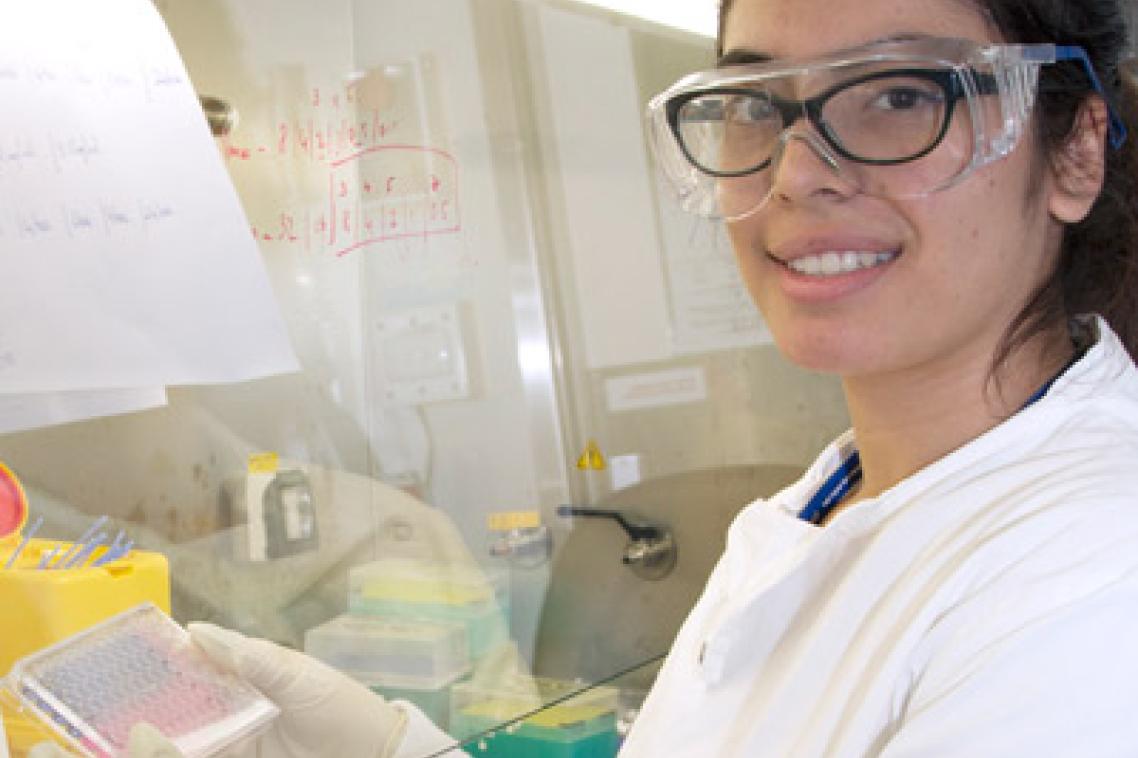
While many students took a well-earned break over summer, Brisbane woman Cindy Bermudez spent her holidays studying plants, bacteria and fungi in an effort to find treatments for infectious diseases.
Ms Bermudez joined The University of Queensland’s Institute for Molecular Bioscience (IMB) to hunt for compounds from nature that could be used to combat diseases including drug-resistant Golden Staph and cryptococcosis, a fungal infection common in HIV patients.
“Infectious disease is one of the world’s leading causes of death, and living organisms such as plants, fungi and bacteria are a vital source of compounds for new drugs,” Ms Bermudez said.
“Some of the plants I am studying are species used in traditional medicine and I will focus on these particular plants to determine if they have any compounds with anti-fungal or anti-bacterial activity.”
“Fungi and bacteria themselves can also hold a treasure trove of compounds that evolved as fungal and bacterial species competed against other fungal and bacterial species for resources.”
Ms Bermudez spent 10 weeks at IMB in Professor Matt Cooper’s laboratory as a paid summer intern.
She became interested in research after undertaking a third-year project with Associate Professor James Fraser from UQ’s School of Chemistry and Molecular Biosciences and Dr Mark Butler from the Cooper lab.
Ms Bermudez said Dr Butler had recommended she apply for a summer internship before starting her honours, which will be jointly supervised by Dr Fraser and Dr Butler.
“I’ve gained valuable experience being a summer intern through learning how to use the equipment in the laboratory and attending seminars on topics such as undertaking a PhD or publishing a scientific paper,” Ms Bermudez said.
“It’s allowed me to find my feet before the busy honours year, but would also suit someone who wants to test the waters and decide whether to take on a longer research project.”
Ms Bermudez is enrolled in a Bachelor of Biotechnology at UQ, which she chose because it allowed her to combine science and business.
“Biotechnology sounded like an interesting degree that would increase my job prospects. I chose UQ because I wanted to study at a university known for its research and expert science.”
Once she has completed honours, Ms Bermudez said she would like to continue her studies through enrolling in medicine or completing a PhD.
If you are interested in joining IMB as a paid summer intern, please visit http://www.imb.uq.edu.au/summer-research-scholarship-program
To make a tax-deductible donation to IMB drug discovery research, visit www.imb.uq.edu.au/donate or call +61 (07) 3346 2134.
To discuss commercial opportunities associated with this research, contact Dr Mark Ashton on m.ashton@uniquest.com.au or +61 (07) 3346 2186.
The Institute for Molecular Bioscience (IMB) is a research institute of The University of Queensland that aims to improve quality of life by advancing medical genomics, drug discovery and biotechnology.
Media contact: IMB Communications Manager Bronwyn Adams, 0418 575 247, 07 3346 2134, b.adams@imb.uq.edu.au.
Related articles

Feed the children: food provision in early childcare falls short
