
Birds of a feather flock left or right
University of Queensland researchers believe they have discovered how flocks of birds navigate difficult environments, with individuals inclined to favour the left or right side.
The research, by The University of Queensland’s Queensland Brain Institute (QBI) and the Australian Research Council Centre of Excellence in Vision Science, sheds light on how birds fly in flocks without colliding with each other.
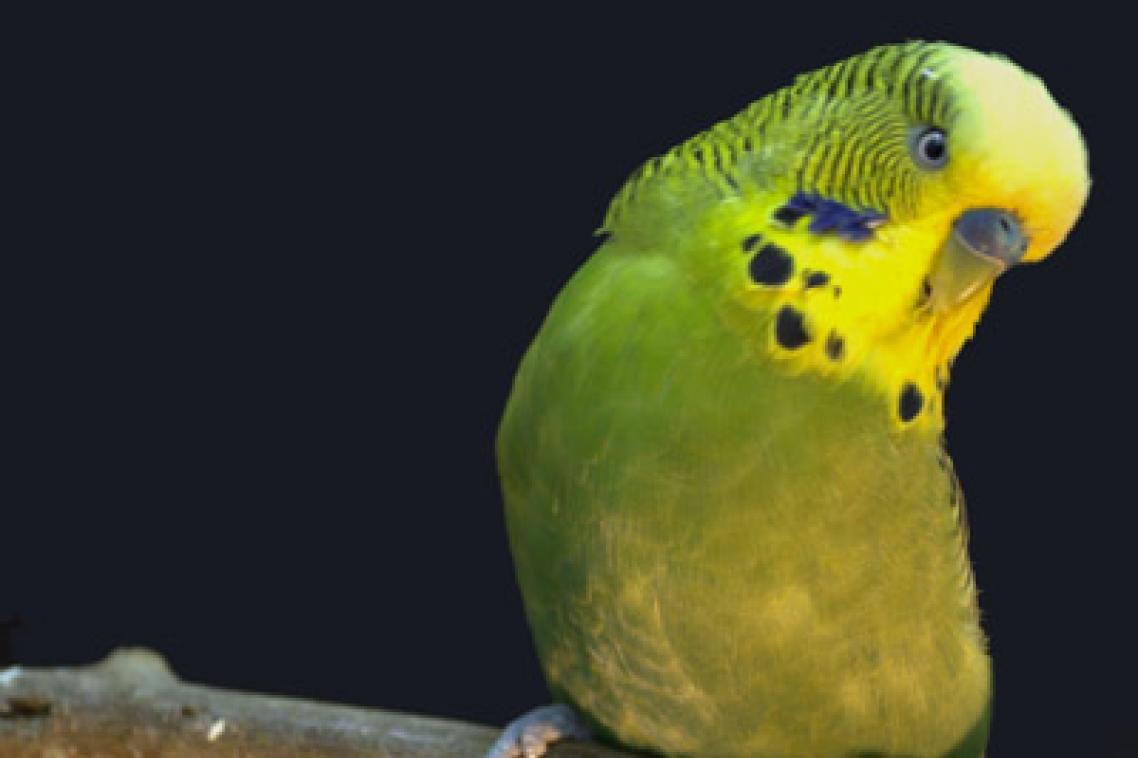
Lead author Dr Partha Bhagavatula, from QBI, said the study found budgerigars displayed an individual bias to fly to either the left or the right of objects.
This inbuilt bias would allow flocks to quickly navigate past obstacles by splitting up and not slowing down due to crowding.
“We were looking at how birds decide to navigate because they’re very good at quickly travelling through environments with narrow gaps, such as dense bush, without collisions,” Dr Bhagavatula said.
“By having a natural mechanism where populations of birds are predisposed to choosing different flight paths around obstacles, an entire flock could avoid situations where they block each other, slow down, lose time and expend more energy.”
Researchers flew the budgerigars down a tunnel where they were met by an obstacle and a choice of two flight paths.
“By giving birds the choice of flying left or right, through a pair of two adjacent openings, we were able to see that they displayed individual preferences,” Dr Bhagavatula said.
He said some birds had no bias and would choose the wider gap every time, while others with a distinct bias preferred going to one side even if it was significantly narrower than the alternative.
“This is very interesting and unexpected – because it’s generally expected for an animal species to have one dominant side that they prefer, such as humans being predominantly right-handed,” Dr Bhagavatula said.
Project leader Professor Mandyam Srinivasan said further studies should be conducted by flying the birds in groups to see how individuals behaved in a group dynamic, and whether they maintained those preferences when flying in a flock.
The findings could have implications for Professor Srinivasan’s work on robotic aircraft.
“The interactions between other aircraft are certainly very important, and when sending up autonomous aircraft without any human guidance it would certainly be worth investigating developing aircraft with individual biases like we see here,” he said.
The study was funded by an Australian Research Council (ARC) Discovery Project grant and the Centre of Excellence in Vision Science (ACEVS).
Results are published in PLOS Computational Biology.
Media: Queensland Brain Institute Advancement and Communications Director Mikaeli Costello, +61 401 580 685, mikaeli.costello@uq.edu.au; Professor Mandyam Srinivasan, +61 7 3346 6322, +61 434 603 082, m.srinivasan@uq.edu.au
Queensland Brain Institute
The Queensland Brain Institute (QBI) is a world-class research facility based at The University of Queensland’s (UQ) St Lucia campus. Researchers at QBI make great contributions to the field by studying fundamental cellular and mechanistic processes, as well as disorders and diseases from early brain development through to later life. Our scientists work to understand complex functions such as cognition, ageing, neurological disease, mental illness, and learning and memory.
Topics
Related articles

The UQ degree helping to address veterinary workforce shortages
