
‘Extinct’ bat rediscovered after 120 years in the wilderness
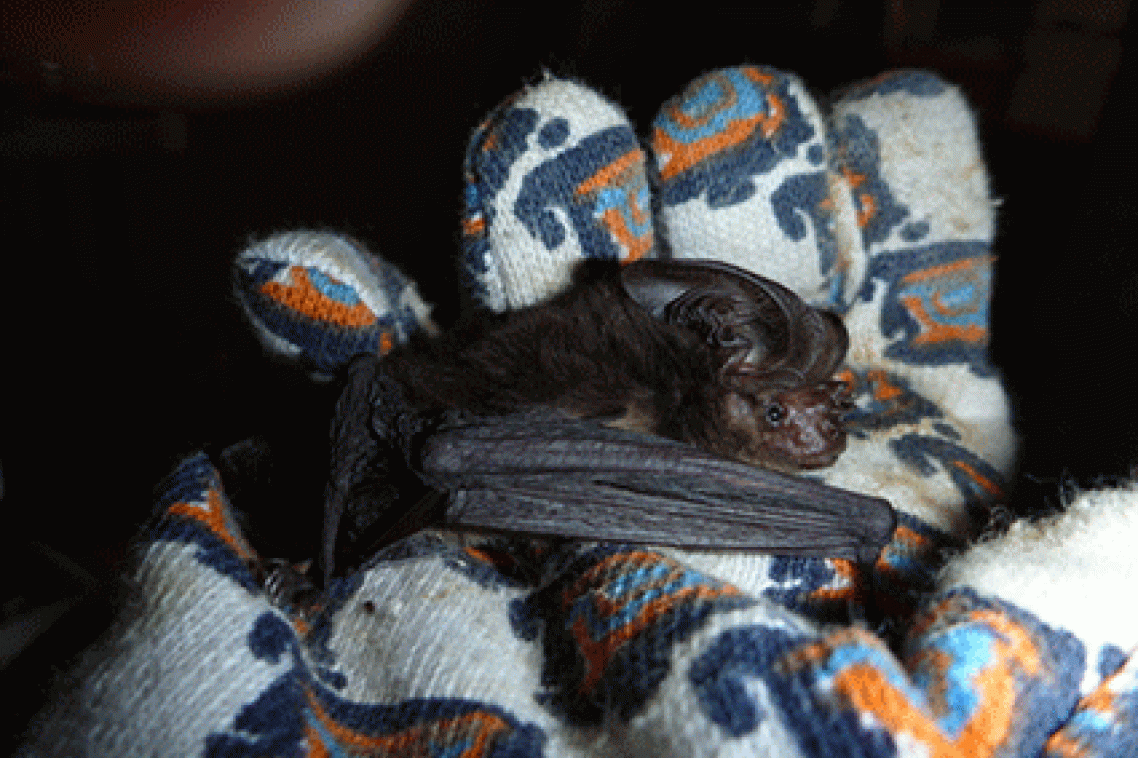
A Papua New Guinea bat species thought to be extinct has been rediscovered by a team of University of Queensland researchers.
UQ School of Agriculture and Food Sciences students Catherine Hughes and Julie Broken-Brow were on a field expedition in the Abau coastal district in Papua New Guinea’s Central Province when they caught one of the rare bats.
Researcher Dr Luke Leung’s said the New Guinea Big-eared Bat Pharotis imogene had not been reported since the first and only specimens were collected in 1890 by an Italian scientist.
“The species was presumed extinct,” Dr Leung said. “We captured one individual about 120km east of the only previous known locality at Kamali.”
The New Guinea big-eared bat and the long-eared bats (also called big-eared bats) are distinguished from all other Papua New Guinea bats by a combination of large ears and a simple nose-leaf located behind their nostrils.
The only information on the species has been taken from a few specimens in collections which have originated from the Museo Civico di Storia Naturale in Genova, Italy, where the specimens collected in 1890 were housed.
The bat is listed as critically endangered (possibly extinct) on the International Union for the Conservation of Nature “‘Red List” of Threatened Species and is also in the list of the top 100 of the world’s unique and endangered mammals.
Ecological knowledge is sparse for much of Papua New Guinea’s bat fauna, and a third echolocating species which uses ultrasonic calls to identify and navigate habitats is known from fewer than five localities.
The lack of information on PNG bat fauna makes species identification and conservation difficult.
“Further studies need to be done to establish whether the New Guinea big-eared bat is one of a small number of mammal species endemic to the south-eastern peninsula region, or if it occurs more widely,” Dr Leung said.
“Many of the coastal lowland habitats throughout Papua New Guinea are among the most threatened in the country due to clearing for logging and agriculture, and more field surveys of local bat populations could assess the conservation status of the species and inform future strategies to ensure their preservation,” he said.
Papua New Guinea is a recognised biodiversity hotspot, with seven per cent of the world’s species diversity located there.
Dr Leung said that with the identification of many new species every year, biodiversity numbers would continue to grow but many species were under imminent threat.
For more information see the research paper at at http://australianmuseum.net.au/journal/Hughes-2014-Rec-Aust-Mus-664-225232; an article on
The Conversation at http://theconversation.com/lost-bat-species-rediscovered-after-120-years-in-the-wilderness-26062; and the
Australian Museum blog at http://australianmuseum.net.au/news-blogs
Contact: Dr Luke Leung, School of Agriculture and Food Sciences, 0418 171 062, or Jackie Mergard, Faculty of Science, 0435 090 802.
Related articles

Mapping the green transition of Asia Pacific economies
