
UQ scientists help unlock the secrets of photosynthesis
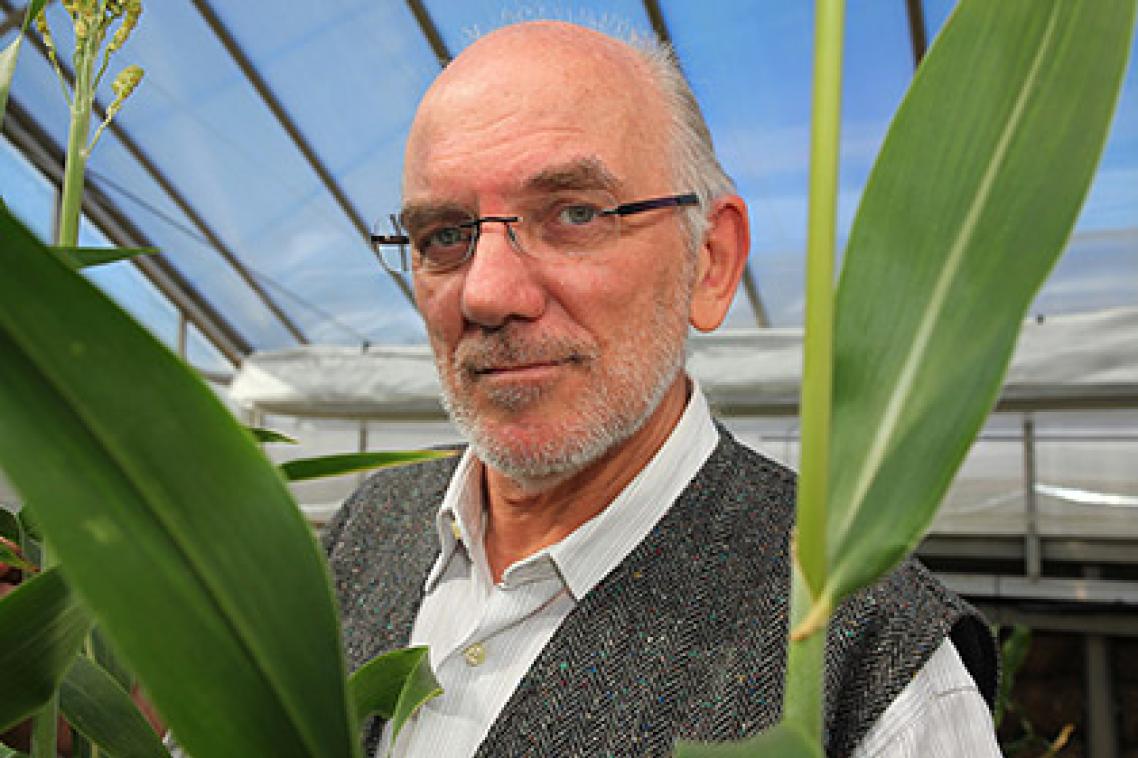
Queensland scientists will play a key role in a new Australian research centre working to increase major food crop yields.
University of Queensland researchers will form the Queensland node of the $22 million Australian Research Council Centre of Excellence for Translational Photosynthesis, launched in Canberra today (24 October).
Photosynthesis is the process plants use to convert sunlight into chemical energy to fuel the plant’s growth and functions.
Centre Director Professor Murray Badger, of the Australian National University, said photosynthesis was important for all life on earth, but scientists had only recently developed the technology to manipulate it at a molecular level.
“We have now tools that could initiate a new agricultural revolution through enhanced photosynthesis,” he said.
The new centre will explore how changes to photosynthesis can increase the yield of important staple crops such as sorghum.
The photosynthetic process varies among species and within locally adapted crop populations, which suggests some plants have evolved novel ways of converting sunlight into energy and processing carbon.
Professor Badger said this was an underexploited area of science that could help feed future populations.
The Queensland node of the centre will be led by Professor Graeme Hammer from UQ’s Queensland Alliance for Agriculture and Food Innovation.
The UQ research component will include major projects on photosynthetic variation in sorghum and mathematical modelling of photosynthesis.
A UQ project investigating the mechanisms and genes regulating photosynthetic performance in sorghum will be led by Associate Professor David Jordan.
UQ research on developing a dynamic crop model linking leaf function and field performance will be led by Professor Hammer.
“In collaboration with participants from ANU and CSIRO, we will be linking a model of a leaf’s photosynthetic biochemistry to canopy growth and crop yield models for major cereals,” Professor Hammer said.
The centre will bring together world leaders in photosynthesis research from six institutions: Australian National University, UQ, the University of Sydney, the University of Western Sydney, CSIRO and the International Rice Research Institute in the Philippines.
It features state-of-the-art plant science facilities and the most sophisticated suite of photosynthetic measurement technologies in Australia.
Australian Research Council CEO Professor Aidan Byrne said one of the key features of the ARC Centres of Excellence scheme, in addition to long-term funding, was that it allowed relationships to be built nationally and internationally between universities and industry.
“This particular centre has established links that will enhance the prospects of translating genetic improvements into crops,” he said.
“This is an important research program at a time when there is unprecedented demand on food supply and food security,” he said.
Media: Professor Graeme Hammer 07 3346 9463, g.hammer@uq.edu.au, Margaret Puls 07 3346 0553, m.puls@uq.edu.au
Related articles

UQ’s QARC wins at Engagement Australia Awards
