
Climate engineering ‘might save coral reefs’
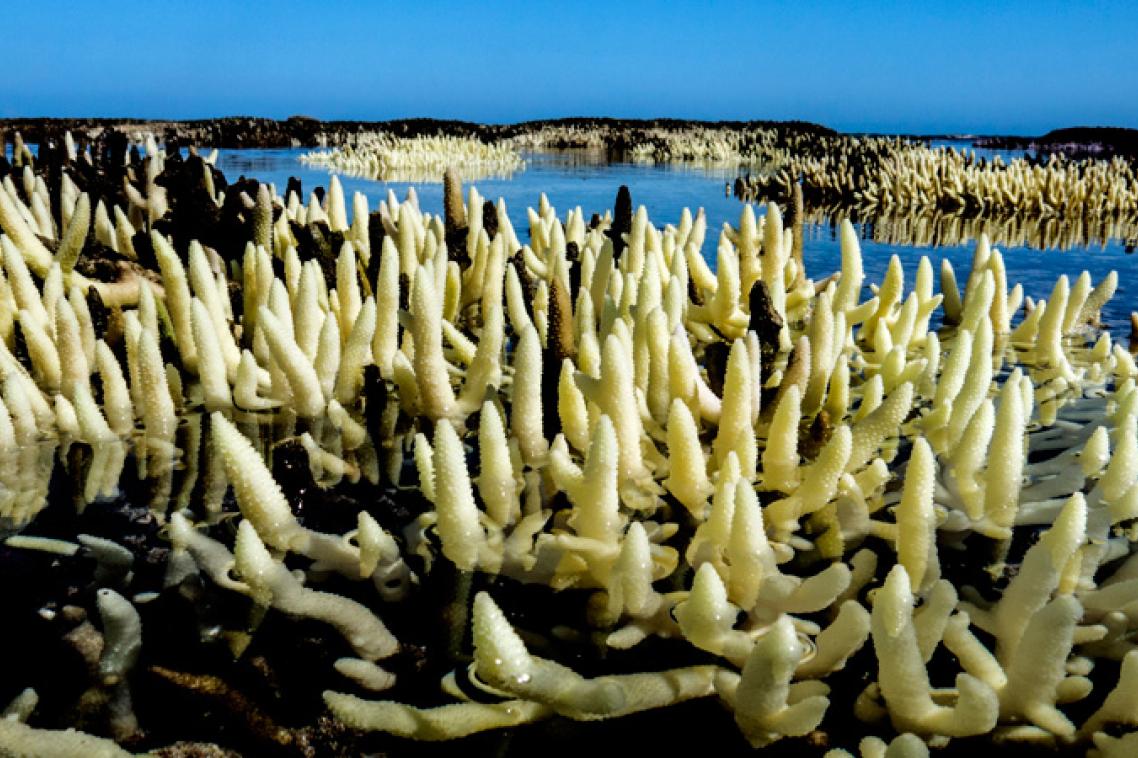
Climate geoengineering may be the only way to save coral reefs from destructive mass bleaching, according to new research involving The University of Queensland.
Coral reef ecosystems are considered extremely vulnerable to future climate change, due to rising sea surface temperatures and ocean acidification caused by higher atmospheric levels of carbon dioxide.
UQ’s Professor Peter Mumby said rising sea temperatures were a critical threat for coral reefs, and geoengineering could vastly reduce the problem.
The research, which involved international partners, found devastating mass coral bleaching was likely to occur far more frequently in future, due to stress caused by higher seawater temperatures.
A geoengineering technique called Solar Radiation Management (SRM), which involves injecting gas into the stratosphere to form microscopic particles that reflect some of the sun’s energy, could help limit rising sea surface temperatures.
“We find that the benefits of SRM, over the standard CO2 reduction scenario, are dependent on the sensitivity of corals to changes in seawater acidity,” Professor Mumby said.
“Resolving this sensitivity remains a key priority for science.”
The research involved the Carnegie Institution for Science, the University of Exeter and the UK Hadley Centre.
The study compared a hypothetical SRM geoengineering scenario to the most aggressive future CO2 reduction strategy considered by the Intergovernmental Panel on Climate Change (IPCC), and found that coral reefs fared much better under geoengineering, despite increasing ocean acidification.
Professor Peter Cox, from the University of Exeter, said coral reefs faced a dire situation regardless of how intensively society decarbonised the economy.
“In reality there is no direct choice between conventional mitigation and climate engineering, but this study shows that we need to either accept that the loss of a large percentage of the world’s reefs is inevitable or start thinking beyond conventional mitigation of CO2 emissions,” Professor Cox said.
The pioneering international study is published in leading scientific journal, Nature Climate Change.
Media: Professor Peter Mumby, p.j.mumby@uq.edu.au, +61 449 811 589.
Related articles

How brainless sea sponges use sunset as a cue to prepare for metamorphosis
