
Fishy business: cleaners with happy clients
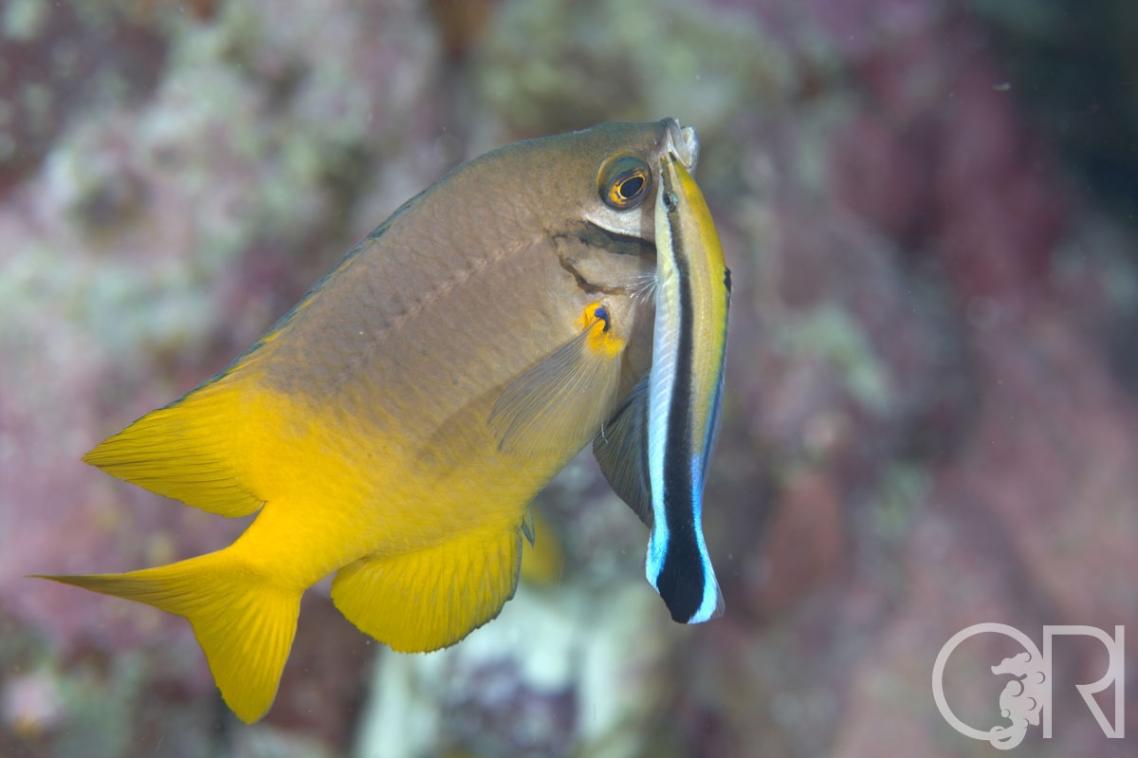
A cleaner wrasse with a client Scarface damsel fish.
(Photo credit: Richard Smith. )
University of Queensland researchers have discovered the presence of the bluestreak cleaner wrasse increases the number of juvenile fish on reefs.
The study, led by UQ School of Biological Sciences postgraduate student Derek Sun at Lizard Island, highlights the importance of cleaner wrasses in affecting the population structure of fishes on coral reefs.
“We conducted field observations on patch reefs at Lizard Island which have either been left untouched or have had cleaner wrasse removed since 2000,” Mr Sun said.
“We found that the presence of cleaner wrasse increased the number of recruited juvenile damselfishes, which are an important fish group on coral reefs.”
Mr Sun said the group’s research, which is the largest and longest study of its kind, has demonstrated for the first time that the presence of cleaner wrasse has positive effects on adult fish population size from the beginning of the recruitment period.
Cleaner wrasses are known to remove harmful ectoparasites from client fishes, reduce stress levels through their interactions, and lower predator aggression towards potential prey.
“There are plenty of potential direct and indirect benefits for a young reef fish to select reefs where cleaner wrasses are present,” Mr Sun said.
However, despite their significant roles on coral reefs, cleaner wrasses are one of the top marine fishes caught for the aquarium industry, due to their charismatic behaviour displayed in the wild.
Mr Sun said understanding the factors that determine the population dynamics of a species and community is important in ecology.
“By showing that cleaners increase abundances of recruits, they may ultimately also increase the abundance of reef fish in general,” he said.
“So the ecological importance of cleaners should be factored into how we conserve cleaners and manage marine parks.”
The study was completed in collaboration with UQ researchers Alexandra Grutter, Karen Cheney and Thomas Cribb, James Cook University’s Mark McCormick and the Australian Institute of Marine Science’s Mark Meekan.
Read the research in Biology Letters.
Related articles

UQ researchers send an unblockable message using gravity
