
Crocs suffer in competition with humans
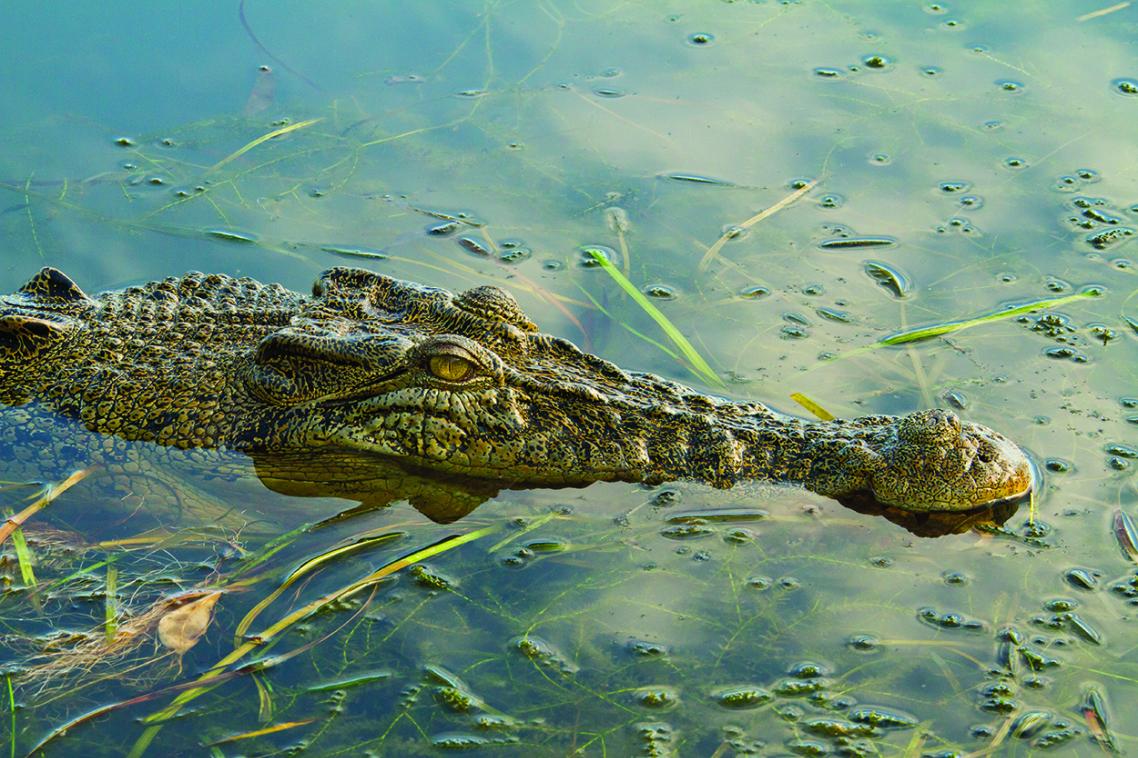
Many of the world’s 27 species of crocodylians will soon be either totally or locally extinct due to human population expansion and intensive land-use, according to a University of Queensland researcher.
Emeritus Professor Gordon Grigg, of UQ’s School of Biological Sciences, said that although the fact these reptiles had survived millions of years was no guide to their future.
“The current human population level and its magnitude and rate of resource consumption are unprecedented,” Professor Grigg said.
“The most likely crocodylian species that will survive humanity’s unsustainable population increases and resource use will be those living in remote wetland habitats in which humans see no benefit.”
Some crocodylians might have already become extinct if not for active conservation management stemming from the growth of the conservation ethic in the second half of the 20th Century.
“For some species, the incentive for conserving them has been the commercial value of their hides, but that is dependent upon its use in high fashion garments and accessories, and that is a somewhat fragile foundation,” he said.
“On a more positive note for crocodylians, but not for us, rising temperatures and rising sea levels from climate change will likely create more habitat that will be suitable for any species that survive the human onslaught.”
The largest living crocodiles, the estuarine or saltwater crocodile (Crocodylus porosus), are found in Northern Australia and can grow to six metres and weigh more than 900 kilograms.
Professor Grigg said estuarine crocodiles, also known as Indo-Pacific crocodiles or “salties”, were one of the luckier species because human populations across Australia’s north were unlikely to increase significantly in the next few decades. They might be among the survivors.
Professor Grigg and illustrator and biologist David Kirshner have released a book, Biology and Evolution of Crocodylians, a comprehensive review of knowledge about these apex predators.
The book reviews the biology of the crocodiles, alligators, caimans and gharials, and also discusses the great diversity of their gigantic extinct ancestors, some of which were probably warm-blooded.
It deals with their evolutionary history, anatomy, locomotion, sensory organs, feeding behaviour, physiology, diving behaviour, thermal biology, reproduction, population ecology, and conservation, and it features more than 500 photographs and original artwork.
Media: Professor Gordon Grigg, g.grigg@uq.edu.au, +61 7 3374 1737.
Related articles

All-in-one on-farm genetic testing proves to be quick and reliable
