
Size matters when crocs are on the move
Crocodiles turning up in populated areas like Darwin Harbour or on east coast beaches can cause problems, but a long-term University of Queensland study is shedding light on which crocodiles travel and why.
The tracking program, started by UQ School of Biological Sciences’ Professor Craig Franklin, is the largest and longest study in the world.
“We’ve discovered a strong relationship between crocodile size and how they use the environment,” Professor Franklin said.
“Small crocs hide in creeks and the big guys up to five metres long are the top crocs of water holes. It’s middle-size crocs, about 3 to 3.5 metres long, that seem to be nomadic — and these are the ones causing problems for humans.
“By monitoring their movements we are starting to understand what wildlife managers are seeing on the ground with animals moving outside their normal ranges.”
Professor Franklin has just returned from a field trip to the Wenlock River on Cape York in far north Queensland with ARC Postdoctoral Research Fellow and spatial ecologist Dr Ross Dwyer.
In the research program, which began in 2008, waterproof transmitters have been fitted to estuarine crocodiles.
The devices are tracked by satellite, giving researchers real time and precise information of crocodile movements in remote locations
With the help of Australia Zoo, the team has now captured 139 crocodiles, ranging from a metre to five metres in length.
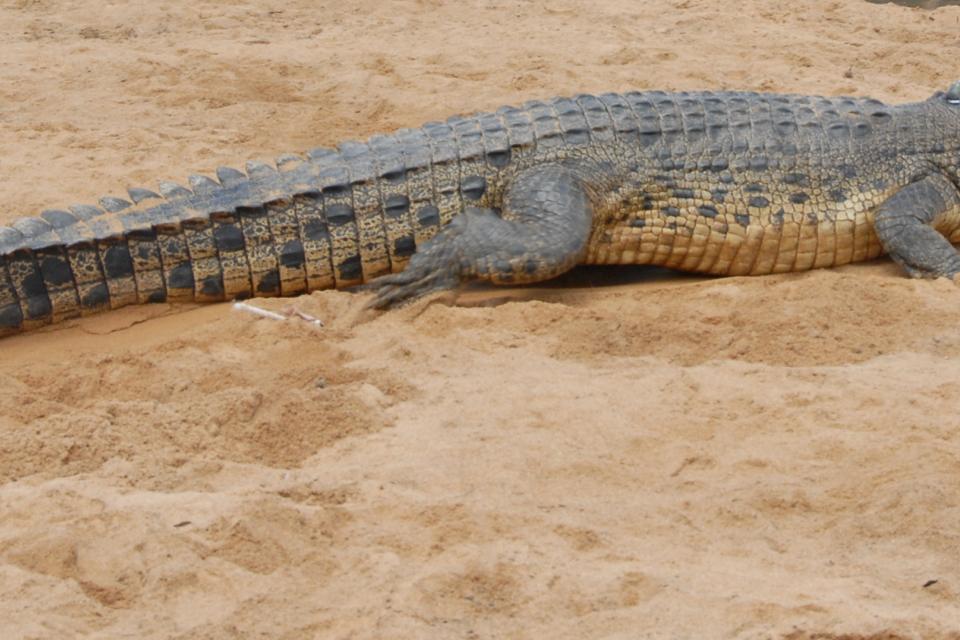
“We have seven years of data, and with a new generation of acoustic tags set to last 10 years, potentially we’ll have 17 years of information – an unparalleled data set internationally,” Professor Franklin said.
“Our goal is to understand the role of crocs in the ecosystem and look how they move into the river systems, estuaries, creeks and waterholes.
“We’ve discovered that estuarine crocs can move 1000km in a year and up to 60 km a day.
“We’ve tracked them moving 0.7 metres a second using tides to their advantage.”
Professor Franklin said he hoped the information his team was gathering would feed back into sensible and evidence-driven management plans to conserve the species.
His team is now building computer models to predict where estuarine crocs might travel with future climate change.
Professor Franklin said the research was possible due to the support of the Federal Government and Australia Zoo collaborators, particularly Dr Terri Irwin.
The Irwin family bought the Cape York land in 2007 with the help of a $6.3 million Federal Government grant, and runs it as a conservation and scientific reserve in memory of Steve Irwin.
You can follow the movement of crocodiles in North Queensland by satellite at the Franklin eco-lab website.
Media: Professor Craig Franklin, c.franklin@uq.edu.au, +61 7 3365 2355 or Dr Ross Dwyer, ross.dwyer@uq.edu.au, +61 7 3365 1390.
Related articles

Big supernova dataset challenges dark energy theory
