
Light-optics research could improve medical imaging
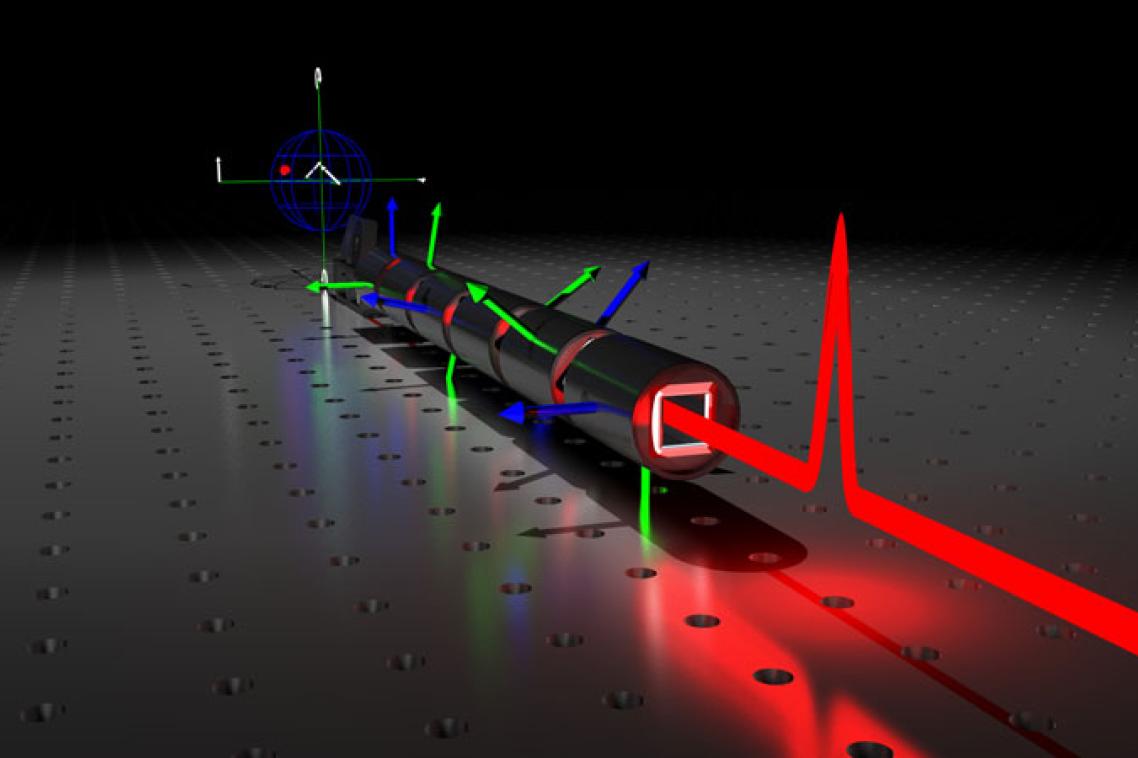
A team of researchers, including The University of Queensland’s Dr Joel Carpenter, has developed echo-less lights that could improve medical imaging inside the body, leading to less-intrusive surgery.
First proposed in 1948, but never before tested, the new light states may lead to the development of ‘super-thin’ endoscopes that can reach into what were before inaccessible regions, such as inside the brain.
The team, from the Centre for Ultrahigh Bandwidth Devices for Optical Systems (CUDOS), created techniques to take images deep inside skin tissue.
The method allows waves of light, sound or radio to travel through complex obstacles, which would usually scatter the wave, yet have the entire wave arrive at once at its point of destination, echo-free.
Dr Carpenter, who designed and performed the experiments, likened the waves of light to yelling a message to a friend at the end of a tunnel.
“Because of the way sound waves bounce off walls and other objects, the message your friend receives will be distorted by echoes and they might not be able to understand you,” Dr Carpenter said.
“Now imagine you had a specially-shaped horn or speaker that launched your voice into the tunnel in a very special shape, so that somehow no echo arrives at the other end.
“We’ve demonstrated the same idea, except using light bouncing around inside an optical fibre.
“It is hoped that this will lead to many new uses within the medical industry, such as the ability to conduct endoscopes within areas like the brain and allow for less-intrusive surgery options.
“We demonstrated this new phenomenon using light waves in optical fibres by precisely measuring the way light travels through the fibre in space and time.
“Then, we worked out what shape laser beams need to be in order to travel through without echoes, and generated beams of those shapes, put them into the fibre, before confirming that all the light arrived simultaneously at the other end.”
Although the researchers used light, the principle is also applicable to other waves like sound waves or waves in WiFi, radio or mobile phones transmission.
The technique could be applied to any application where a signal is send through a complex medium without being distorted by “echoes”.
The team comprises of Dr Carpenter, Professor Benjamin Eggleton from the University of Sydney, and Dr Jochen Schröder from RMIT University
The research has been published in international journal Nature Photonics
Media: Dr Joel Carpenter j.carpenter@uq.edu.au or + 61 7 3365 1656 or Madelene Flanagan m.flanagan@uq.edu.au or + 61 7 3365 8525
Related articles

UQ to support development of mobile launcher for high-speed flight R&D
