Skip to menu Skip to content Skip to footer
News

UQ’s first sustainable building wins national architecture awards

9 November 2015
The Global Change Institute won the David Oppenheim Award for Sustainable Architecture and the National Award for Interior Architecture at the Australian Institute of Architects’ Annual Awards.

The University of Queensland’s landmark six-star sustainability building has been recognised at the nation’s leading architecture awards.

The Global Change Institute won the David Oppenheim Award for Sustainable Architecture and the National Award for Interior Architecture at the Australian Institute of Architects’ Annual Awards.

GCI Director Professor Ove Hoegh-Guldberg said the zero-carbon, sustainable building reflected the University’s commitment to challenge and lead in the community.

“This is a great example of UQ creating change by pushing the barriers in design and construction,” he said.  

“This building is more than a place to work – it’s a place that demonstrates the future and inspires others to develop buildings that are not only practical, but good for the environment as well.

“The Institute regularly hosts tours for political leaders, building professionals and academics wanting to know more about sustainability in practice.”

The Australian Institute of Architects judging panel noted the use of sustainability in the GCI’s design, and called the building’s sky-lit atrium “a triumph, transforming a former service zone into a showpiece for the university”.
Decorative
 

The building was made possible through the support of UQ alumnus and philanthropist Dr Graeme Wood.  

“We wanted a building that would turn heads as well as inspire both workers and visitors,” Dr Wood said.

“Sustainability in building design and function is no longer an option, a 'nice to have'.

“Congratulations to all those on the team who demonstrated such powerful applied imagination.”

The Global Change Institute hosts weekly building tours – register here.

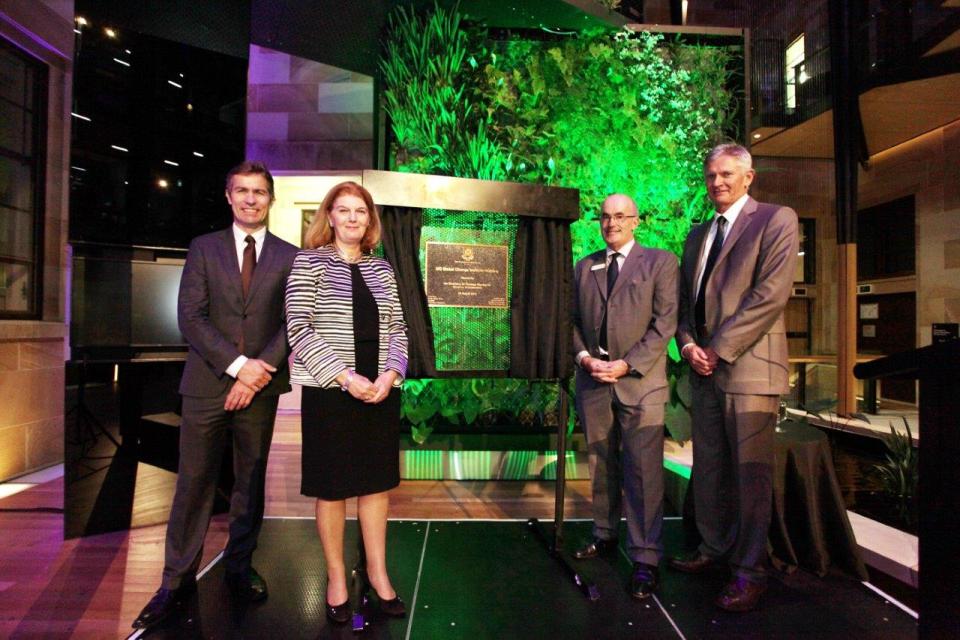
Pictured: Professor Peter Høj, Dr Penelope Wensley, Professor Ove Hoegh-Guldberg and Dr Graeme Wood. 

Contact: GCI Communications and Engagement Manager Anna Moloney, a.moloney@uq.edu.au,  +61 7 3443 3148, +61 (0) 478 487 211. 

Related articles

Three researchers wearing blue protective lab gowns stand among rows of potted chickpea plants inside a controlled-environment plant research facility.

Turning up the heat on chickpea yield

A University of Queensland study has outlined a practical pathway for accelerating the development of heat adapted chickpeas using data from new ‘omic’ technologies. PhD candidate Callum Jamie said the suite of technologies offered tremendous opportunities to understand how a complex trait like heat tolerance works. “The narrow genetic diversity in the elite chickpea gene pool has limited conventional breeding’s effectiveness for stress tolerance,” Mr Jamie said. “These technologies have improved our capacity to dissect trait architecture and phenotype secondary traits but their use in chickpeas has been limited.” The technologies include genomics, epigenomics, transcriptomics, proteomics, metabolomics, phenomics and enviromics, and help provide a comprehensive picture of biological systems. Epigenomics helps understand what controls gene activity; transcriptomics considers gene expression; proteomics protein production; metabolomics looks at biochemical processes; phenomics observes traits; and enviromics considers environmental factors influencing outcomes. Mr Jamie said previous studies had focused on just 1 to 2 -omic datasets, a small number of genotypes, and single tissues. This has meant it was hard to infer what results meant for trait architecture and mechanisms and the ability to extrapolate the information to breeding populations was limited. There have also been challenges around cost, scalability and integrating very different types of data to make the technologies useful. To overcome the hurdles, Mr Jamie’s research at the Queensland Alliance for Agriculture and Food Innovation has resulted in a proposed staged approach. It would start with genomic prediction and phenotyping, before adding -omic layers as costs fall and unknowns were resolved. “These technologies are novel and we still don’t know which information provides added value and how best to integrate all of this data to achieve an outcome,” Mr Jamie said. His PhD is supported by the Grains Research and Development Corporation (GRDC) and the International Research Training Group (IRTG) Accelerating Crop Genetic Gain and is aligned to a project which aims to fast-track the development of chickpea varieties adapted to high temperatures. Project leader Dr Millicent Smith said heat stress causes severe yield implications through flower and pod loss, reduced pollen viability and impaired grain filling. “Late sown chickpea is particularly in the firing line across most of Australia's crop in southern Queensland and northern New South Wales,” Dr Smith said. “We want to ensure that Australian growers maintain their competitive edge. “New varieties with improved genetics to cope with heat stress are essential for the future. “This work, suggesting a staged approach to utilising the new -omic technologies, is an exciting frontier.” The research was published by Food and Energy Security. Callum Jamie’s PhD is supported by the Grains Research and Development Corporation (GRDC) and the International Research Training Group (IRTG) Accelerating Crop Genetic Gain.
15 October 2026
Thirteen members of the Varghese family stand in front of the Social Sciences building at The University of Queensland with new signage announcing it as the Peter N Varghese Building.

From childhood to the top job, Varghese family's UQ legacy cemented

The University of Queensland has honoured the extraordinary contribution of former Chancellor Peter Varghese AO naming a building in his honour on the campus that became a “second home” to his family in the 1960s.
13 October 2026

Media contact

Subscribe to UQ News

Get the latest from our newsroom.