
Great Barrier Reef bleaching
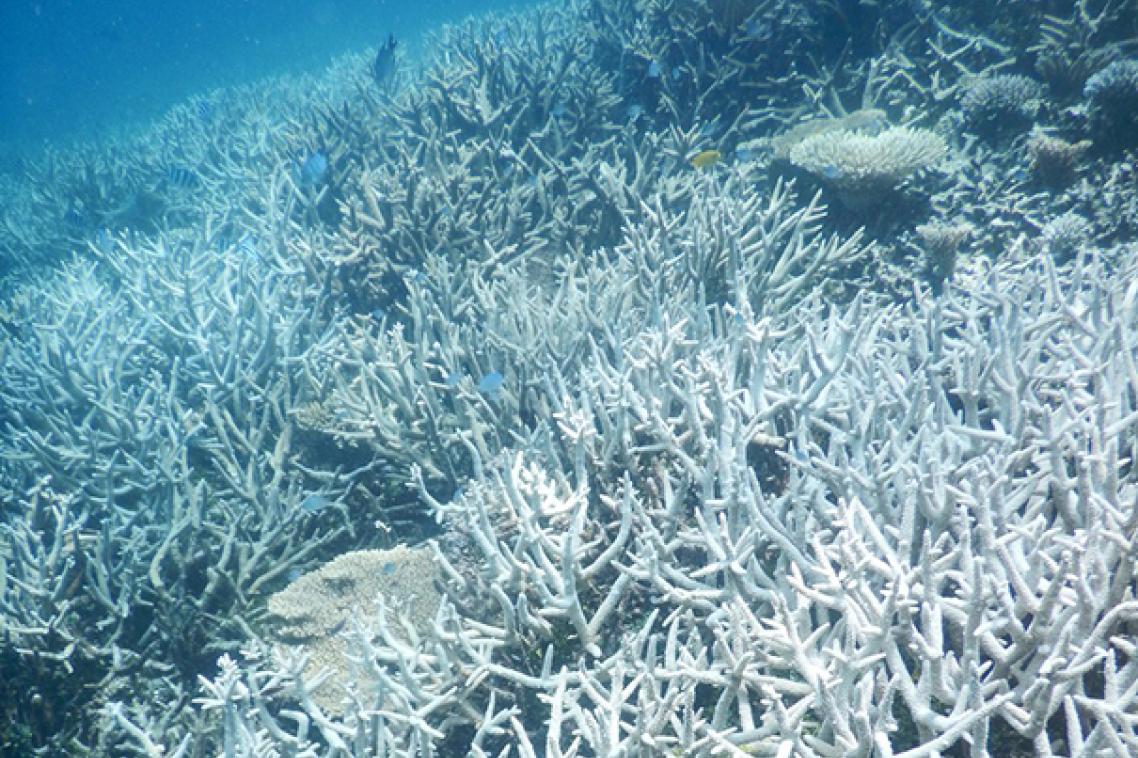
The Great Barrier Reef Marine Park Authority (GBRMPA) has released a statement on low level coral bleaching, prompting marine researchers to respond.
The University of Queensland’s Global Change Institute Director Professor Ove Hoegh-Guldberg, a member of The Great Barrier Reef Taskforce on water quality, said he was concerned about the outlook for the Great Barrier Reef.
“The scientific community has been following the very warm conditions this summer and has been concerned that the outbreak of mass coral bleaching was a very strong possibility,” he said.
“The announcement released by GBRMPA today confirms that those concerns were justified.
“If we continue to experience still and calm conditions for the next two to four weeks, we could see the level and extent of mass coral bleaching increase.
“We’re not out of the woods yet.”
Professor Hoegh-Guldberg said if temperatures stay warm for a long time corals will not only bleach, they will also die.
“At this point they will become covered by algae and that’s when the lights go out on our beautiful and diverse reefs.
“Patches of reef may recover but with the increase of bleaching events in recent years, more and more white patches of reef will turn into dead algal-coloured coral with fewer fish - so your favourite patch of coral turns into something resembling an underwater desert.
“This threat of widespread coral bleaching underscores the sensible nature of the funding decision made by state and federal governments to solve the other problems facing the reef such as water quality issues which are exacerbated by climate change.
“We need to solve both the climate problem and these other localised threats such as pollution because if we don’t deal with either one, we can’t improve the prognosis for the Great Barrier Reef.
“The GBRMPA is world class at minimising other stress factors on the reef. It would be disheartening to see these worthy efforts come to nothing if we don’t solve the problem of climate change.
“The looming risk of mass coral bleaching is also highlighting the importance of the strong COP21 agreement in Paris to limit average global temperature to well below two degrees Celsius.
“We have to do everything possible to rein in our emissions or we will see more and more of these climate related threats, which paint a gloomy future for the reef.”
Media: Rachael Hazell, r.hazell@uq.edu.au, 3443 3150 or 0415 814 529; Professor Ove Hoegh-Guldberg, oveh@uq.edu.au, 3443 3112; and Dr Tyrone Ridgway, t.ridgway1@uq.edu.au, 3443 3147
Related articles

Want to help Nepal recover from its deadly floods? Here’s what tourists need to know
