
On the cards: Card gaming for science engagement
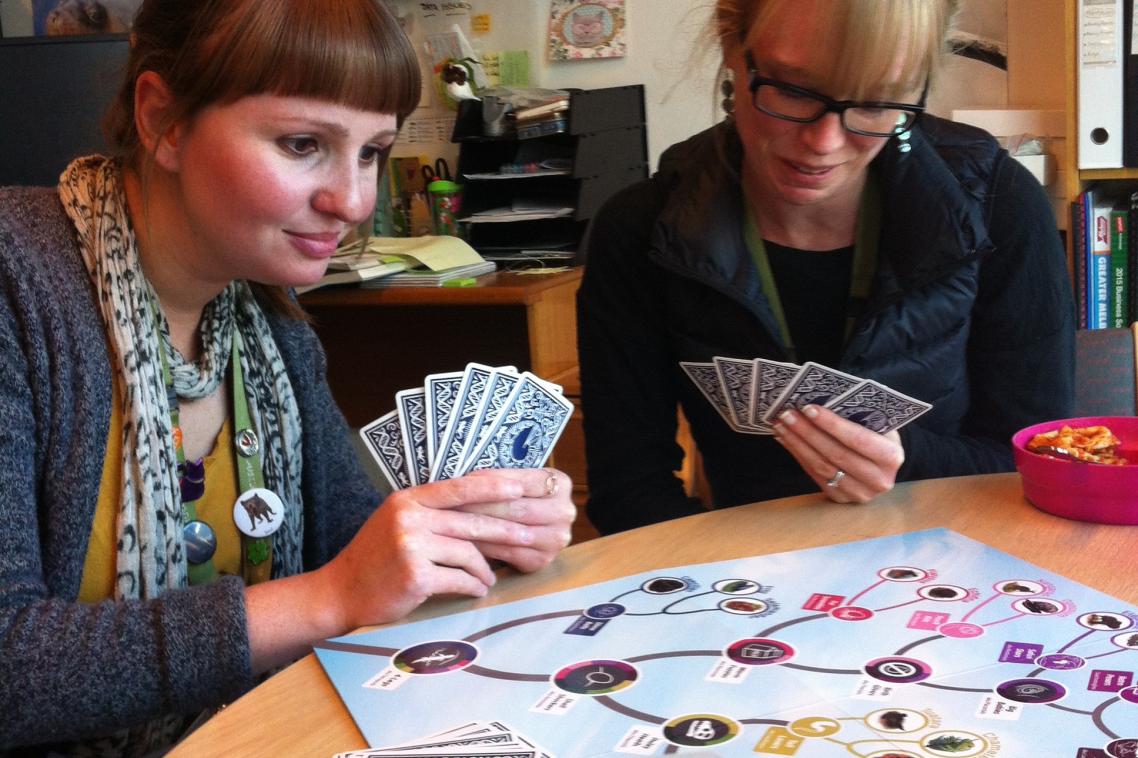
Creativity is a critical part of science, says the University of Queensland PhD student behind a colourful card game that teaches evolutional theory.
International peer-reviewed journal Science has devoted a full page to Go Extinct!, a popular game developed by Ariel Marcy, who is studying evolutionary biology in UQ’s School of Biological Sciences.
“Some kids are turned off science because of the stereotype that it is boring number-crunching,” Ms Marcy said.
“If they only knew how creative it was, more kids would be inspired to pursue science.”
Go Extinct! teaches players how to read ‘evolutionary trees’ and targets children aged eight and up.
Evolutionary trees illustrate one of the most profound ideas in science - that life is diverse yet unified by common ancestors.
The game has been adopted by a number of science and education institutions, including The National Science and Technology Centre Questacon.
“In general, a kind of nerd and geek culture is flourishing,” Ms Marcy said.
“Science fiction and Star Trek have been very popular lately, and that is driving a kind of interest in how we create our future, and science and technology are at forefront of that,” Ariel said.
“The tack that I’m taking is to emphasise the enormous role that creativity plays in science, technology, engineering and mathematics, or STEM, and how these fields are very much aligned with arts and graphic design.”
Originally from Vermont in the United States, Ariel developed an interest in games at aged seven when her physician father gave her an electronic game that helped her learn about the human body and understand what he did each day.
She researched and developed Go Extinct! and tested prototypes with several schools to get student feedback.
She raised $16,000 through crowdfunding site Kickstarter, which paid for an artist and the production of 1000 games. It sold out in its first year, and she has printed 3000 more.

She has now formed STEAM Galaxy Studios, which aims to increase the diversity of kids who flourish in science, technology, engineering and maths, and to provide educators with access to high quality, fun STEM teaching resources.
Now she’s focused on creating a new game called Suddenly Cute, which translates some of the evolutionary biology knowledge she has gained at UQ into accessible knowledge for children. The project demonstrates how one small change in embryos can lead to a giant leap in evolution.
“Whichever path I end up taking, I would like to be involved with students in helping them to develop science games of their own,” Ms Marcy said.
Media: Ariel Marcy 0473 087 727, aemarcy@gmail.com, @aemarcy (Twitter)
Related articles

Supercharged 'molecule highway' could transform industrial processing
