
Is that you? This fish can recognise human faces
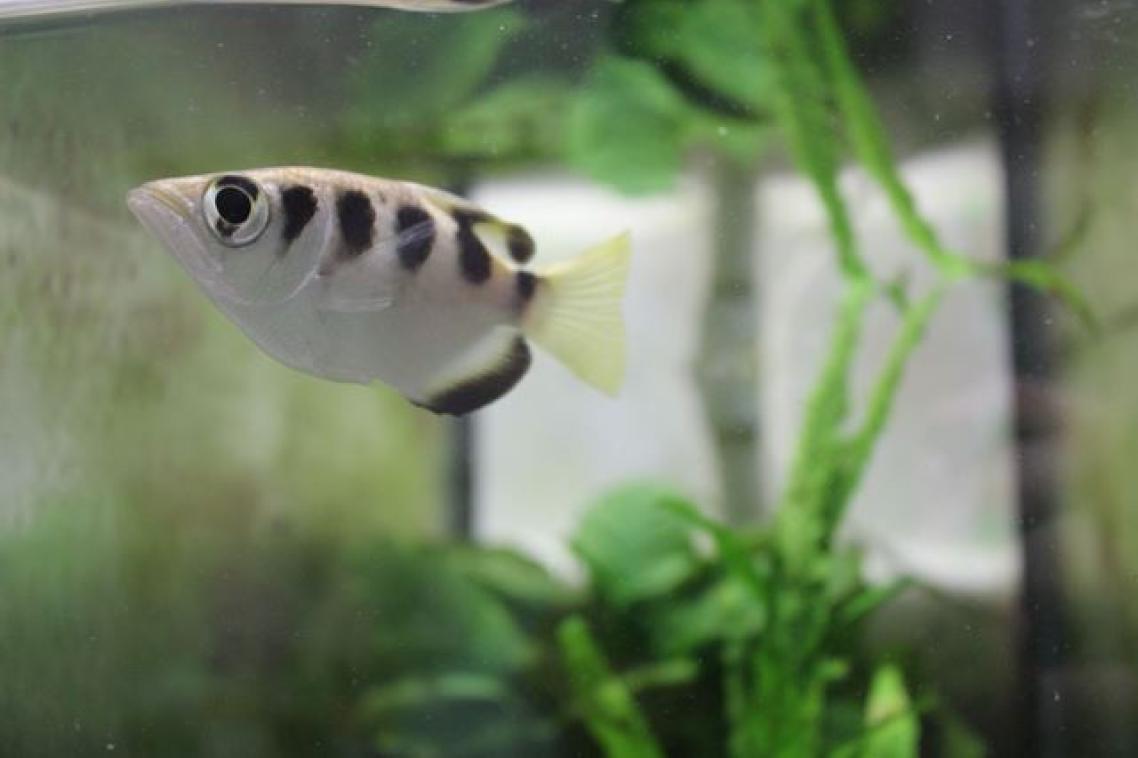
The tropical archerfish can recognise people and spit at familiar faces, researchers from The University of Queensland and University of Oxford have found.
Dr Ulrike Siebeck from the UQ School of Biomedical Science (SBMS) said the findings suggested that human facial recognition was driven by learned behaviour, rather than innate processes facilitated by specialized cells in the human brain.
“This is the first time any fish has been known to demonstrate this ability, and it comes as a surprise, as fish lack the brain area (neocortex) used for this task by humans,” Dr Siebeck said.
“During testing, the fish were able to consistently identify the learned face from up to 44 new faces.
“The fish achieved an accuracy average of between 81 per cent and 86 per cent over two experiments, even when obvious facial features such as head shape and colour were standardised for all faces.”

Dr Siebeck said there are two rival theories about how humans recognise faces.
“One is that the human brain requires a specialised area of the brain that provides us with an innate ability to recognise faces, the other is that it is learned behaviour.
“As archerfish do not have a neocortex, and are unlikely to have evolved a specialised area for human face recognition, this study adds weight to the theory that facial recognition is learned behaviour.
“This would impact on our understanding of human visual perception.”
UQ PhD student and first author on the project Dr Cait Newport, who is currently based at Oxford University on a Marie Curie Research Fellowship, said facial recognition was a complex task, particularly for a fish.
“Being able to distinguish between a large number of human faces is a surprisingly difficult task, mainly due to the fact that all human faces share the same basic features,” Dr Newport said.
“All faces have two eyes above a nose and mouth, therefore to tell people apart we must be able to identify subtle differences in their features.
“If you consider the similarities in appearance between some family members, this task can be very difficult indeed.”
The study is published in the journal Scientific Reports.
Video credit: Dr Cait Newport.
Media: Dr Uli Siebeck, +61 3365 4070, u.siebeck@uq.edu.au. Kim Lyell, UQ Faculty of Medicine and Biomedical Sciences, k.lyell@uq.edu.au, +61 7 3346 5214, 0427 530647.
Topics
Related articles

Calling people with whiplash to trial new treatment
