
Stand up at work and be counted
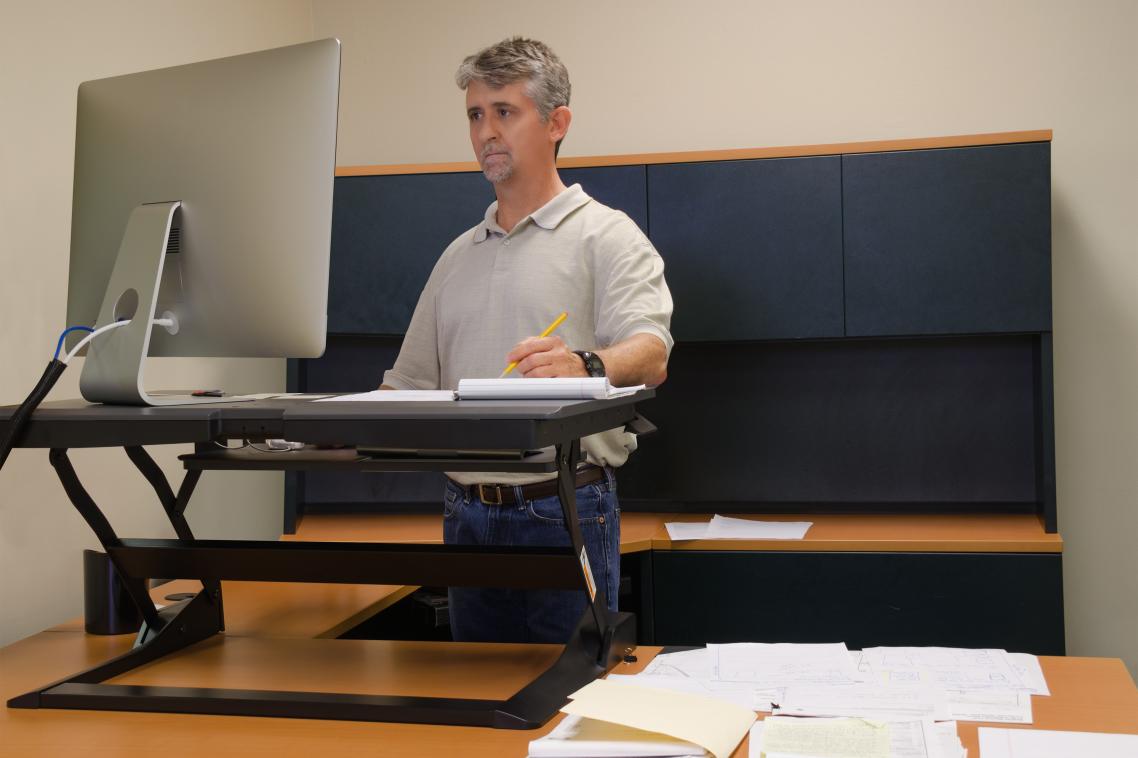
A program encouraging office workers to stand up, sit less and move more has significantly reduced sitting time among participating public servants.
The University of Queensland’s Associate Professor Genevieve Healy said ‘Stand Up Victoria’ achieved big changes after three months, and was still making a significant difference after 12 months.
The intervention was tested in 14 offices of the Department of Human Services across Victoria.
“After the three-month intensive phase there was an average work day reduction of around one and a half hours in sitting time,” Dr Healy said.
“At 12 months we still saw reductions of approximately 45 minutes a day.”
The program was one of the first large cluster randomised controlled trials of its kind, and followed 231 workers over a year.
“It was a multi-component intervention which addressed many of the reasons that office workers sit when they are in the workplace,” Dr Healy said.
The organisation was supportive of less sitting, and sit-stand workstations were provided so participants could easily change their posture.
“Participants also received health coaching in the first three months to support their behaviour change.”
Dr Healy, from UQ’s School of Public Health, said improvements occurred through reductions in the time participants spent sitting for 30 minutes or more at work – the behaviour particularly targeted in the intervention.
“If you work in an office, or behind a desk, chances are that you spend most of your day sitting,” she said.
“With too much sitting now linked to poor health, it is important to understand how to reduce the time that we sit, and whether this change can be maintained in the long term.
“The next step for us now is to adapt this intervention for wide-scale use by workplaces.”
The research was funded by the National Health and Medical Research Council (NHMRC), the Victorian Government and VicHealth’s Creating Healthy Workplaces program.
The study led by researchers at UQ and Baker IDI has been published in the journal of the American College of Sports Medicine.
Media: Associate Professor Genevieve Healy, 0401 889 453, g.healy@uq.edu.au, Kim Lyell, UQ Faculty of Medicine, k.lyell@uq.edu.au, +61 7 33465214, 0427 530647.
Topics
Related articles

Clinical trial a step forward in easing kidney dialysis shortfall
