
This snake is a killer of killers
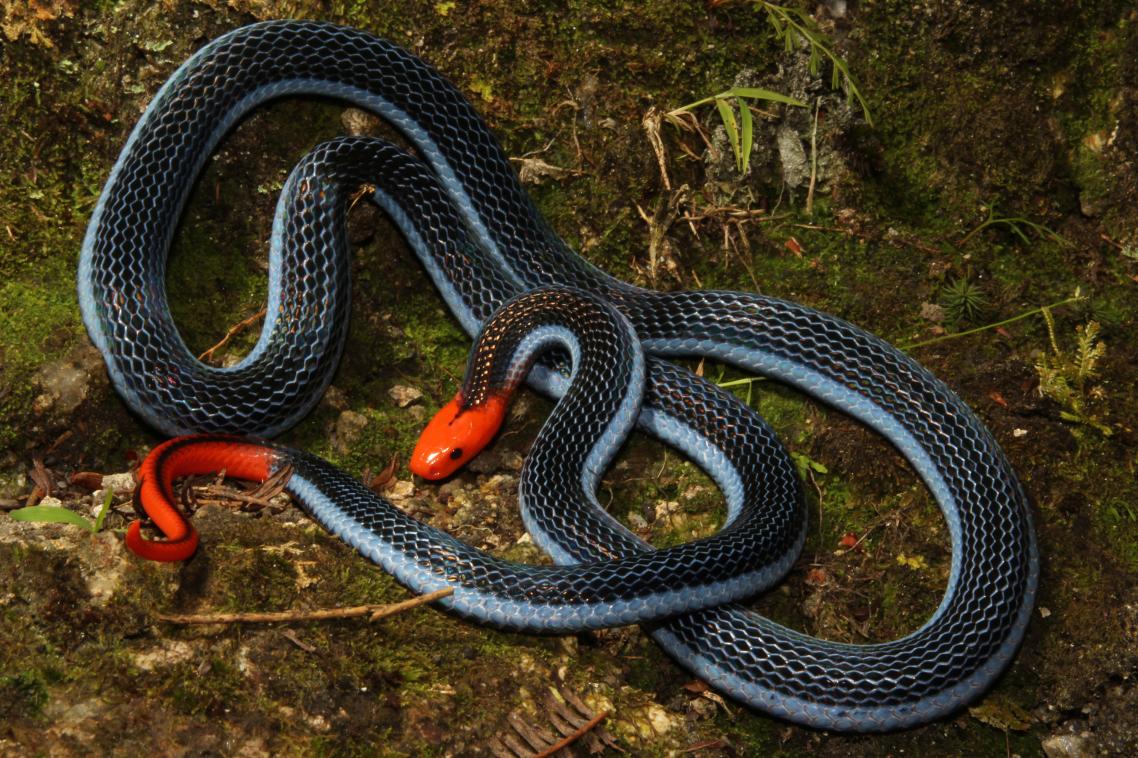
One of the world’s most beautiful and venomous snakes has a venom unlike that of any other snake, research involving University of Queensland scientists has revealed.
The School of Biological Science’s Associate Professor Bryan Fry said venom from South-East Asia’s long-glanded blue coral snake had been found to send a massive shock to the system, triggering full body spasms by causing all nerves to fire at once.
“This style of venomous predation is identical to that of a cone snail, and not like any other snake in the world,” he said.
Ironically, the discovery could eventually lead to improved pain treatment for humans.
“These snakes are ‘killer’s killers’,” Professor Fry said.
“They specialise in preying on other venomous snakes, including young king cobras, so they play a ‘hunt the most dangerous’ game.
“With its combination of electric blue stripes and neon red head and tail, the blue coral snake is arguably one of the world's most striking species of snake.
“It also has the biggest venom glands in the world, extending over a quarter the length of its body.”
Associate Professor Fry said the Hollywood movies portrayal of venom causing instant death was not usually reflected in reality, with snakes such as cobras taking minutes to kill rodent prey, and longer to kill humans, sometimes taking hours.
“However some animals cause their prey’s nerves to become fried by a massive shock to the system,” he said.
“A cone snail instantly paralyses a fish into a rigid death mask, fully tensing the muscles in a tetanus-like spasm.
“This keeps the fish from escaping the immobile snail.
“Now it has been shown there is a snake that kills the same way.
“Their blazingly fast venom does not kill immediately. Instead, it turns on all the nerves of their fast-moving prey – who are also potential predators – at one time, almost instantly resulting in a frozen state.
“They do this by preventing the nerves from turning off their sodium channels, keeping the nerve firing continuously.”
Associate Professor Fry said the blue coral snake’s venom was not just of evolutionary interest.
“This venom hits a particular type of sodium channel that is important for the treatment of pain in humans,” he said.
“This is another in the long line of useful discoveries from venom that could benefit human health.”
The research, involving scientists from Australia, China, Singapore and the US, is published in the journal Toxins.
Media: Bryan Fry, bgfry@uq.edu.au , 0400 193 182 (Australia) +61 400 193 182 (international).
Topics
Related articles

Hay fever can strike even when grass pollen concentrations are low
