Skip to menu Skip to content Skip to footer
News

Ferals running rampant
5 January 2017
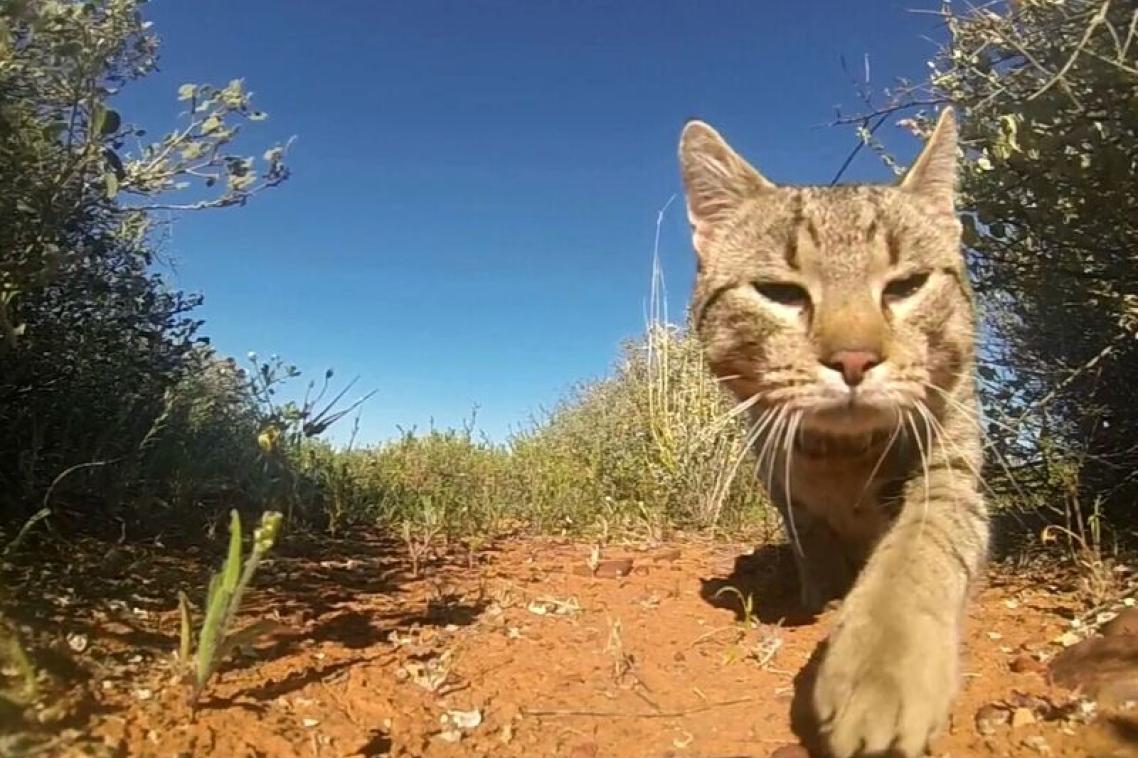
Feral cat strolls through Australian rural area. Credit: Hugh McGregor.

Feral cats cover more than 99.8% of Australia’s land area, including its islands. 

New research, led by Dr Sarah Legge from The University of Queensland, brings together more than 40 of Australia’s top environmental scientists and evidence from nearly 100 separate studies across the country.

“Australia’s feral cat population fluctuates between 2.1 million when times are lean, up to 6.3 million when widespread rain results in plenty of available prey,” Dr Legge said. 

In a worrying find, cat densities were the same both inside and outside conservation reserves, such as national parks.

“This shows that declaring protected areas is not enough on its own to safeguard native wildlife,” Dr Legge said.

“Our study highlights the scale and impact of feral cats and the urgent need to develop effective control methods, and to target our efforts in areas where control will produce the biggest gains.

“At the moment feral cats are undermining the efforts of conservation managers and threatened species recovery teams across Australia.”

Dr Legge said that, in addition to strategic cat control in bushland areas, there was a need to address feral cats in heavily urbanised areas where their population density could be 30 times higher than in natural environments.

As well as preying on threatened native species in and near to urban areas, urban feral cats can provide a source of further feral cats to bushland areas.

The research was funded by the Threatened Species Recovery Hub of the Australian Government’s National Environmental Science Programme.

Australia’s Threatened Species commissioner Gregory Andrews said findings substantiated the need for a humane and effective cull.

“The density of feral cats in Australia is lower than it is in North America and Europe, and yet feral cats have been devastating for our wildlife,” Mr Andrews said.

“Aside from Antarctica, Australia is the only continent where animals evolved without cats, which is a reason our wildlife has been so vulnerable.

“Feral cats have already driven at least 20 Australian mammals to extinction, which makes investing in research like this important.

“This science reaffirms the importance of ambitious targets to cull feral cats, which I am implementing with the support of Minister for Environment and Energy Josh Frydenberg under the Threatened Species Strategy.”

The research has been published in research journal Biological Conservation.

Note to editors: Photographs to accompany the story available via Dropbox. Photographers should be credited.

Media: Dr Sarah Legge, s.legge@uq.edu.au +61 (0) 476 861 951; TSR Hub Science Communications – Jaana Dielenberg, j.dielenberg@uq.edu.au, +61 (0) 413 585 709. 

Related articles

Three researchers wearing blue protective lab gowns stand among rows of potted chickpea plants inside a controlled-environment plant research facility.

Turning up the heat on chickpea yield

A University of Queensland study has outlined a practical pathway for accelerating the development of heat adapted chickpeas using data from new ‘omic’ technologies. PhD candidate Callum Jamie said the suite of technologies offered tremendous opportunities to understand how a complex trait like heat tolerance works. “The narrow genetic diversity in the elite chickpea gene pool has limited conventional breeding’s effectiveness for stress tolerance,” Mr Jamie said. “These technologies have improved our capacity to dissect trait architecture and phenotype secondary traits but their use in chickpeas has been limited.” The technologies include genomics, epigenomics, transcriptomics, proteomics, metabolomics, phenomics and enviromics, and help provide a comprehensive picture of biological systems. Epigenomics helps understand what controls gene activity; transcriptomics considers gene expression; proteomics protein production; metabolomics looks at biochemical processes; phenomics observes traits; and enviromics considers environmental factors influencing outcomes. Mr Jamie said previous studies had focused on just 1 to 2 -omic datasets, a small number of genotypes, and single tissues. This has meant it was hard to infer what results meant for trait architecture and mechanisms and the ability to extrapolate the information to breeding populations was limited. There have also been challenges around cost, scalability and integrating very different types of data to make the technologies useful. To overcome the hurdles, Mr Jamie’s research at the Queensland Alliance for Agriculture and Food Innovation has resulted in a proposed staged approach. It would start with genomic prediction and phenotyping, before adding -omic layers as costs fall and unknowns were resolved. “These technologies are novel and we still don’t know which information provides added value and how best to integrate all of this data to achieve an outcome,” Mr Jamie said. His PhD is supported by the Grains Research and Development Corporation (GRDC) and the International Research Training Group (IRTG) Accelerating Crop Genetic Gain and is aligned to a project which aims to fast-track the development of chickpea varieties adapted to high temperatures. Project leader Dr Millicent Smith said heat stress causes severe yield implications through flower and pod loss, reduced pollen viability and impaired grain filling. “Late sown chickpea is particularly in the firing line across most of Australia's crop in southern Queensland and northern New South Wales,” Dr Smith said. “We want to ensure that Australian growers maintain their competitive edge. “New varieties with improved genetics to cope with heat stress are essential for the future. “This work, suggesting a staged approach to utilising the new -omic technologies, is an exciting frontier.” The research was published by Food and Energy Security. Callum Jamie’s PhD is supported by the Grains Research and Development Corporation (GRDC) and the International Research Training Group (IRTG) Accelerating Crop Genetic Gain.
15 October 2026
Man sits amongst grass and flowers while blowing his nose

Hay fever can strike even when grass pollen concentrations are low

A low pollen count does not always mean a symptom-free day for those with asthma or hay fever, with new research showing some people still experience symptoms even when grass pollen levels are classified as low.
6 October 2026

Media contact

Subscribe to UQ News

Get the latest from our newsroom.