
UQ researchers to set sail with global ocean mapping program
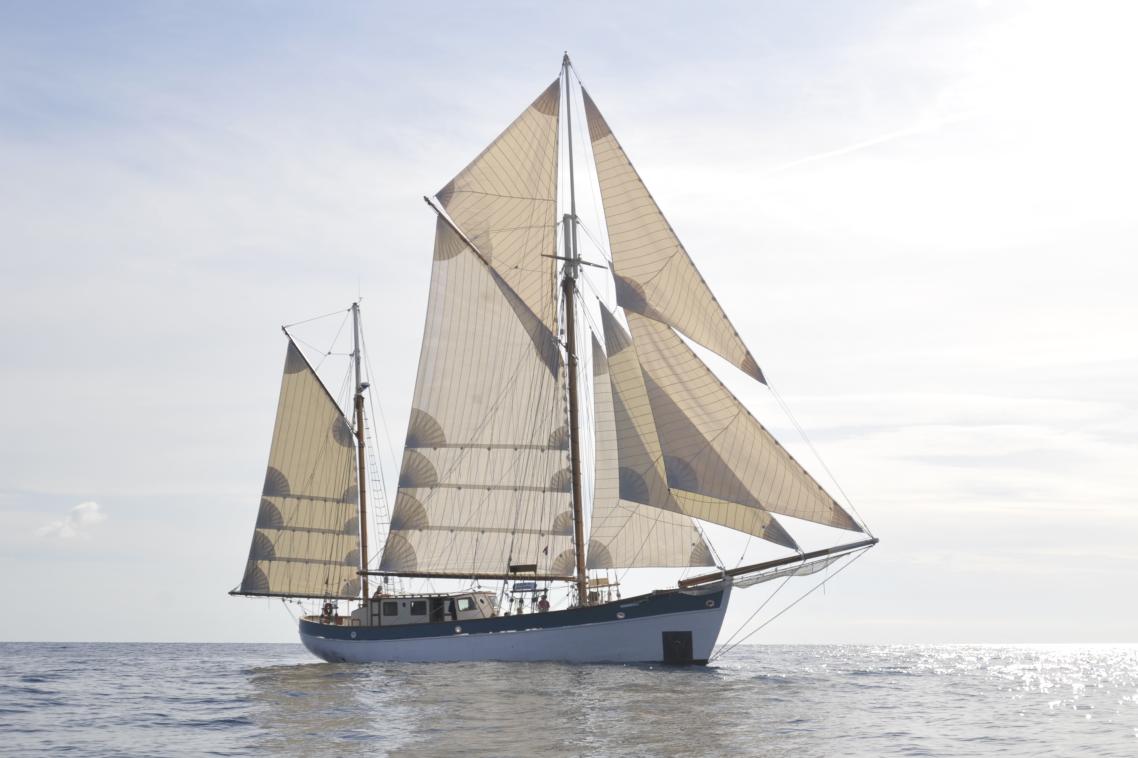
A Swiss yacht on an epic research expedition to map the world’s oceans will host University of Queensland marine scientists on the Great Barrier Reef in March and April.
UQ’s Professor Justin Marshall and Dr Chris Roelfsema will lead two research projects as part of the 33m Fleur de Passion’s four-year-long Ocean Mapping Expedition.
Dr Roelfsema, of UQ’s Remote Sensing Research Centre, is leading a program to map the habitat of the Great Barrier Reef, focussing on the 200 shallow reefs in the waters around Cairns to Cooktown.
Twenty of these reefs will be surveyed from the Fleur de Passion.
“No comprehensive map of the composition of all the diverse habitats on the whole Great Barrier Reef currently exists,” Dr Roelfsema said.
“These maps will provide valuable information for monitoring and management to support current bleaching surveys, the crown of thorn star fish eradication program, marine park zone design, and day-to-day management of the Great Barrier Reef.”
The crew of the Fleur de Passion will be trained to collect reef data for the CoralWatch citizen science project.
CoralWatch project leader Professor Justin Marshall, who also leads the UQ Queensland Brain Institute’s Sensory Neurobiology Group, said the Fleur de Passion’s visit to Australia and the cooperative relationship could have not come at a better time.
“The Great Barrier Reef continues to face a barrage of threats,” he said.
“As a second major coral bleaching event takes hold, now more than ever the reef requires support by international government, industry, science and the community.”
“Citizen science is recognised as an effective way to bolster information flow between these sectors.”
CoralWatch engages non-scientists to collect scientific data using a Coral Health Chart.
Fleur de Passion, led by the Fondation Pacifique, will leave Brisbane for the Great Barrier Reef on Wednesday 29 March.
Fondation Pacifique Vice-President Samuel Gardaz said the Swiss non-profit organisation combined scientific research and environmental awareness programs.
The Ocean Mapping Expedition aims to observe and map the world’s oceans.
“These two programs on the Great Barrier Reef contribute to our mission to deepen understanding of humanity’s impact on the oceans, and raise awareness about environmental sustainability,” he said.
Media: Samuel Gardaz, samuel@pacifique.ch, +61 431 295 108; Dr Chris Roelfsema, UQ Remote Sensing Research Centre, c.roelfsema@uq.edu.au, +61 7 336 56977; Professor Justin Marshall, QBI, justin.marshall@uq.edu.au, +61 7 3365 1397, 0423 024 162.
Related articles

Transforming communities: 2026 UQ Alumni Award winners
