
Physicists make quantum leap in understanding life's nanoscale machinery
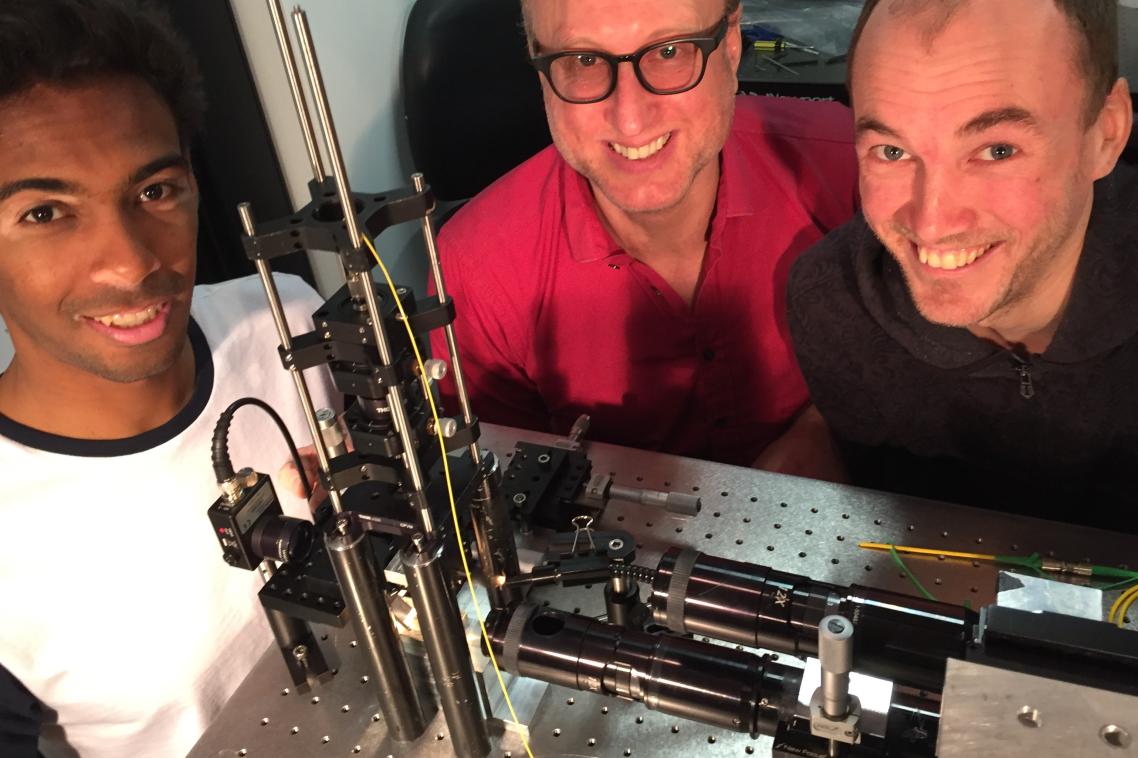
A diagnostic technique that can detect tiny molecules signalling the presence of cancer could be on the horizon.
The possibility of an entirely new capability for detecting cancer at its earliest stages arises from University of Queensland physicists applying quantum physics to single molecule sensing for the first time.
Australian Research Council Future Fellow Professor Warwick Bowen said the research – reported in Nature Photonics this week – demonstrated how quantum technologies could revolutionise the study of life’s “nanoscale machinery, or biological motor molecules”.
“Motor molecules encode our genetic material, create the energy our cells use to function, and distribute nutrients at a sub-cellular level,” Professor Bowen said.
“Unlike methods currently available, the technique helps us observe the behaviour of single biomolecules without large-label particles or damaging light intensities.”
PhD student Nicolas Mauranyapin said motor molecules drove all of life’s primary functions, but scientists did not yet completely understand their workings.
“Our research opens a new door to study motor molecules in their native state, at the nanoscale,” Mr Mauranyapin said.
Project researcher Dr Lars Madsen said the project applied techniques used to detect gravitational waves from black holes in outer space to the nanoscale – super small – world of molecular biology.
“The techniques required to detect extremely faint signals produced by distant black holes were developed over decades,” Dr Madsen said.
“Our research translates this technological development over to the biosciences and offers the possibility of a new biomedical diagnostics technique capable of detecting the presence of even a single cancer marker molecule.”
Researchers from five countries - Australia, New Zealand, Denmark, France and Pakistan – were involved in the project.
It is funded by the United States Air Force Office of Scientific Research, which aims to use the technique to help understand stress on pilot behaviour at the sub-cellular level.
The project is part of the University of Queensland Precision Sensing Initiative, a joint initiative of the schools of Mathematics and Physics and of Information Technology and Electrical Engineering.
It was supported by the ARC Centre of Excellence for Engineered Quantum Systems, which aims to develop next-generation quantum technologies for future Australian industries.
Evanescent single-molecule biosensing with quantum limited precision (doi: 10.1038/nphoton.2017.99)
Media: Professor Warwick Bowen, w.bowen@uq.edu.au, 0404 618722, @ARC_EQuS; Tara Roberson, t.roberson@uq.edu.au, +61 7 3346 7953.
Related articles

Sick of being told to ‘just lose weight’? Health promotion shouldn’t come with weight stigma
