Through the lens of the Wild Australia Show
Was Meston’s Wild Australia Show of the late nineteenth century a form of exploitation or a vital link between Indigenous Australians and the wider world?
A new photographic exhibit, documenting the controversial troupe, is allowing people to decide for themselves as it tours the country.
Professor Paul Memmott and Mr Michael Aird of The University of Queensland found a previous static exhibit of photos from the Wild Australia Show (shown at UQ’s Anthropology Museum in 2015) proved a popular and thought-provoking project.
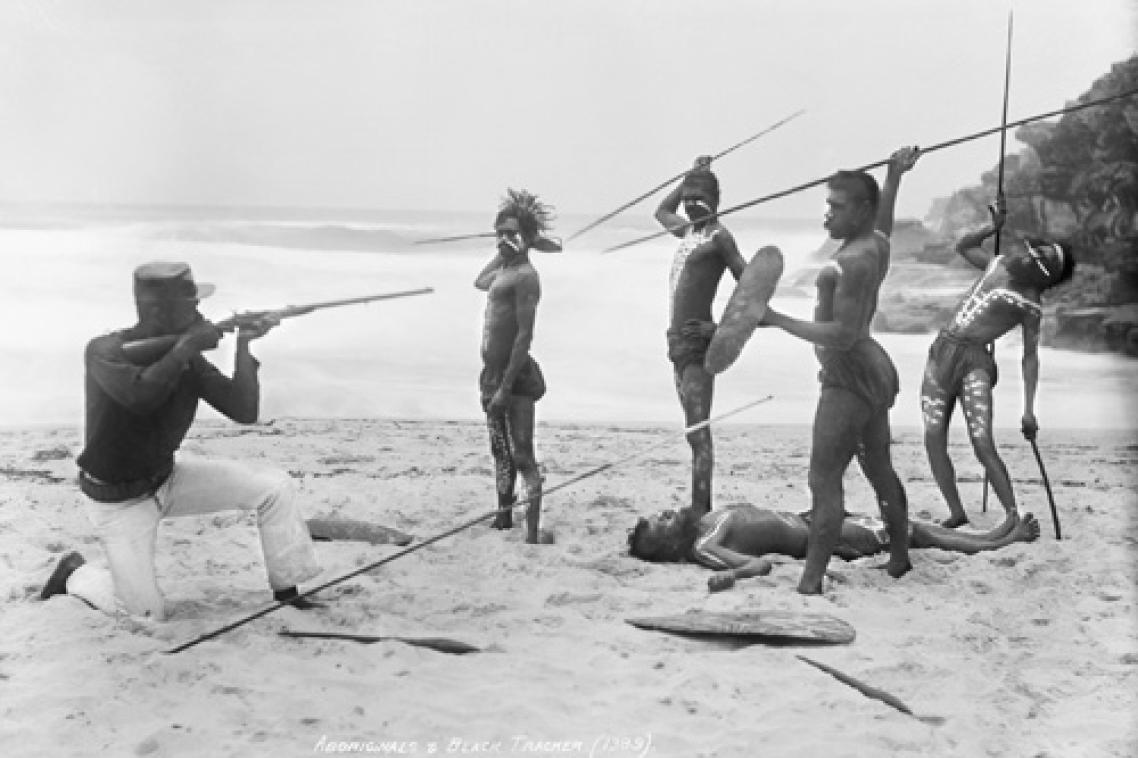
The original Wild Australia Show was conceived by entrepreneur Archibald Meston and toured Brisbane, Sydney and Melbourne in 1892-1893, featuring a choreographed troupe of 27 Indigenous people recruited from the Northern Territory, Queensland and the Torres Strait.
“The Wild Australia Show came at a critical time in colonial history,” Professor Memmott said.
“The perception of Aboriginal people on the frontier was shifting from one of being a threatening population justifiable of extermination, to that of a ‘subject’ people requiring protection.
“Mr Meston’s vision for the Wild Australia Show was to be a demonstration of the superior physique and skills of ‘wild’ Aborigines, presented for the last time because of theories of likely racial extinction.
“During the troupe’s tour, striking portraits of the performers were taken by three leading Australian studio photographers - Charles Kerry, Henry King and John W. Lindt - and these photographs plus research findings make up the current Wild Australia Show travelling exhibition.”
Mr Meston abandoned the troupe in Melbourne after payment for a performance was withheld after a contract dispute, but the troupe - under the guidance of its manager - persevered with seeking new contracts in Victoria.
They eventually raised fares back to Sydney where they appeared in a play at Her Majesty’s Theatre.
“Queensland’s Colonial Secretary then agreed for the government to pay for their steamer tickets home. Despite being away for a year without wages, the troupe maintained a professional execution of their performances,” Professor Memmott said.
The first stop of the 2017 photo exhibition tour was Grafton Regional Gallery, where it was shown during May and June.
It is now programmed to appear at regional centres in areas where the troupe’s members originally came from.
“We are very fortunate to be able to include such a large number of the original photographs, which have been traded through global networks and are held by museums, libraries and private collections around the world,” Professor Memmott said.
“The photographs continue to communicate ideologies about Australian Indigenous people to international audiences.
“It is hoped that an outcome of the travelling exhibition will be the potential to engage the descendants of troupe members in the recovery of the history of their ancestors and through this to strengthen their connection to their history and heritage.”
The project, How Meston’s ‘Wild Australia Show’ Shaped Australian Aboriginal History, is supported by an Australian Research Council Linkage grant, with collaborators from The University of Queensland, Australian National University, Museum Victoria, Queensland Museum and State Library of New South Wales.
Media: Professor Paul Memmott, 07 3365 3660, p.memmott@uq.edu.au
Related articles

From cooked breakfast to their own TV, aged care residents need to watch for extra fees