
Cretaceous croc had steamy past
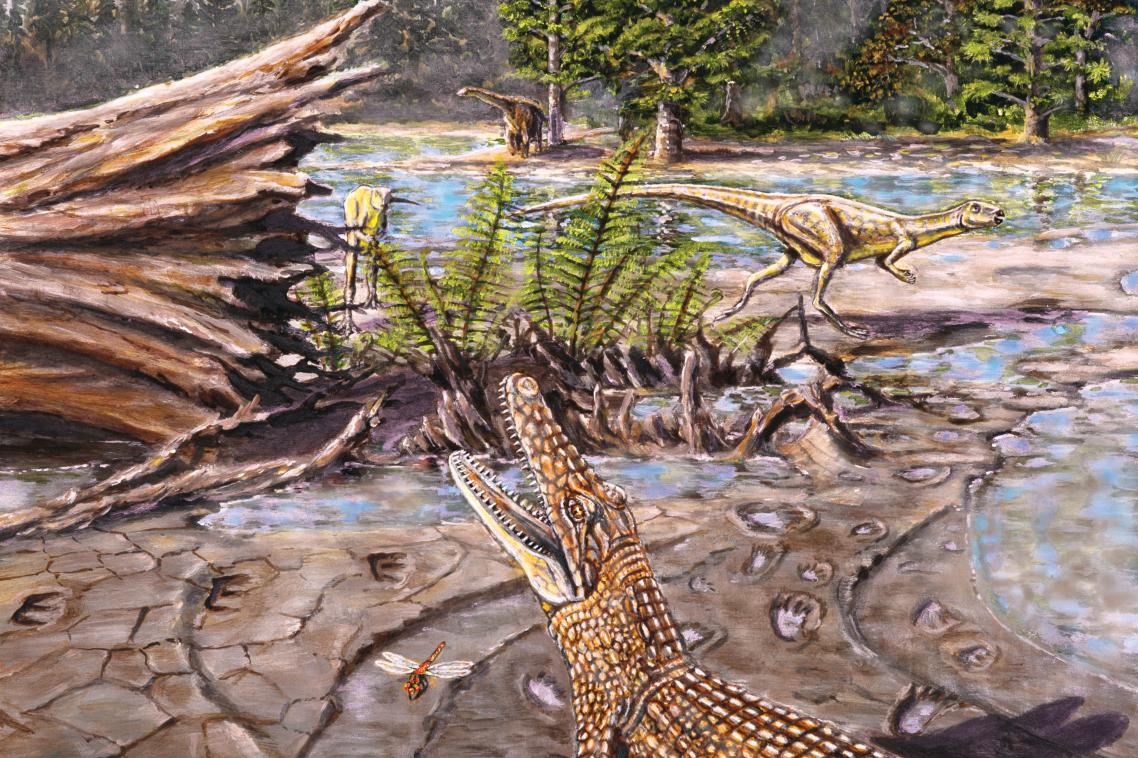
The death, decay and burial of an ancient extinct crocodilian from outback Queensland has revealed more about Cretaceous Period landscapes in Australia.
Scientists from The University of Queensland have completed a forensic-style investigation into fossils of the Isisfordia duncani, and found the diminutive crocodilians lived and died in brackish-water deltas.
School of Biological Sciences Dr Caitlin Syme said it was already known that the crocodile carcasses eventually ended up in the deltas, but it was uncertain if they had lived in the delta or drifted in after death.
“A decaying animal carcass can swell or bloat, and if it is washed into a lake or river, it can float and drift along in river currents,” Dr Syme said.
“If this is what happened to individuals of Isisfordia duncani, then it is possible they were already dead by the time their carcasses drifted in to the delta.”
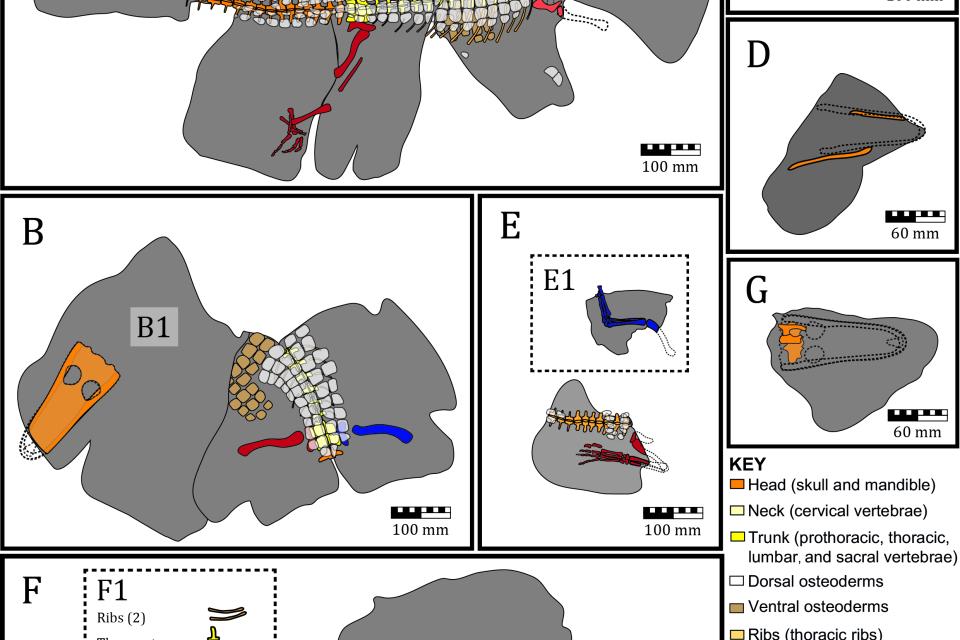
Dr Syme compared the crocodilian fossils to modern animal carcasses and used the science of taphonomy—the study of death, decay, burial, and preservation of animal and plant remains—to predict the movement of the carcasses before they were fossilised.
“We counted which fossil bones and how many were present, whether they were still joined together as they would be in life, and whether they were scratched or broken,” she said.
“When a carcass floats in water, it will continue to decay, and parts of the skeleton will detach and sink.
“With carcasses of modern animals, for instance, the head is often the first part of the body that falls off.
“Where a fossil specimen comprises isolated and broken leg and hip bones, it indicates that the carcass probably drifted for quite a while before parts of it sunk and were eventually buried.”
Although some Isisfordia duncani fossils were incomplete, researchers found two with a large proportion of their bones still connected and intact, indicating the crocodile died near to where they lived.
“Both juvenile and adult crocodilian fossils are found at this site, which also suggests that these crocodilians were breeding in or near to these ancient deltas,” Dr Syme said.
Dr Steven Salisbury said the findings were significant because they suggested that the central-western Queensland Cretaceous Period climate was warm and wet enough for the cold-blooded reptiles to live and breed.
“The results of this study greatly improve our understanding of this part of outback Queensland during the Age of Dinosaurs, and provides valuable information on the life and times of the one of the world’s first modern crocodilians,” Dr Salisbury said.
Fossils of Isisfordia duncani were first found by a local grazier, Ian Duncan, near the outback Queensland town of Isisford in the mid-1990s.
The species was named in 2006 and the Cretaceous crocodilian is considered to be close to the ancestry of all modern crocodilians: true crocodiles, alligators and caimans, and the Indian gharial.
Seven individual Isisfordia duncani have been found, making it the best-represented Cretaceous crocodilian in Australia.
The study is published in the Royal Society Open Science journal.
Fossils and dioramas of Isisfordia duncani are on display at the Outer Barcoo Interpretation Centre and at the Queensland Museum.
Media: Dr Caitlin Syme, caitlin.syme@uqconnect.edu.au, @taphovenatrix, +61 (0)428 642 061; Dr Steven Salisbury, @implexidens, s.salisbury@uq.edu.au, +61 (0)407 788 660.
Topics
Related articles

Hay fever can strike even when grass pollen concentrations are low
