
Gamers help physicists in massive experiment to challenge Einstein
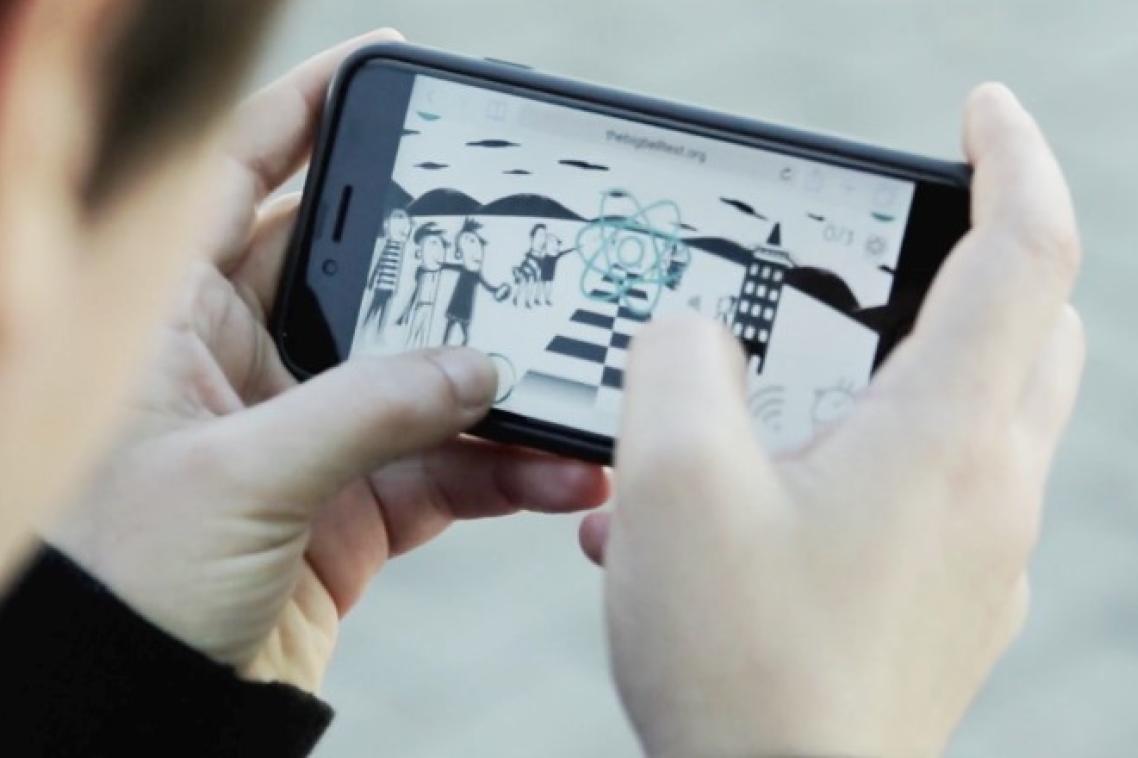
More than half a million levels of a video game have provided random data for a global study testing the laws of quantum physics.
University of Queensland’s ARC Centre of Excellence for Engineered Quantum Systems (EQUS) was one of 12 laboratories from five continents to participate in the Big Bell Test, coordinated by the Institute of Photonic Sciences (ICFO) in Barcelona.
EQUS Director Professor Andrew White said 100,000 participants generated more than 90 million human-generated random numbers, tripling expectations.
“People are unpredictable, and when using smartphones even more so,” Professor White said
“We asked folk to contributed unpredictable numbers, using smartphones and so on.
“These random bits then determined how various entangled atoms, photons, and superconductors were measured in the experiments, closing a stubborn loophole in tests of Einstein’s principle of local realism.”
Lead author Martin Ringbauer said local realism – the idea that quantum behaviour can be explained by cause and effect – is a tenet of classical physics, but there is growing evidence the quantum world does not obey these rules.
“Each of the labs carried out a different experiment, to test local realism in different physical systems, and test other concepts related to realism.”
The EQUS team, led by Dr Martin Ringbauer and Professor White, studied human-generated random numbers to test quantum entanglement in time.
“We showed that a key property of entanglement in space, so-called monogamy of entanglement, does not hold in the temporal domain,” Dr Ringbauer said.
“There are still many open questions, and this experiment is a first step towards exploring quantum correlations in time: one suggested application is in quantum blockchain.”
The results are reported in Nature.
Media: Professor Andrew White, Director, director@equs.org, or Tara Roberson, EQUS Communications, t.roberson@uq.edu.au, +61 404 516 635.
Watch Dr Martin Ringbauer explaining some of the research in the EQUS video: Meet Alice, Bob and Charlie.
Topics
Related articles

From birdsong to galaxies: unleashing the potential of citizen science
