
Renewed partnership to tackle world challenges
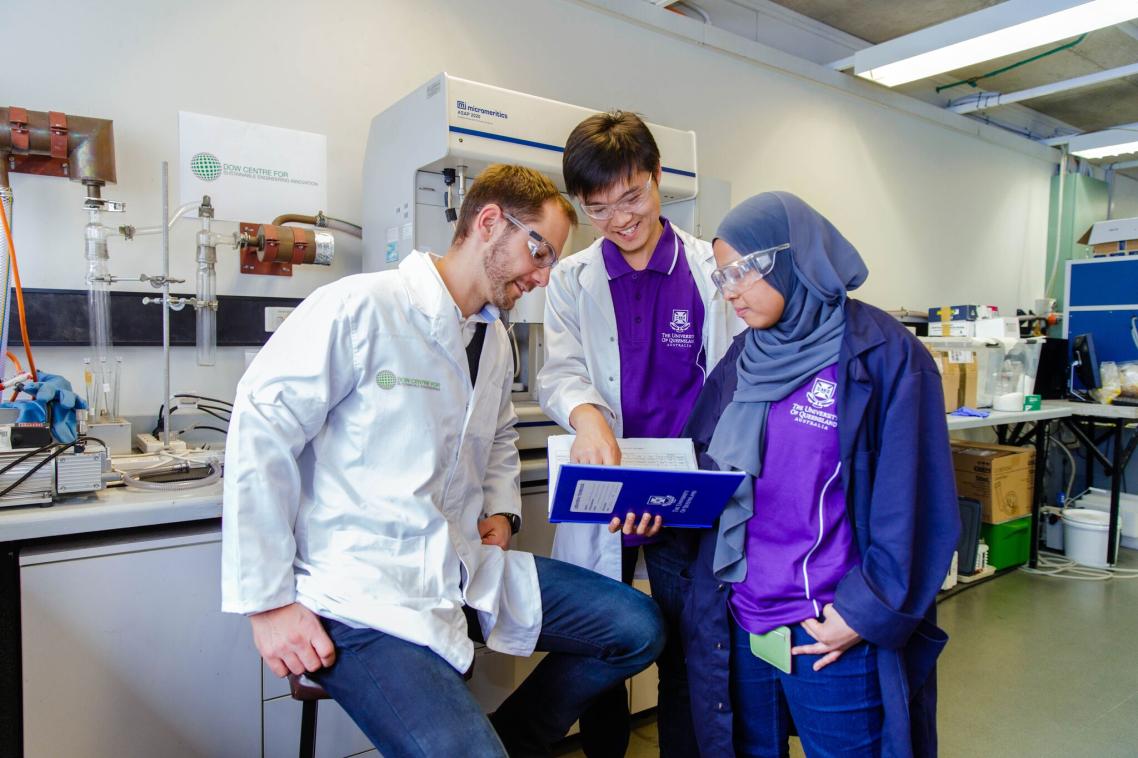
A $4.4 million investment from the Dow Chemical Company will power University of Queensland (UQ) research to deliver new technologies and processes to improve the sustainable production and use of chemicals, energy, transportation, and other key areas of focus for both the Company, University and societal needs.
UQ Vice-Chancellor and President Professor Peter Høj said the contribution builds on UQ’s longstanding partnership with Dow that has already delivered innovative research in low-carbon dioxide (CO2) steel and next-generation fertilisers.
“Dow’s investment will help cultivate the next generation of innovators and support the UQ Dow Centre for Sustainable Engineering Innovation’s work to push the frontiers of economically and environmentally sustainable research with global impact,” Professor Høj said.
The UQ Dow Centre has operated since 2014, thanks to a US$10 million donation from the Dow Chemical Company.
Jim McIlvenny, President of Dow Asia Pacific, said the Dow Centre at UQ had produced excellent outcomes.
“The Dow Centre has become a hub of excellence for collaborative research across diverse fields, generating potential solutions to some of the biggest issues facing society,” Mr McIlvenny said.
“The collaboration joins those successful models Dow has invested in around the world, to help us to further address the technological needs in the economies in which we operate.”
The Dow Centre is focusing on three flagship programs that aim to make a significant contribution to global sustainability by creating solutions for the production and use of energy and materials.
Promising research breakthroughs at the centre include a new iron making process that decreases CO2 emissions, the Rapid Switch Project, and the development of fertilisers that decrease environmental degradation and impact on areas such as the Great Barrier Reef.
The new process for low CO2 steel development uses molten salts and natural gas to prevent the production of CO2 as a by-product of the ironmaking process.
This breakthrough, if scalable, could drastically reduce greenhouse gas emissions, as the steel industry is currently one of the largest industrial sources of CO2 and accounts for about six percent of global emissions.
Knowing that deep decarbonisation will require abrupt and dramatic change to the global economy, the Rapid Switch Project involves collaborating with leading research and industry partners in the USA, China, India and Europe, to identify and overcome key bottlenecks that will otherwise constrain the critical transitions that are required.
Through targeted controlled release biocomposites formulations, researchers at the Dow Centre are also developing cost-effective and environmentally sustainable alternatives to commercial fertilisers.
These new formulas will reduce the amount of run-off that makes its way to our streams and oceans.
The $4.4 million Dow investment will support the continuation of these projects and the development of new solutions that tackle threats to global sustainability.
It will be further leveraged by a recent $6 million allocation towards the establishment of the Dow Chair in Sustainable Engineering Innovation — a prestigious research and teaching position in the School of Chemical Engineering.
“UQ’s School of Chemical Engineering is ranked number one in Australia in the 2018 QS World University Rankings, and the Dow Chair will build on this standing by enhancing our talent and research in chemical engineering and related fields,” Professor Høj said.
MEDIA: Mikaeli Costello, mikaeli.costello@uq.edu.au, +61 (0) 401 580 685.
Topics
Related articles

UQ to support development of mobile launcher for high-speed flight R&D
