
Ancient enzymes the catalysts for discoveries
University of Queensland-led research recreating 450 million-year-old enzymes has resulted in a biochemical engineering ‘hack’ which could lead to new drugs, flavours, fragrances and biofuels.
Professor Elizabeth Gillam from UQ’s School of Chemistry and Molecular Biosciences said the study showed ancient enzymes could survive high temperatures and that this could help create chemicals cheaply and at scale.
“We looked at how we could use a biological agent, like enzymes, to accelerate chemical reactions, as an alternative to current commercial processes,” Professor Gillam said.
“It’s often very difficult to make precise changes to complex chemicals, but this is essential in many industries, the pharmaceutical industry being a prime example.
“These methods often attack multiple sites on a chemical, so one ends up with a mixture of by-products, while often requiring a lot of energy and creating harmful waste.”
The team found enzymes that were more effective at higher temperatures and could be better, quicker and cheaper catalysts, using less energy and avoiding toxic chemicals.
“Naturally occurring enzymes do not survive for long enough to make this alternative competitive - so we came up with a hack,” Professor Gillam said.
“These enzymes’ pre-Cambrian-era-ancestors were able to survive great heat, when temperatures on Earth were around 60 degrees Celsius.
“We obtained all the gene sequences we could for a particular set of ancient enzymes, worked out their genetic evolutionary history and determined the most likely sequence of their common ancestor that would have existed in the earliest vertebrate animals.
“Then we recreated this gene, put it into a bacterium and tested the properties of the enzyme it encoded.”
“This means more ‘bang for your buck’ in a commercial process, but also improves environmental sustainability, and widens our understanding and use of enzymes in synthetic biology.
“The breadth of commercial applications is only limited by the imagination.
“For example, this discovery could advance fields like gene therapy or help remediate polluted environments – there’s a lot of work to do.”
The study has been published in Nature Catalysis (DOI: 10.1038/s41929-018-0159-5).
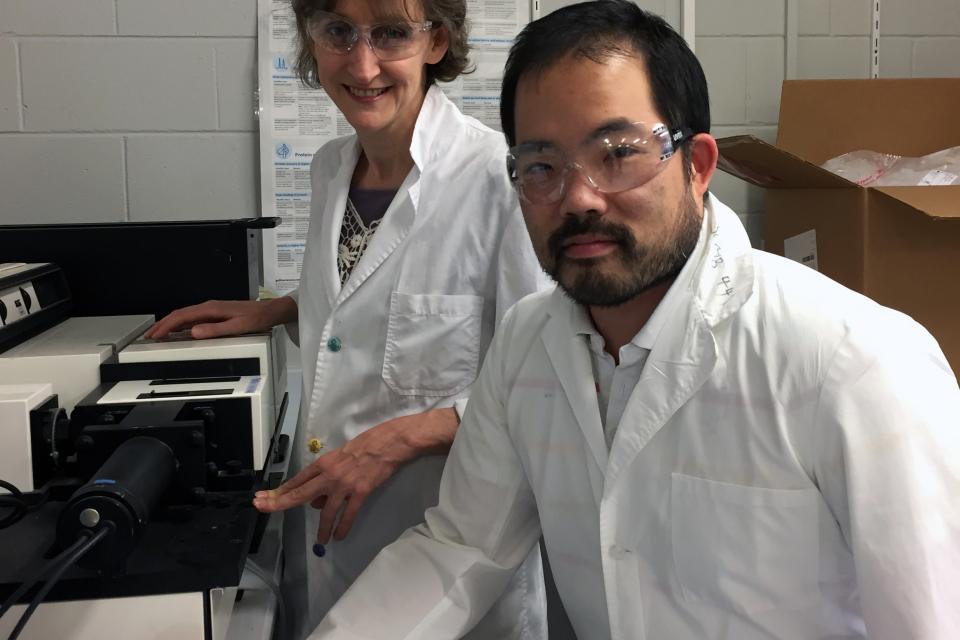
Image: (L-R) Professor Elizabeth Gillam and Jong-Min (Joseph) Baek.
Media: Professor Elizabeth Gillam, e.gillam@uq.edu.au; Dominic Jarvis, dominic.jarvis@uq.edu.au, +61 413 334 924.
Related articles

Mapping the green transition of Asia Pacific economies
