
Water quality changes set to make a splash
Environmental water quality is set to improve in Australia and New Zealand thanks to research transforming water quality guidelines.
The University of Queensland has been part of collaborative research effort to develop a new method to help set the maximum acceptable concentration of chemicals in waterways.
UQ School of Earth and Environmental Sciences researcher Dr Michael Warne said the work, which would help protect aquatic ecosystems, was part of a revision of the Australian and New Zealand Guidelines for Fresh and Marine Water Quality.
“Australia and New Zealand are leading the way with our new guidelines incorporating scientific developments since the year 2000, when they were last updated,” he said.
“We can now be much more confident that our waterway ecosystems will be protected.
“The new method is helping develop guidelines for approximately 60 high-priority chemicals, particularly pesticides, metals, industrial chemicals and pharmaceuticals.
“This means we can continue to make sure our waterways aren’t toxic to the thousands of species, from fish to microalgae, that we share these resources with.”
Dr Warne said his decades of work to clean Australia’s waterways was inspired by the book Silent Spring by Rachel Carson.
“It made me realise the importance of water quality to ecosystem health and the harmful effects of pesticides,” he said.
Dr Warne said there was still room for improvement.
“These guidelines are designed to protect organisms from the effects of individual chemicals, but organisms are generally exposed to mixtures of different chemicals,” he said.
“I’m now focusing my research, along with my colleagues from DES, on developing a method to estimate the effects of mixtures of chemicals.
“There’s simply no room for complacency, particularly with issues like the quality of water discharged on the Great Barrier Reef and the water quality in many urban waterways.
“We need to keep working towards better water quality, for not only our own sake, but for the life that thrives in our waterways.”
The project’s collaborative partners are the Queensland Department of Environment and Science (DES), CSIRO, the Environmental Research Institute of the Supervising Scientist, the NSW EPA, Environmetrics and the National Institute of Water and Atmospheric Research (New Zealand).
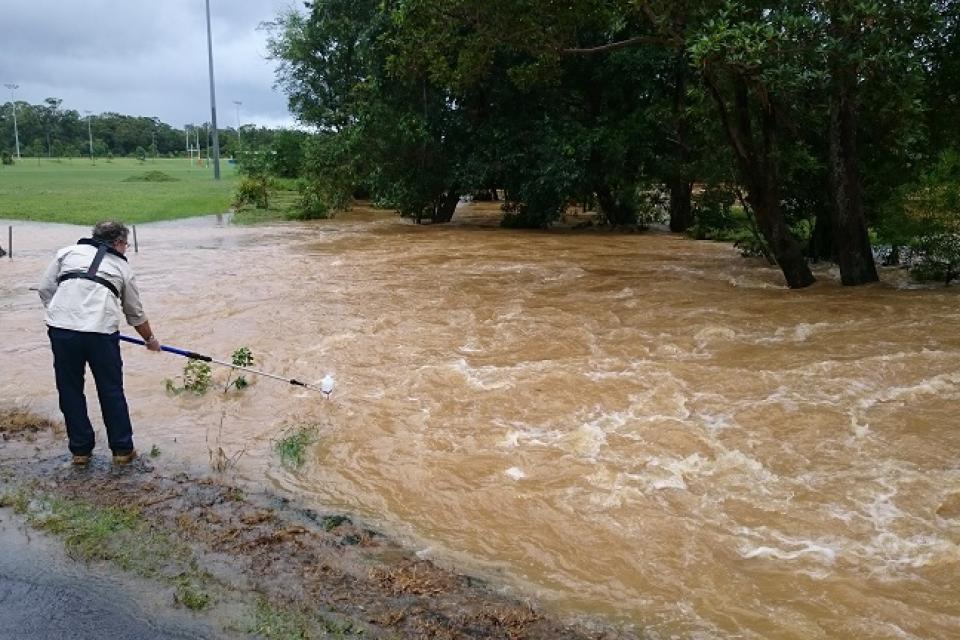
Image above left: Dr Michael Warne taking water samples in the field.
Media: Dr Michael Warne, michael.warne@uq.edu.au, +61 424 133 053; Dominic Jarvis, dominic.jarvis@uq.edu.au, +61 413 334 924.
Topics
Related articles

From birdsong to galaxies: unleashing the potential of citizen science
