
Partnership to supercharge vaccine production
Vaccines to stop the world’s next epidemic could be developed in record time under a $14.7 million partnership using technology developed at The University of Queensland.
The Coalition for Epidemic Preparedness Innovations (CEPI) has funded a research consortium to develop a rapid response pipeline to develop and test new vaccines in as little as 16 weeks.
The Australia Government has been an early supporter of CEPI by providing a previous contribution of $2 million, and UQ and CEPI are pleased to see a further contribution today of $4.5 million.
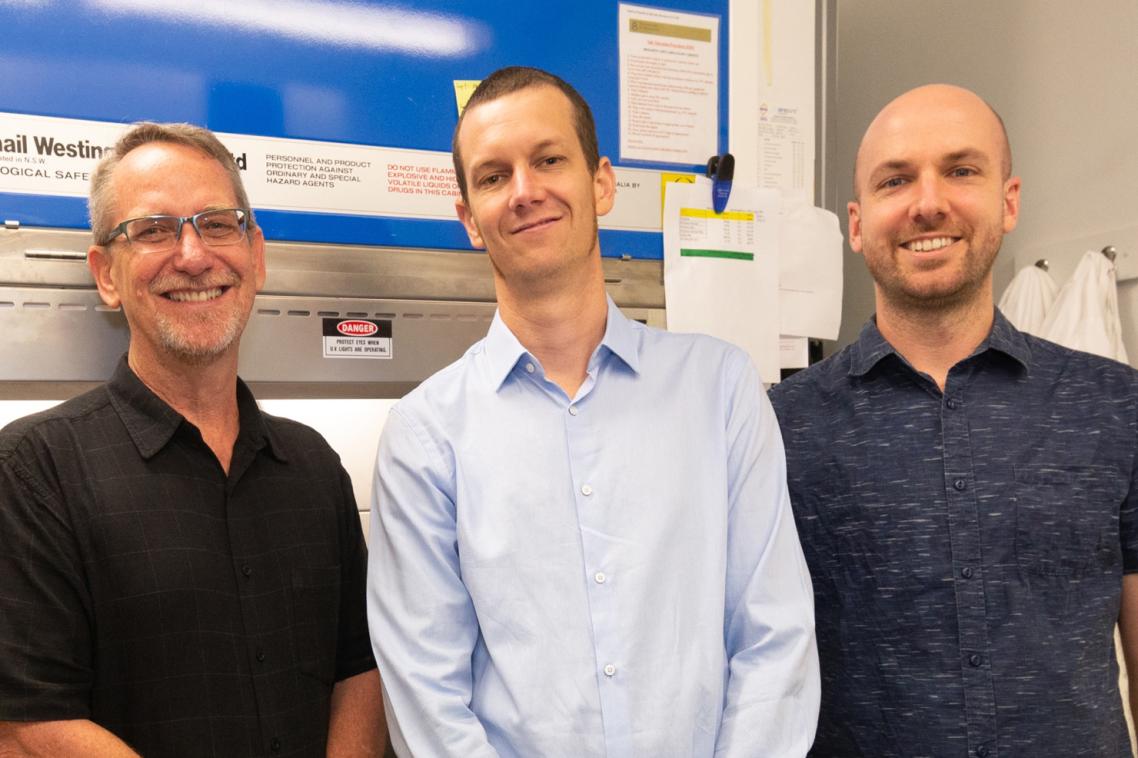
UQ’s Professor Paul Young and Dr Keith Chappell are leading the project, which has the potential to save millions of lives by targeting existing and new pathogens.
Vaccine Pipeline from The University of Queensland on Vimeo.
“The World Health Organization’s Blueprint list of priority diseases recognises that new epidemics can arise from known and unknown viruses – the latter referred to as ‘Disease X’,” Professor Young said.
“These new and emerging pathogens have the potential to reach global epidemic levels.”
Dr Chappell said the project was ambitious, as more conventional approaches could take years or even decades.
“We aim to be able to manufacture more than 200,000 doses of a new vaccine, demonstrate safety and the likelihood of efficacy, and be ready for field deployment in as little as six months,” he said.

“The technology has been designed as a platform approach to generate vaccines against a range of human and animal viruses,” Professor Young said.
“We’ve had some extremely promising results so far from trials targeting viruses such as influenza, Ebola, Nipah and MERS coronavirus.”
Dr Watterson said the collaboration would act as an insurance policy against deadly outbreaks caused by the emergence of viral epidemics or pandemics.
“By rapidly creating vaccines to these new threats, we’ll be able to quickly limit the spread of disease and diffuse potentially catastrophic situations.
“Molecular clamp technology has the potential to address some of today’s most devastating diseases and to fundamentally change how we protect ourselves from common diseases.”
The collaboration involves UQ, the CSIRO, the World Health Organization’s Collaborating Centre for Reference and Research on Influenza (WHO-CC), the Australian National University (ANU), Hong Kong University (HKU) and Q-Pharm Pty Ltd.
The technology has been patented by UniQuest, UQ’s commercialisation company.
Media: Professor Paul Young, p.young@uq.edu.au, +61 423 565 446; Dr Keith Chappell, k.chappell@uq.edu.au, +61 406 644 435; Dominic Jarvis, dominic.jarvis@uq.edu.au, +61 413 334 924.
Topics
Related articles

Sick of being told to ‘just lose weight’? Health promotion shouldn’t come with weight stigma
