
Physicists mash quantum and gravity and find time, but not as we know it
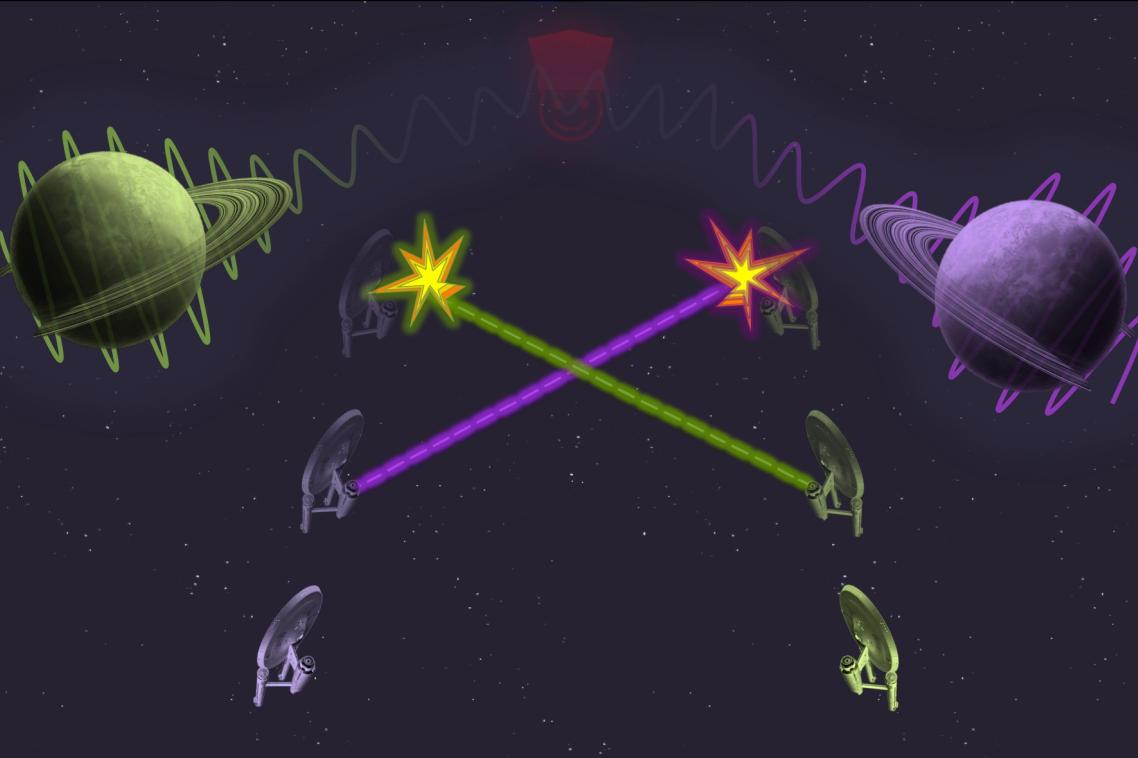
A University of Queensland-led international team of researchers say they have discovered “a new kind of quantum time order”.
UQ physicist Dr Magdalena Zych said the discovery arose from an experiment the team designed to bring together elements of the two big – but contradictory – physics theories developed in the past century.
“Our proposal sought to discover: what happens when an object massive enough to influence the flow of time is placed in a quantum state?” Dr Zych said.
She said Einstein’s theory described how the presence of a massive object slowed time.
“Imagine two space ships, asked to fire at each other at a specified time while dodging the other’s attack,” she said.
“If either fires too early, it will destroy the other.”
“In Einstein’s theory, a powerful enemy could use the principles of general relativity by placing a massive object – like a planet – closer to one ship to slow the passing of time.”
“Because of the time lag, the ship furthest away from the massive object will fire earlier, destroying the other.”
Dr Zych said the second theory, of quantum mechanics, says any object can be in a state of “superposition”
“This means it can be found in different states – think Schrodinger’s cat,” she said.
Dr Zych said using the theory of quantum mechanics, if the enemy put the planet into a state of “quantum superposition”, then time also should be disrupted.
“There would be a new way for the order of events to unfold, with neither of the events being first or second – but in a genuine quantum state of being both first and second,” she said.
UQ researcher Dr Fabio Costa said although “a superposition of planets” as described in the paper -- may never be possible, technology allowed a simulation of how time works in the quantum world – without using gravity.
“Even if the experiment can never be done, the study is relevant for future technologies,” Dr Costa said.
“We are currently working towards quantum computers that – very simply speaking – could effectively jump through time to perform their operations much more efficiently than devices operating in fixed sequence in time, as we know it in our ‘normal’ world.”
Stevens Institute of Technology and the University of Vienna scientists were co-authors on Bell’s Theorem for Temporal Order, published in Nature Communications, 10.1038/s41467-019-11579-x.
Contact: Dr Magdalena Zych, m.zych@uq.edu.au, +61 475 058 394, +61 7 3346 7348.
Topics
Related articles

Fishmeal alternative aims to protect marine wildlife from overfishing
