
$125m Warwick Solar Farm powers UQ to 100 per cent renewable
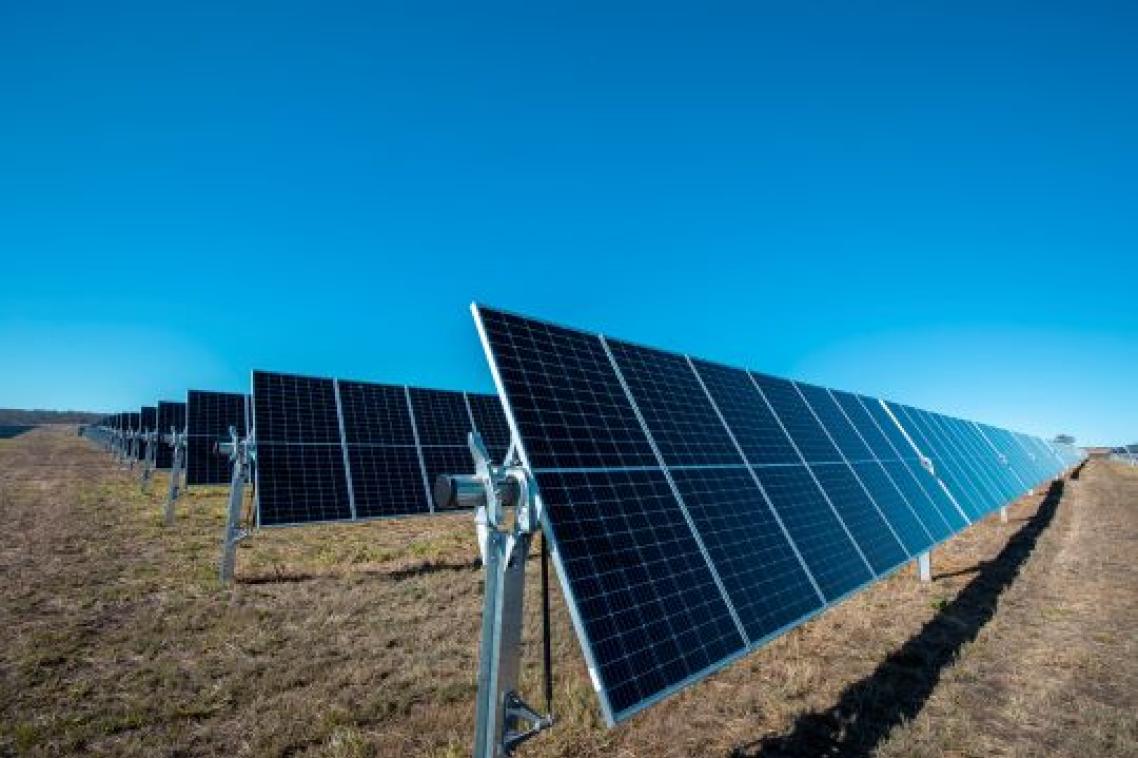
Australia’s renewable energy research capacity has been boosted with the completion of The University of Queensland’s 64 megawatt solar farm at Warwick in the state’s south east.
UQ is the first major university in the world to offset 100 per cent of its electricity use with its own renewable power.
UQ Vice-Chancellor and President Professor Peter Høj AC said as the world demanded more energy for human wellbeing and economic development, renewables would have to provide a greater proportion of that energy production.
“The Warwick Solar farm is first and foremost an act of leadership that demonstrates that a transition to renewables can be done at scale, that’s practicable and makes economic sense,” Professor Høj said.
“The power generated at Warwick, in addition to 7 megawatts produced at Gatton and St Lucia, will make us the first major university in the world to offset 100 per cent of our electricity use with renewable power produced from our own assets.
“The output of Warwick Solar Farm will be about 160GWh per annum – the equivalent of powering more than 25,000 households or reducing coal consumption by more than 60,000 tons.
"This isn’t just an economic choice; industry and government look to us for expertise and leadership in renewable technologies and this asset will support a wide range of current and emerging research and industry partnerships across a broad array of disciplines.
“The generation profile of the solar farm provides an ideal opportunity for piloting emerging battery energy storage or hydrogen conversion technologies.
“It will keep our teaching and research at the forefront of the booming renewables industries, aided by the University’s own large operational investments into sustainable engineering technologies over the past decade or more.”

Professor Høj said UQ published data from its solar installations online and would continue to do so with the new solar farm, as well as sharing its knowledge among government and industry including commercial operators.
“When it comes to climate change, we all share the responsibility and the consequences, and so we need to be acting in a way that is informed by research and with collaboration in mind,” he said.
“With solar technology becoming increasingly affordable in the past decade, the economics of solar photovoltaic power are increasingly compelling and we look forward to developing collaborations with industry partners who wish to pilot and prove innovative new energy solutions.”
Faculty of Engineering, Architecture and Information Technology Executive Dean Professor Vicki Chen said the booming renewables sector offered good graduate careers.
“Each year we enrol around 1000 first-year Engineering students and ‘work-integrated learning’, or industry placement, is integral for them during their degrees and the opportunities in the renewables industry are vast,” Professor Chen said.
“Many of our Engineering students have been fascinated to learn about UQ’s own operational moves into renewable energy, including the Warwick Solar Farm.
“The Master of Sustainable Energy students also see it as a privilege to see UQ’s own renewable energy assets up close and to work hands-on with our own data.”
Last November Australasian Campuses Towards Sustainability presented UQ with a coveted Green Gown Award for ‘commitment to sustainability through the Warwick Solar Farm project’.
UQ is committed to being a global leader in sustainability and is a signatory of the Talloires Declaration.
Download photos from the opening event.
Read more about how organisations can invest in emissions reduction on The Conversation.
Related articles

Supercharged 'molecule highway' could transform industrial processing
