Skip to menu Skip to content Skip to footer
News

Genetic link between cattle temperament and autism
28 August 2020
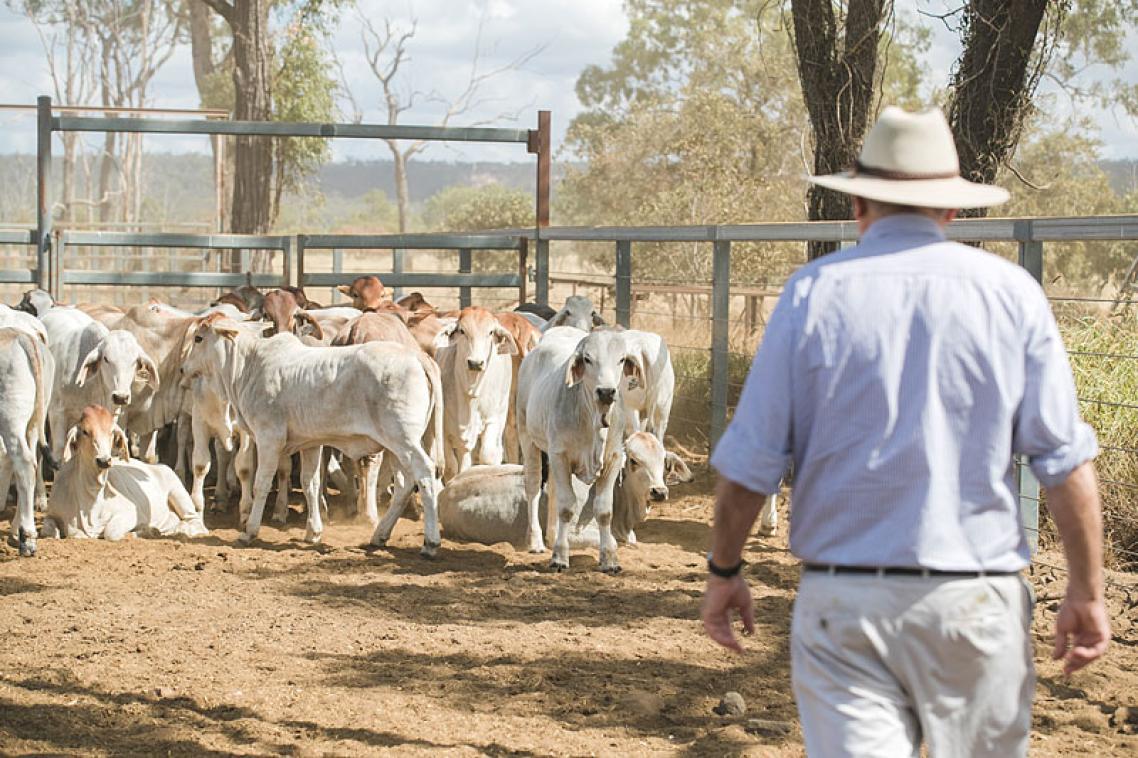
Cattle yards outside of Rockhampton, Central Queensland. (Photo supplied QAAFI).

A strong association between the genes influencing cattle temperament and autism in humans has been discovered by University of Queensland researchers.

UQ genomic expert Professor Ben Hayes said the research by his interdisciplinary team headed by Dr Roy Costilla could lead to improved animal welfare and meat quality.

“The research doesn’t mean that cattle have autism; rather that cattle share an overlap of genes with humans which are critical in brain function and response to fear stimuli,” Professor Hayes said.

“Temperament is an important trait for day-to-day management of cattle.

“We knew that genetic factors were likely to influence temperament in cattle, and we thought that genes involved in behavioural traits in humans could also influence temperament in cattle.

“We found that genes known to contribute to autism spectrum disorders also influence temperament in cattle.”

Professor Hayes said the results were important as it opened the way for research conducted on behavioural traits in humans to shed further light on temperament in cattle.

“As I’ve found talking to farmers over the years, it can be distressing having an animal that has a poor temperament in the mob, and stirs up all the other cattle putting them into a state of stress,” he said.

“If we can identify those animals early, or breed to eliminate them, we can potentially reduce the stress of the whole mob.

“That has great implications for welfare – not only of the cattle but also the people handling the cattle who are less likely to be charged or kicked.”

Professor Hayes said there was an association between a calmer temperament in cattle and better meat quality.

“The cattle industry’s standard for measuring temperament is ‘flight time’ – the speed in which cattle move after release from an enclosure,” Professor Hayes said.
Decorative
“What a producer wants is cattle that move calmly and slowly from the enclosure, rather than an animal that charges out in an aggressive or stressed state.

“Our study found flight time is about 35 percent heritable, which is very significant.

“It means you can make a lot of progress by breeding for better temperament – it’s about the same as milk production in dairy cattle, and we’ve made big breeding gains there.”

Professor Hayes said the same genes were identified in other genomic research conducted on domestication of foxes.

“The same genes just come up again and again,” he said.

“Some DNA variants in those genes are more common in people with autism and, in cattle, some DNA variants in those same genes are found to make the cattle more fearful in new situations and have a reactive temperament.”

It’s the first time whole genome sequencing has been used to analyse temperament in beef cattle.

Researchers looked at 28 million data points per animal on the 9,000 cattle with temperament records in the initial study, and then validated the results in over 80,000 cattle from Ireland.

Professor Hayes said his team would incorporate the temperament data into a panel of markers available for producers that would also provide breeding values for fertility.

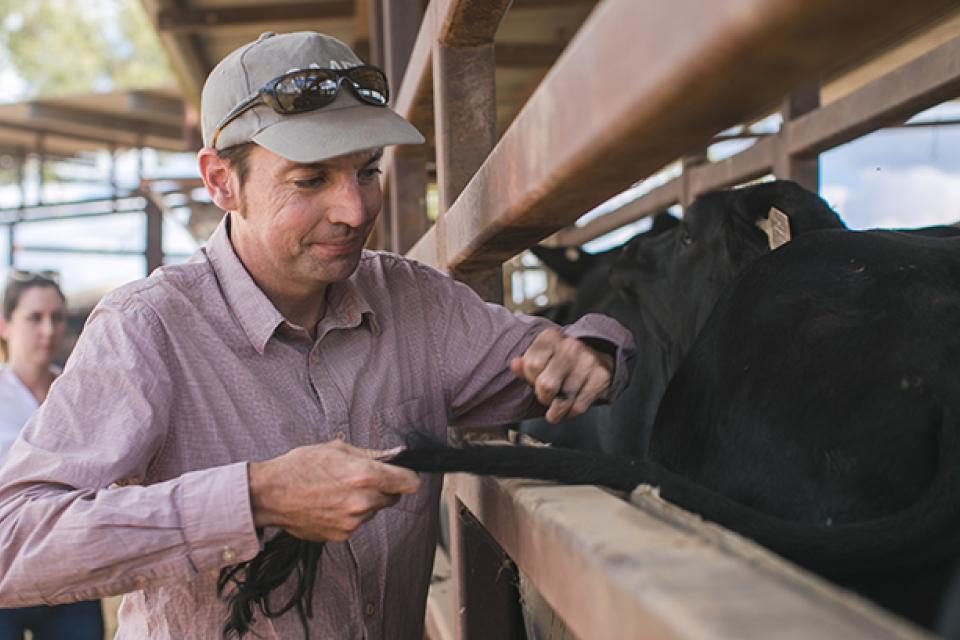
“It means a producer will be able to use a sample of tail hair which contains DNA to quickly get information on the genetic value of their animals for temperament and fertility. 

The temperament analysis was conducted primarily in northern cattle Bos indicus breeds and was validated in Bos taurus cattle. 

The study was a result of strong cooperation between Australian researchers, the beef industry and international collaborators from Ireland and Brazil.   

The research is published in Genetics Selection Evolution (DOI: 10.1186/s12711-020-00569-z).

Image above: UQ's Professor Ben Hayes, Director Centre for Animal Science, Queensland Alliance for Agriculture and Food Innovation (QAAFI) (Photo supplied QAAFI). 

Media: Professor Ben Hayes, b.hayes@uq.edu.au, +61 (0) 434 210 890; UQ’s QAAFI communications, m.puls@uq.edu.au, +61 (0) 419 578 356.

Related articles

Three researchers wearing blue protective lab gowns stand among rows of potted chickpea plants inside a controlled-environment plant research facility.

Turning up the heat on chickpea yield

A University of Queensland study has outlined a practical pathway for accelerating the development of heat adapted chickpeas using data from new ‘omic’ technologies. PhD candidate Callum Jamie said the suite of technologies offered tremendous opportunities to understand how a complex trait like heat tolerance works. “The narrow genetic diversity in the elite chickpea gene pool has limited conventional breeding’s effectiveness for stress tolerance,” Mr Jamie said. “These technologies have improved our capacity to dissect trait architecture and phenotype secondary traits but their use in chickpeas has been limited.” The technologies include genomics, epigenomics, transcriptomics, proteomics, metabolomics, phenomics and enviromics, and help provide a comprehensive picture of biological systems. Epigenomics helps understand what controls gene activity; transcriptomics considers gene expression; proteomics protein production; metabolomics looks at biochemical processes; phenomics observes traits; and enviromics considers environmental factors influencing outcomes. Mr Jamie said previous studies had focused on just 1 to 2 -omic datasets, a small number of genotypes, and single tissues. This has meant it was hard to infer what results meant for trait architecture and mechanisms and the ability to extrapolate the information to breeding populations was limited. There have also been challenges around cost, scalability and integrating very different types of data to make the technologies useful. To overcome the hurdles, Mr Jamie’s research at the Queensland Alliance for Agriculture and Food Innovation has resulted in a proposed staged approach. It would start with genomic prediction and phenotyping, before adding -omic layers as costs fall and unknowns were resolved. “These technologies are novel and we still don’t know which information provides added value and how best to integrate all of this data to achieve an outcome,” Mr Jamie said. His PhD is supported by the Grains Research and Development Corporation (GRDC) and the International Research Training Group (IRTG) Accelerating Crop Genetic Gain and is aligned to a project which aims to fast-track the development of chickpea varieties adapted to high temperatures. Project leader Dr Millicent Smith said heat stress causes severe yield implications through flower and pod loss, reduced pollen viability and impaired grain filling. “Late sown chickpea is particularly in the firing line across most of Australia's crop in southern Queensland and northern New South Wales,” Dr Smith said. “We want to ensure that Australian growers maintain their competitive edge. “New varieties with improved genetics to cope with heat stress are essential for the future. “This work, suggesting a staged approach to utilising the new -omic technologies, is an exciting frontier.” The research was published by Food and Energy Security. Callum Jamie’s PhD is supported by the Grains Research and Development Corporation (GRDC) and the International Research Training Group (IRTG) Accelerating Crop Genetic Gain.
15 October 2026
Alt text goes here

Unlocking AI as a research tool for plant microscopy

Software created by University of Queensland scientists could help AI platforms overcome a blind spot limiting their value in plant research.
30 September 2026

Media contact

Subscribe to UQ News

Get the latest from our newsroom.