Skip to menu Skip to content Skip to footer
News

Natural pest control saving billions
3 September 2020
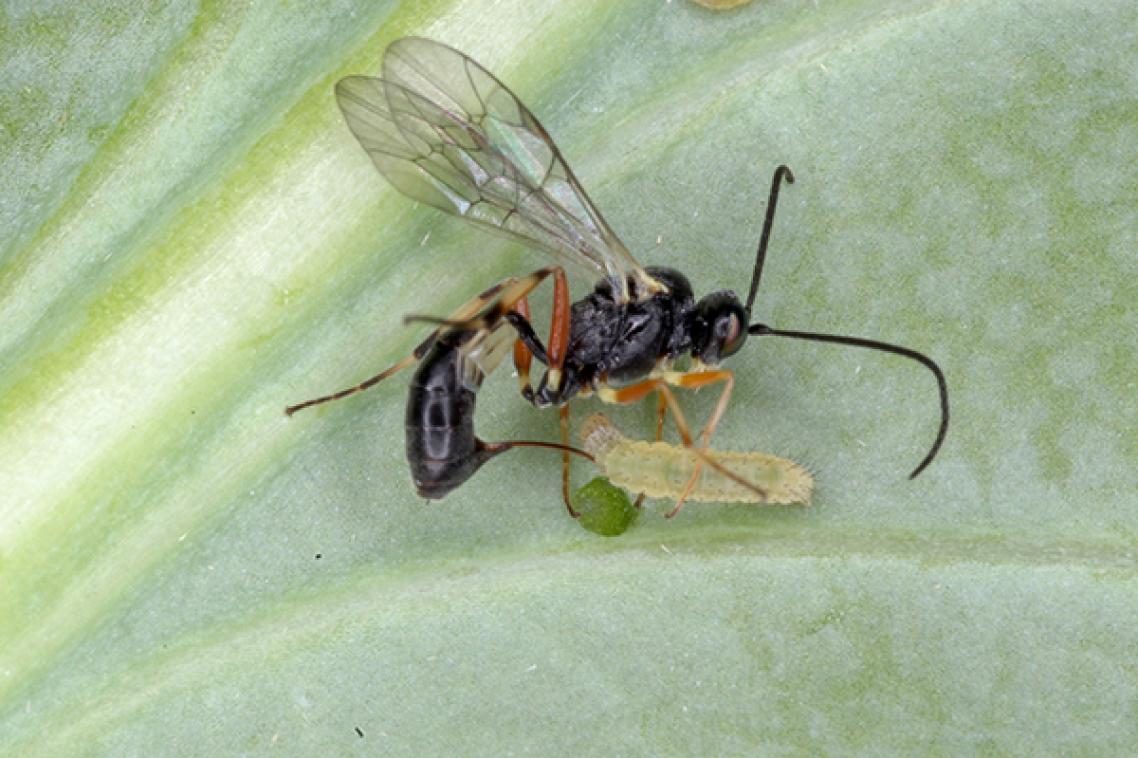
A close up of a parasitic wasp against a white background
A parasitic wasp (biological control agent) injects an egg into a pest caterpillar. The wasp will develop inside the caterpillar, eventually killing it.

Biological control of insect pests – where ‘natural enemies’ keep pests at bay – is saving farmers in Asia and the Pacific billions of dollars, according to University of Queensland-led research.

Dr Kris Wyckhuys from UQ’s School of Biological Sciences said biological control involved the careful release of an exotic natural enemy from a pest's native habitat.

“Scientists meticulously choose co-evolved beneficial insects that are the most effective and least likely to pose ecological upsets,” Dr Wyckhuys said.

“We’ve reviewed how biological control introductions have effectively managed 43 insect pests in food, feed and fibre crops in the Asia-Pacific region over a century.”

The team found that biological control has helped regulate invasive pest threats in multiple key food crops such as banana, breadfruit and coconut.

“Our work shows these techniques are saving farmers in Asia around $20.1 billion to $26.8 billion (US$14.6-19.5 billion) per year,” Dr Wyckhuys said.

“That’s a phenomenal amount of money and benefit, particularly when compared to other innovations in the agricultural sector.

“A good point of comparison is the Green Revolution in Asia during the late 1960s, which tripled the output of local rice production but also saw a rise of chemical fertilisers, agrochemicals and newer methods of cultivation.

“A large part of the Green Revolution impacts can be ascribed to double-yielding rice varieties, which generated $4.8 billion (US$4.3 billion) per year in Asia.”

UQ’s Associate Professor Michael Furlong said recognition of the success of biological control might lead to greater uptake and more resilient, prosperous farming globally.

“Biological control offers great opportunities for some of the world’s poorest farmers,” Dr Furlong said.

“It’s promoted rural growth and prosperity even in marginal, poorly endowed, non-rice environments.

“A great example is the coconut scale (Aspidiotus destructor), which jeopardised the economic prosperity and food security of entire nations.

“This coconut scale posed a serious problem to crops like coconut, bananas and copra industries in Fiji at the start of the Twentieth Century.

“In 1928, lady beetles from Trinidad and millimetre-long parasitic wasps were introduced, and the results were almost immediate.

“Coconut scale ceased to be an economic issue on all of the main Fijian islands within nine months, and after 18 months, the scale was so rare it was difficult to find.

“These innovative approaches, with increasingly better science, are helping feed the world, safeguard on-farm biodiversity and increase farmers’ quality of life.

“We’re hoping this research provides lessons for future efforts to mitigate invasive species, restore ecological resilience, and sustainably increase the output of our global food system.”

The research has been published in Nature Ecology and Evolution (DOI: 10.1038/s41559-020-01294-y).

Media: Associate Professor Michael Furlong, m.furlong@uq.edu.au, +61 418 159 762; Dr Kris Wyckhuys, k.wyckhuys@uq.edu.au, +84 842 597 495; Dominic Jarvis, Dominic.jarvis@uq.edu.au, +61 413 334 924.

Related articles

Three researchers wearing blue protective lab gowns stand among rows of potted chickpea plants inside a controlled-environment plant research facility.

Turning up the heat on chickpea yield

A University of Queensland study has outlined a practical pathway for accelerating the development of heat adapted chickpeas using data from new ‘omic’ technologies. PhD candidate Callum Jamie said the suite of technologies offered tremendous opportunities to understand how a complex trait like heat tolerance works. “The narrow genetic diversity in the elite chickpea gene pool has limited conventional breeding’s effectiveness for stress tolerance,” Mr Jamie said. “These technologies have improved our capacity to dissect trait architecture and phenotype secondary traits but their use in chickpeas has been limited.” The technologies include genomics, epigenomics, transcriptomics, proteomics, metabolomics, phenomics and enviromics, and help provide a comprehensive picture of biological systems. Epigenomics helps understand what controls gene activity; transcriptomics considers gene expression; proteomics protein production; metabolomics looks at biochemical processes; phenomics observes traits; and enviromics considers environmental factors influencing outcomes. Mr Jamie said previous studies had focused on just 1 to 2 -omic datasets, a small number of genotypes, and single tissues. This has meant it was hard to infer what results meant for trait architecture and mechanisms and the ability to extrapolate the information to breeding populations was limited. There have also been challenges around cost, scalability and integrating very different types of data to make the technologies useful. To overcome the hurdles, Mr Jamie’s research at the Queensland Alliance for Agriculture and Food Innovation has resulted in a proposed staged approach. It would start with genomic prediction and phenotyping, before adding -omic layers as costs fall and unknowns were resolved. “These technologies are novel and we still don’t know which information provides added value and how best to integrate all of this data to achieve an outcome,” Mr Jamie said. His PhD is supported by the Grains Research and Development Corporation (GRDC) and the International Research Training Group (IRTG) Accelerating Crop Genetic Gain and is aligned to a project which aims to fast-track the development of chickpea varieties adapted to high temperatures. Project leader Dr Millicent Smith said heat stress causes severe yield implications through flower and pod loss, reduced pollen viability and impaired grain filling. “Late sown chickpea is particularly in the firing line across most of Australia's crop in southern Queensland and northern New South Wales,” Dr Smith said. “We want to ensure that Australian growers maintain their competitive edge. “New varieties with improved genetics to cope with heat stress are essential for the future. “This work, suggesting a staged approach to utilising the new -omic technologies, is an exciting frontier.” The research was published by Food and Energy Security. Callum Jamie’s PhD is supported by the Grains Research and Development Corporation (GRDC) and the International Research Training Group (IRTG) Accelerating Crop Genetic Gain.
15 October 2026
Close-up photograph of a red-bellied black snake coiled across pale, weathered wood. The snake has glossy black scales on its back and vivid red coloration along its sides and underside. The image highlights the texture of the scales and the contrast between the dark body and the light wood background.
Analysis

Deadly fungi are harming Australia’s wild reptiles. This is how to stop the spread

With spring underway and the weather warming, reptiles are on the move in suburbs, parks and bushland across Australia. Snake catchers and wildlife carers are responding to calls for help, and reptile enthusiasts – known as “herpers” – are heading outdoors in search of their next sighting.
13 October 2026

Media contact

Subscribe to UQ News

Get the latest from our newsroom.