
Rice has many fathers but only two mothers
Researchers investigating the heritage of thousands of rice varieties have identified just two distinct maternal lineages, a discovery which could help address the issue of global food security.
University of Queensland scientists studied more than 3000 rice genotypes and found diversity was inherited through two maternal genomes identified in all rice varieties.
Lead researcher UQ’s Professor Robert Henry said the finding was important in understanding how rice adapted to its environment.
“We think there were two separate domestications of virgin wild plants that diverged around a million years ago in the wild, and then in the last 7000 thousand years human domestication of rice has occurred,” Professor Henry said.
The two domesticated varieties interbred with the local wild rices throughout Asia.
“The wild rice has pollinated the domesticated rices planted nearby and the seed of the domesticated variety has then incorporated the genetics of the local wild varieties,” he said.
“The maternal lineage is preserved via the seed, and we’ve identified that because rice farmers have and still continue to collect the seed from the field, the local varieties become very much like the local wild rices.”
“It gives us clues as to how we might try to capture more of the diversity in the wild and bring it into the domesticated gene pool to improve rice crops,” he said.
“It also points to the need to understand the significance of the maternal genotype in terms of performance of rice because we did not previously understand there are two very distinct maternal functional types.”
Rice is the staple food of more than half of the world's population and is the third-largest worldwide agricultural crop, with more than 630 million tonnes produced annually.
“Now we’ve got an ongoing collaboration with mathematicians to try and find a way of analysing the rice data in more detail, we want to look at relationships between lots of different subgroups,” Professor Henry said.
“This would include examining how the Basmatis and the Japonicas really relate and the various types of Indica rices.”
The research is published in BMC Plant Biology.
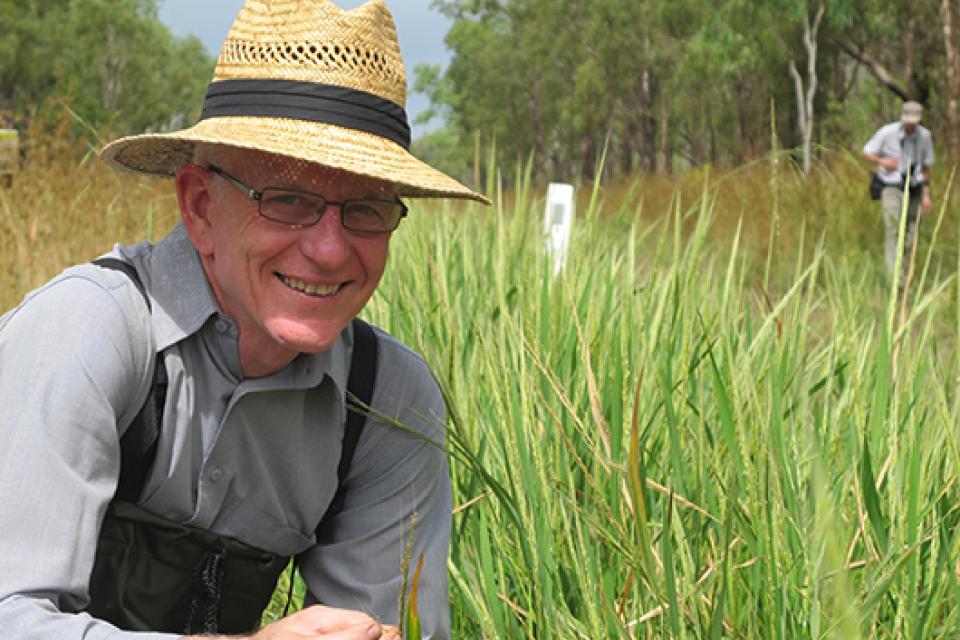
Image above: UQ researcher Professor Robert Henry
Media: Professor Robert Henry, robert.henry@uq.edu.au, +61 7 3443 0552; QAAFI Communications, Margaret Puls, m.puls@uq.edu.au, +61 (0) 419 578 356.
Related articles

UQ nutrition trial targets healthier piglets with fewer antibiotics
