
Truly astronomical: over half a billion celestial objects mapped
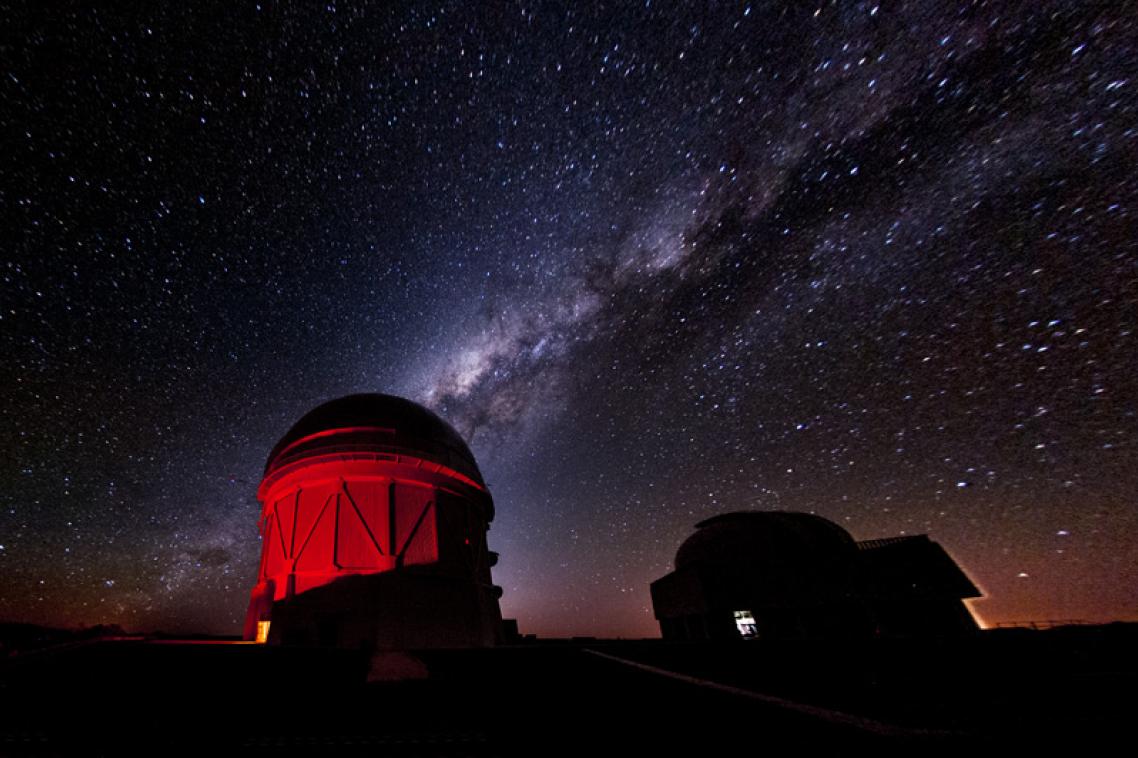
More than 690 million celestial objects have been catalogued, photographed and are now available online for exploration by the public, thanks to an international research collaboration.
In a collaboration including The University of Queensland, The Australian National University and researchers from around Australia, the Dark Energy Survey (DES) has released its second set of data, mapping roughly an eighth of the night sky and seeing far back in time to half the age of the known universe.
UQ’s Professor Tamara Davis, co-leader of the Australian venture (OzDES) with the ANU’s Dr Christopher Lidman, said the project was attempting to answer the big questions.
“’What is the universe made of?’, ‘how did it begin?’, ‘how will it end?’ and ‘how do the laws of physics work?’ – these are just some of the mind-boggling questions we hope to answer,” Professor Davis said.
“To tackle them, we’ve had to photograph and map the sheer vastness of the universe, not only in space, but far back in time, before Earth existed.
“For almost eight years we’ve been busy mapping hundreds of millions of galaxies and discovering thousands of supernovae.
“This extensive mapping allows us to measure the history of cosmic expansion and the growth of large-scale structure in the universe, both of which reflect the nature and amount of dark energy in the universe.
“I’m excited to use the data to investigate the nature of dark energy itself, which should reveal what’s behind the acceleration of the expansion of the universe.
“This is one of the biggest mysteries in science and although we haven’t solved it yet, with this new data we’re one step closer.”
The DES began observations in 2013 with a state-of-the-art astronomical camera fixed on a four-metre aperture telescope in Chile.

To better analyse exact distance and composition of captured objects, the Anglo-Australian Telescope (AAT) — a similar telescope to the one used in Chile – partnered with the project.
Now, via a site hosted by the US’s Community Science and Data Center, the public will be able to access DES information on the position, shape, size, colour and brightness of over 690 million stars, galaxies and quasars.
“The data promises to be a valuable source for astronomers and scientists worldwide to continue their explorations of the universe,” Professor Davis said.
“And they no longer have to cover the ‘astronomical’ costs of hosting enormous astronomical data sets on their own computer server.
“Professional and amateur scientists alike are able to dig into this rich mine of astronomical gems – I’m excited to see what they’ll discover.”
ANU’s Professor Chris Lidman said the data release was the result of hundreds of researchers from many countries working together over two decades to achieve a common goal.
“It’s amazing what can be achieved when people work together,” he said.
“And it was especially pleasing to see the large number of students and young researchers, both here in Australia and overseas, that were involved in the project.
“Perhaps the greatest legacy of DES will be the number of students and young researchers that will go into jobs related to science and technology.”
The data is available to access now here.
The AAT is operated by the ANU on behalf of a consortium of 13 Australian universities, and collaborating organisations and sponsors for the DES are listed on the DES website.
Media: Professor Tamara Davis, tamarad@physics.uq.edu.au, +61 432 526 989; Dominic Jarvis, dominic.jarvis@uq.edu.au, +61 413 334 924.
Topics
Related articles

UQ to support development of mobile launcher for high-speed flight R&D
