Skip to menu Skip to content Skip to footer
News

Ancient art reveals extinct goose
23 February 2021
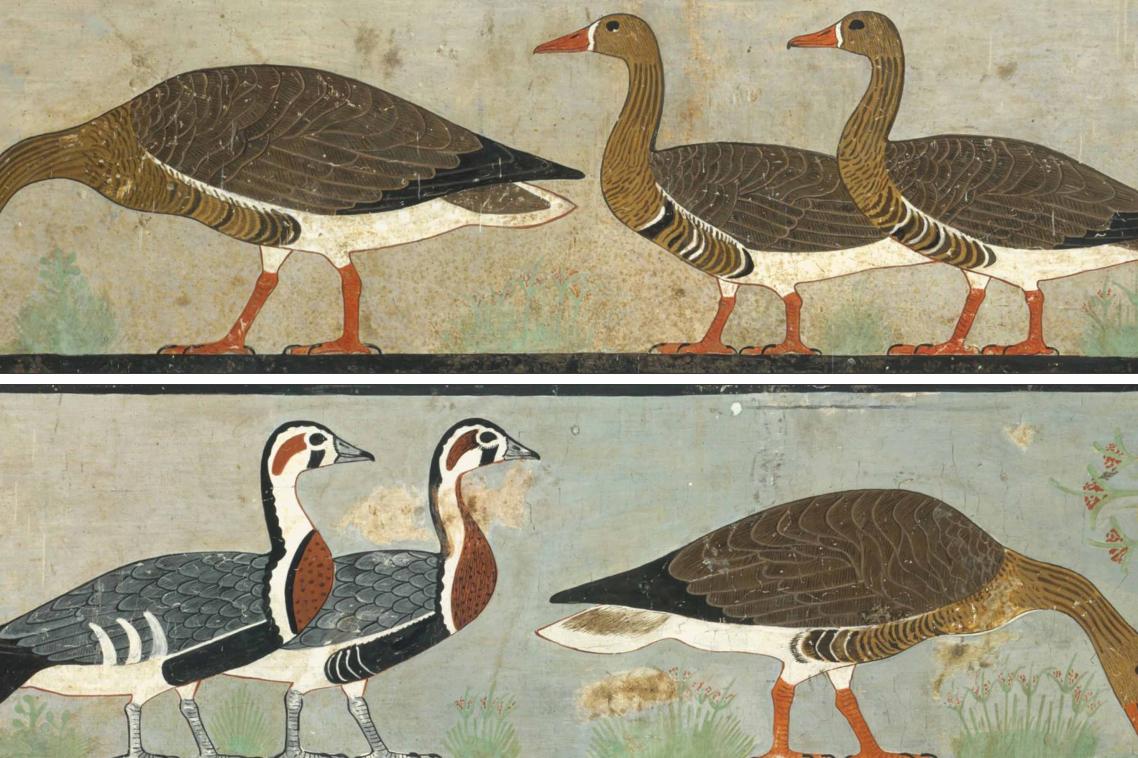
Image above: ‘Meidum Geese’, Chapel of Itet, mastaba of Nefermaat and Itet (Dynasty 4), Meidum, Egypt. Image: C.K. Wilkinson.

As a University of Queensland researcher examined a 4600-year-old Egyptian painting last year, a speckled goose caught his eye.

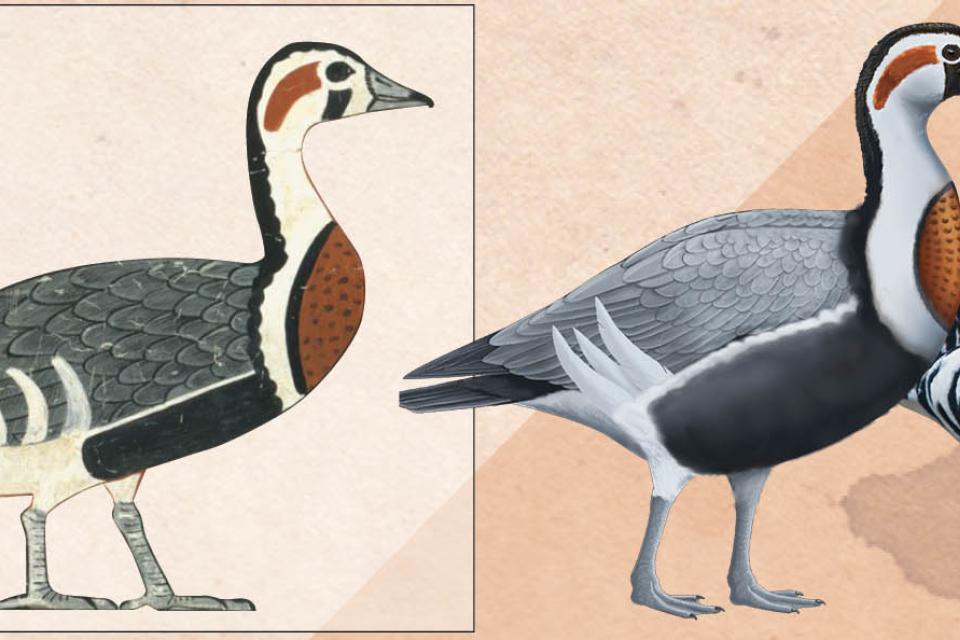
UQ scientist Dr Anthony Romilio said the strange but beautiful bird was quite unlike modern red-breasted geese (Branta ruficollis), with distinct, bold colours and patterns on its body, face, breast, wings and legs.

“The painting, Meidum Geese, has been admired since its discovery in the 1800s and described as ‘Egypt’s Mona Lisa’,” he said.

“Apparently no-one realised it depicted an unknown species.

“Artistic licence could account for the differences with modern geese, but artworks from this site have extremely realistic depictions of other birds and mammals.”

Dr Romilio said no bones from modern red-breasted geese (Branta ruficollis) had been found on any Egyptian archaeological site.

“Curiously, bones of a similar but not identical bird have been found on Crete,” he said.
Decorative
“From a zoological perspective, the Egyptian artwork is the only documentation of this distinctively patterned goose, which appears now to be globally extinct.”

Dr Romilio said extinct animals had been identified previously in ancient art, but not all the species had been scientifically confirmed.

“I applied the Tobias criteria to the goose, along with other types of geese in the fresco,” he said.

“This is a highly effective method in identifying species – using quantitative measurements of key bird features – and greatly strengthens the value of the information to zoological and ecological science.”

Dr Romilio said Egypt was not always predominantly desert and had “a biodiverse history, rich with extinct species”.

“Its ancient culture emerged when the Sahara was green and covered with grasslands, lakes and woodlands, teeming with diverse animals, many of which were depicted in tombs and temples,” he said.

“So far, science has confirmed the identity of relatively few of these species.”

Dr Romilio said the artwork he examined was from the tomb of Nefermaat and Itet at Meidum and was now in Cairo’s Museum of Egyptian Antiquities.

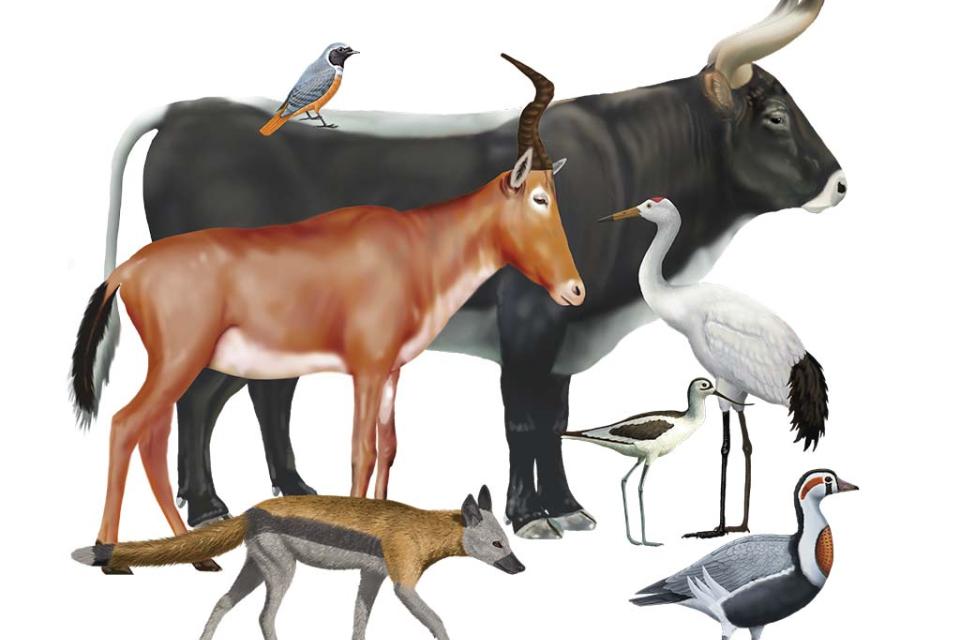
“Art provides cultural insight, but also a valuable, graphical record of animals unknown today,” he said.
Decorative

“These include the predecessor of modern cattle, the auroch (Bos primigenius), and previously unknown forms of gazelle, oryx, antelope and donkey. 

“These ancient animal representations help us recognise the biodiversity thousands of years ago that co-existed with humans.

“I see it also as a reminder of humans’ influence over the survival of species that are with us today.”

The research has been published in the Journal of Archaeological Science: Reports (DOI: 10.1016/j.jasrep.2021.102834).

Dr Romilio said myriad species with colour markings not matching those of modern animals were detailed in A Guide to Extinct Animals of Ancient Egypt.

Images (above right): Ancient goose depiction, photo CK Wilkinson, life reconstruction, A. Romilio, and modern species, photo Tambako the Jaguar. Above left: Life reconstructions from ancient Egyptian art that may depict extinct species. All from A Guide to Extinct Animals of Ancient Egypt.

Contact: Dr Anthony Romilio, a.romilio@uq.edu.au, +61 430 514 169; Dominic Jarvis, dominic.jarvis@uq.edu.au, +61 413 334 924.

Related articles

Hand-coloured drawing of the town of Hobart in the 1800s, depicting grassy plains, the beach and a small town in the distance.
Analysis

What was Australia’s first novel?

The first novel written and published in Australia is a multifaceted work of autobiographical and historical significance, a convict narrative and, arguably, Australia’s first work of crime fiction.
15 October 2026
Three researchers wearing blue protective lab gowns stand among rows of potted chickpea plants inside a controlled-environment plant research facility.

Turning up the heat on chickpea yield

A University of Queensland study has outlined a practical pathway for accelerating the development of heat adapted chickpeas using data from new ‘omic’ technologies. PhD candidate Callum Jamie said the suite of technologies offered tremendous opportunities to understand how a complex trait like heat tolerance works. “The narrow genetic diversity in the elite chickpea gene pool has limited conventional breeding’s effectiveness for stress tolerance,” Mr Jamie said. “These technologies have improved our capacity to dissect trait architecture and phenotype secondary traits but their use in chickpeas has been limited.” The technologies include genomics, epigenomics, transcriptomics, proteomics, metabolomics, phenomics and enviromics, and help provide a comprehensive picture of biological systems. Epigenomics helps understand what controls gene activity; transcriptomics considers gene expression; proteomics protein production; metabolomics looks at biochemical processes; phenomics observes traits; and enviromics considers environmental factors influencing outcomes. Mr Jamie said previous studies had focused on just 1 to 2 -omic datasets, a small number of genotypes, and single tissues. This has meant it was hard to infer what results meant for trait architecture and mechanisms and the ability to extrapolate the information to breeding populations was limited. There have also been challenges around cost, scalability and integrating very different types of data to make the technologies useful. To overcome the hurdles, Mr Jamie’s research at the Queensland Alliance for Agriculture and Food Innovation has resulted in a proposed staged approach. It would start with genomic prediction and phenotyping, before adding -omic layers as costs fall and unknowns were resolved. “These technologies are novel and we still don’t know which information provides added value and how best to integrate all of this data to achieve an outcome,” Mr Jamie said. His PhD is supported by the Grains Research and Development Corporation (GRDC) and the International Research Training Group (IRTG) Accelerating Crop Genetic Gain and is aligned to a project which aims to fast-track the development of chickpea varieties adapted to high temperatures. Project leader Dr Millicent Smith said heat stress causes severe yield implications through flower and pod loss, reduced pollen viability and impaired grain filling. “Late sown chickpea is particularly in the firing line across most of Australia's crop in southern Queensland and northern New South Wales,” Dr Smith said. “We want to ensure that Australian growers maintain their competitive edge. “New varieties with improved genetics to cope with heat stress are essential for the future. “This work, suggesting a staged approach to utilising the new -omic technologies, is an exciting frontier.” The research was published by Food and Energy Security. Callum Jamie’s PhD is supported by the Grains Research and Development Corporation (GRDC) and the International Research Training Group (IRTG) Accelerating Crop Genetic Gain.
15 October 2026

Media contact

Subscribe to UQ News

Get the latest from our newsroom.