
The science is in: Craft beer is unique

While it may irk some people to hear that the beer snobs are right, research has found that craft beer is scientifically unique when compared to mass-produced brews.
The University of Queensland’s Associate Professor Ben Schulz and PhD candidate Edward Kerr have used a technique called mass spectrometry proteomics to identify, quantify and characterise the proteins in 23 different styles and brands of beer.
“Craft beer was strikingly different to beer from multinational breweries,” Dr Schulz said.
“Our initial assumption was that there would be a difference between different styles of beers, such as lagers, pale ales, IPAs, and stouts, but the results proved otherwise.
“Surprisingly, it was only when we targeted our analysis on a single brewery to remove any variation, that we found any differences between beer styles.
“Proteins from yeast make craft beers distinct from beers from larger breweries – which may be due to different process scales, or to different styles of yeast.”
Dr Schulz said proteins played an important part in forming a beer’s sensory properties.
“Crisp, malty and bitter flavours, and floral and fruity aromas, are perhaps the first descriptions that come to mind when describing beer, but other sensory factors are just as important,” he said.
“The ‘beer proteome’ – or the full set of proteins in a beer – is critical in controlling these factors, and is dependent on the ingredients, the yeast used for fermentation, and the overall beer-making process.”
The mass spectrometry techniques allowed Dr Schulz and Mr Kerr to measure the beers’ complete set of proteins.
“Our research looked at what proteins are present and how much there is of each protein,” Mr Kerr said.
“Essentially, a mass spectrometer measures the mass of a molecule, allowing us to then match these experimentally measured masses to a theoretical list of proteins, identifying which are present and measuring the abundance of each.
“When we considered these features, we could clearly distinguish the profiles of different beers and different breweries.”
With only 23 beers studied, there’s more research to do, but Mr Kerr said the findings would prove beneficial in future beer-making processes.
“We’re excited about using these techniques to understand and improve the beer-making process for non-barley gluten-free beers and with different types of yeast,” he said.
This study was completed in collaboration with the University of Melbourne, Newstead Brewing Co. and funded by an Advance Queensland PhD Scholarship to Edward Kerr.
It has been published in Scientific Reports (DOI: 10.1038/s41598-021-95036-0) and is also available as a preprint BioRxiv (DOI: 10.1101/2021.01.27.427706).
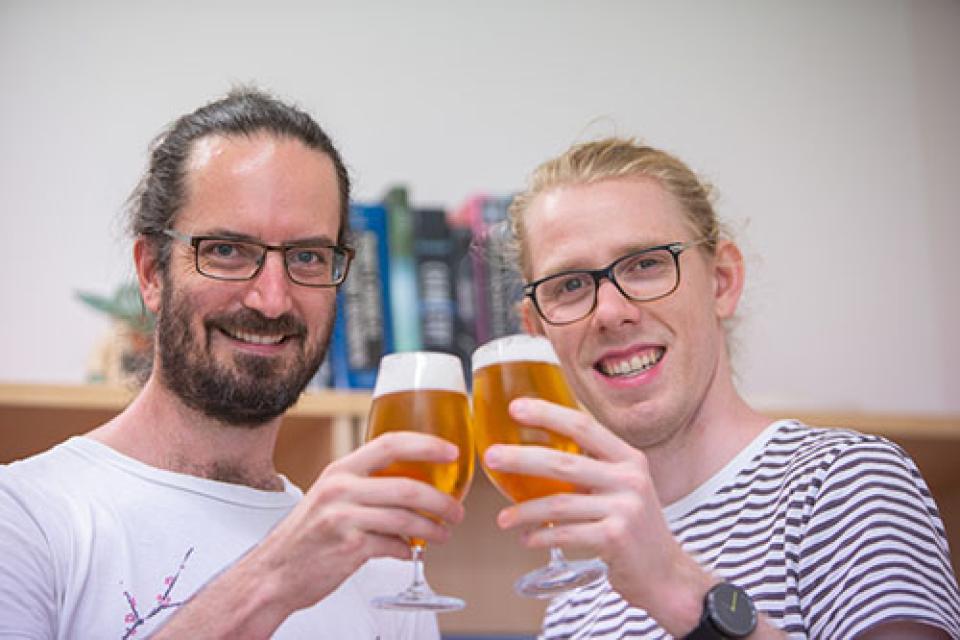
Image above left: Dr Ben Schulz and Ed Kerr enjoy a well-earned craft beer after discovering they're distinct from mass-market beers.
Media: Edward Kerr, edward.kerr@uq.net.au; Dr Benjamin Schulz, b.schulz@uq.edu.au +61 7 336 5 4875, +61 434 298 062; Faculty of Science Media, science.media@uq.edu.au, +61 3365 4043.
Topics
Related articles

UQ banking on a future for koala diversity
