
Inside the head of one of Australia’s smallest fossil crocs
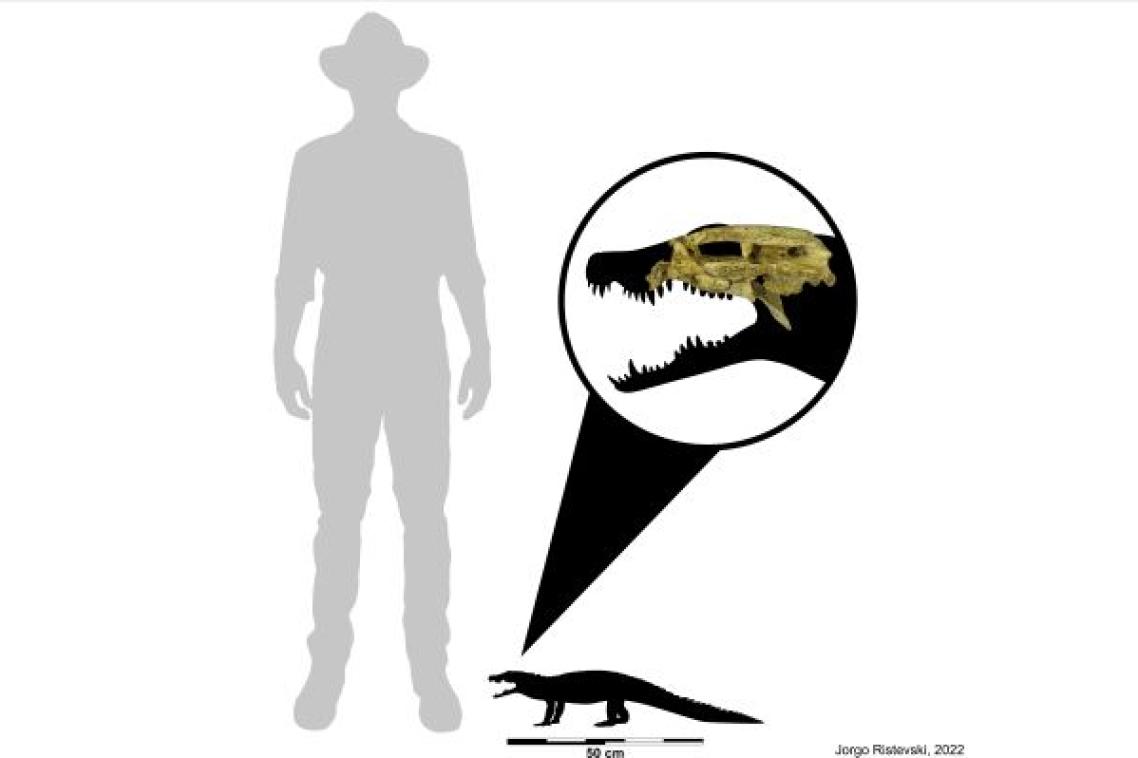
Approximately 13.5 million years ago, north-west Queensland was home to an unusual and particularly tiny species of crocodile and now scientists are unlocking its secrets.
University of Queensland researchers have used state-of-the-art technology to reveal previously unknown details about the prehistoric Trilophosuchus rackhami’s anatomy.
Faculty of Science PhD candidate, Jorgo Ristevski said it is the most detailed examination ever undertaken of the skull anatomy of an extinct croc from Australia.
“By micro-CT scanning the beautifully preserved skull, we were able to digitally separate each bone,” Mr Ristevski said.
“We estimated that at adulthood, Trilophosuchus rackhami would have been between 70 and 90 centimetres long and weighed one to two kilograms, which was very small compared to most present-day crocs.
“This was a truly unique looking croc, with a short snout and three distinct ridges on the top of its skull.”
Trilophosuchus rackhami means Rackham’s three-crested croc, which was named in 1993 in honour of Alan Rackham, who now manages the Riversleigh Fossil Discovery Centre at Mt Isa.
Mr Ristevski said palaeoneurology, a field that studies the brain and nervous system of fossil species, can provide crucial insights into the animal’s evolution, morphology and even behaviour.
“For one of the studies, I digitally reconstructed the brain cavity of Trilophosuchus rackhami and found that it resembles that of some distantly related and potentially terrestrial extinct crocs from Africa and South America,” Mr Ristevski said.
“We were quite surprised to find this because evolutionarily speaking, Trilophosuchus rackhami is more closely related to today’s crocs.
“This may indicate that Trilophosuchus rackhami spent more time on land than most living crocs.”
Mr Ristevski said the findings would be useful in interpreting the evolutionary relationships of extinct crocs, something that will be researched in the future.
Associate Professor Steve Salisbury said up until very recently, Australia had an amazing diversity of prehistoric crocs.
“Trilophosuchus rackhami was certainly one of the cutest,” he said.
“If we could travel back in time to north Queensland 13 million years ago, not only would you need to watch out for crocodiles at the water’s edge, but you’d also have to make sure you didn’t step on them in the forest.”
The research was published in The Anatomical Record and The Journal of Anatomy.
Images are available via Dropbox
Media: Jorgo Ristevski, j.ristevski@uq.net.au, +61 (0)481 745 188; A/Prof Steve Salisbury, s.salisbury@uq.edu.au, +61 (0)407 788 660; Faculty of Science Media, science.media@uq.edu.au, +61 (0)438 162 687.
Topics
Related articles

Archaeology’s assumptions about ancient diets challenged by new research
