
Molecule chip changing the face of modern manufacturing
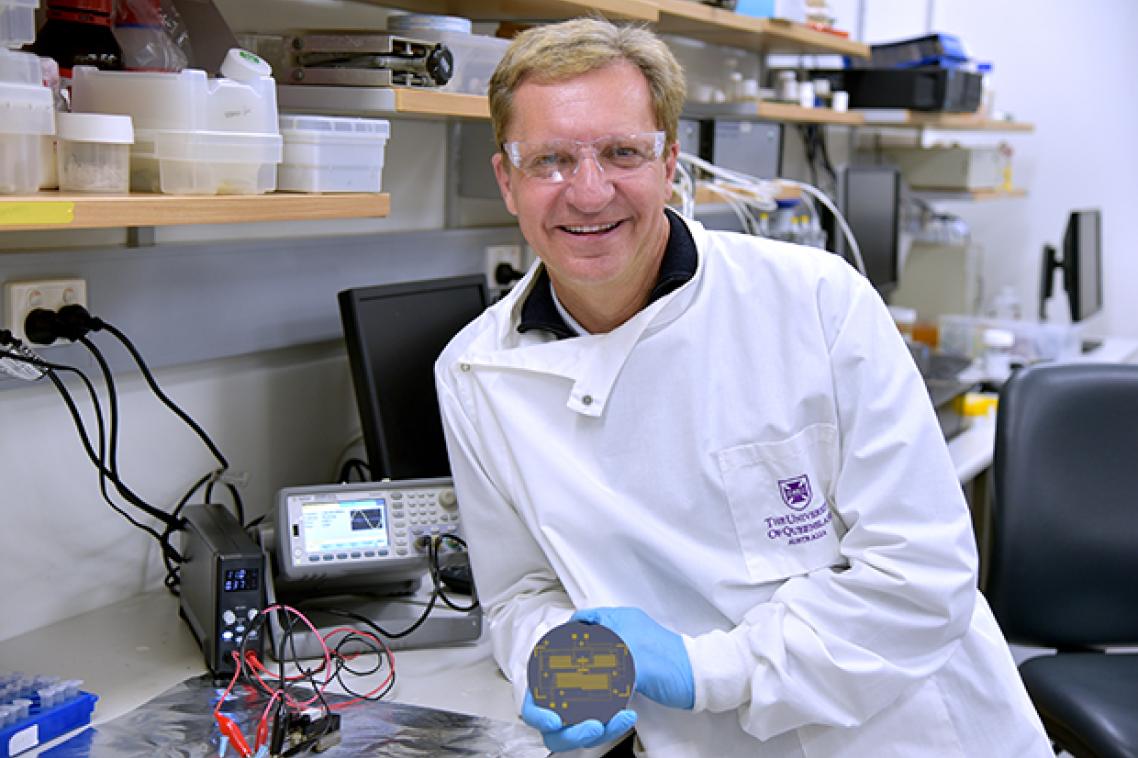
University of Queensland researchers have pioneered a chemical process to manufacture the molecules that are the building blocks for lifesaving medicines, vaccines and energy storage materials.
Professor Matt Trau from UQ’s Australian Institute for Bioengineering and Nanotechnology (AIBN) has been awarded an ARC Laureate Fellowship worth $2.9 million to further understand and develop the process.
“We have been able to accelerate and control chemical reactions on a tiny nano-scaled chip,” Professor Trau said.
“This could enable on-demand, miniaturised, remote manufacturing in a much more economical and environmentally friendly way.
“Much like 3D printing has disrupted manufacturing on a larger scale, this could change modern manufacturing on the molecular scale.”
Professor Trau and his team at AIBN have invented a unique way to synthesise molecules on a tiny electronically controlled chip, or silicon wafer.
“This nanotechnology platform can accelerate chemical reactions in ways not possible in conventional large-scale factories,” he said.
Professor Trau said the technology could be applied to the production of life-saving products.
“The more research we undertake to understand exactly what’s happening to these molecules at the nanoscale, we see more and more applications for entirely new ways to manufacture products such as medicines, vaccines and energy storage materials,” he said.
The project builds upon Professor Trau’s previous research into nano-scaled chips.
“This was a left-field spin-off from research where we used nano-scaled chips to detect rare molecules in blood, to diagnose cancer and dysregulated aspects of the immune system,” he said.
“I’m proud that our research team committed so strongly to what was originally an extremely risky blue-sky idea.
“It has now come to fruition and could potentially contribute to local and global manufacturing of essential molecules.”
Media: Professor Matt Trau, m.trau@uq.edu.au, +61 7 334 64173; Anna Edwards, anna.edwards1@uq.edu.au, +61 (0) 434 313 053.
Related articles

UQ innovators progress therapies to tackle dementia
