
UQ heats up the space race
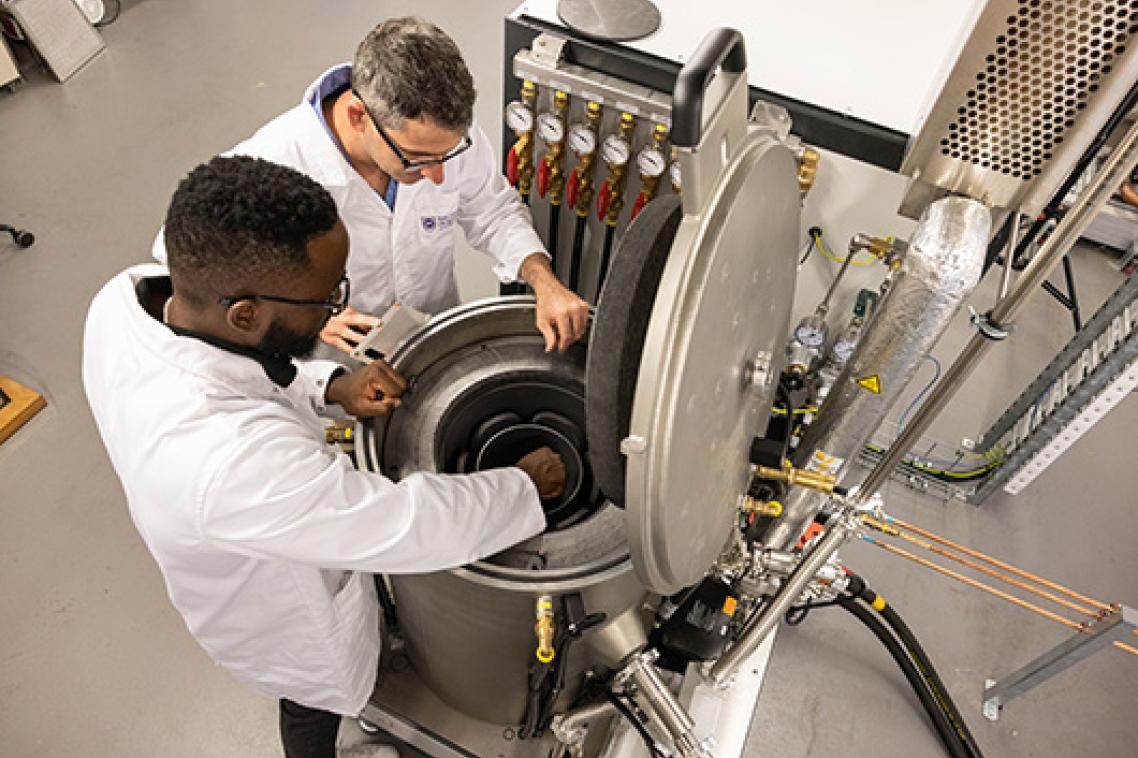
A custom-built furnace that can heat materials to almost 3000 degrees Celsius has been installed at The University of Queensland to develop components for Australia’s burgeoning space industry.
The furnace is the first of its type in Australia, allowing UQ researchers to make the next generation of ultra-high temperature composite materials for hypersonic flight.
Key points
- A UQ furnace heats to temperatures of almost 3000 degrees Celsius
- The furnace can produce components that withstand hypersonic flight into space
- UQ will work with industry partners to pioneer ceramic matrix composites (CMC) manufacturing in Australia
Hypersonic vehicles travel more than five times faster than the speed of sound, and Associate Professor Michael Heitzmann said they have to be made from materials that can withstand extremely high temperatures caused by aerodynamic heating.
“That’s where UQ and our new furnace at the Centre for Advanced Materials Processing and Manufacturing – or AMPAM comes in,” Dr Heitzmann said.
“We are working directly with industry to identify appropriate and cost-effective high temperature ceramic matrix composites or CMCs, tailored to hypersonic flight applications.

“In areas like a rocket nozzle or a hypersonic vehicle, the temperatures we’re talking about approach those seen on the surface of the sun.
“We are trying to get the utmost temperature resistance out of our material and find the most thermal-resistant materials possible.
“We are pioneering CMC manufacturing in Australia – it is a rare class of material because it’s extremely lightweight and has exceptional heat resistance.”
Growing demand for UQ technology

The components made in the German-manufactured furnace will be used by companies such as Brisbane-based aerospace manufacturer Hypersonix Launch Systems, which specialises in hypersonic technology and scramjet engines.
Hypersonix Manufacturing Lead Sam Grieve said the UQ team would produce an engine part for the DART AE, a three-metre-long, single-use vehicle, powered by a hydrogen -fuelled SPARTAN scramjet engine.
“The insert is in a part of the engine that could be subjected to temperatures more than 1300 degrees Celsius, due to hypersonic flows and shock waves,” Mr Grieve said.
“Normal metal alloys would fail at that temperature, so we need high-performance lightweight materials to ensure the engine will survive in flight.”
Mr Grieve said UQ’s AMPAM group would have a capability to produce high quality CMC’s with temperature resistance not previously possible in Australia.
“This is a very important sovereign capability and an important puzzle piece in establishing an Australian space and hypersonics industry,” he said.
“The ultimate goal for Hypersonix is a multi-mission autonomous vehicle capable of delivering satellites to orbit while producing no CO2 in its exhaust.
“Our Engineering team is excited to be working with UQ to deliver outcomes that could see Hypersonix competing internationally, and to see Australia at the forefront of international space technologies.”
How are the components made?
The CMC components are manufactured within UQ’s AMPAM Research Centre using a range of fabrication techniques including winding with a newly acquired filament winding machine.
Carbon fibre threads are wound onto filament reels and fed onto a rotating mandrel, which Dr Heitzmann said was an efficient way to make ultra-lightweight and strong components.
“Having this capability allows us to pair our materials research with industry relevant manufacturing process and it also gives us the ability to manufacture prototype components,” he said.
“The filament winder will also give our extracurricular student teams from UQ Space and UQ Racing the ability to manufacture components at an unprecedented performance level and using industry ‘best-practice’.”
UQ research supporting industry
Dr Heitzmann said AMPAM was passionate about supporting UQ’s industry partners.
“The companies we work with are at the forefront of Australia’s efforts to achieve access to space or prolonged hypersonic flight, which is a milestone achievement,” he said.
“The investment in our capabilities enhances the potential for our partners to deliver real impact and puts our students in touch with space-age manufacturing technologies.”
The furnace will also be used to produce 3D-printed materials for bio-medical applications, battery materials and a new generation of renewable carbon fibres.
“AMPAM is very keen to understand the problems of industry and we’re eager to work in partnership to solve these super challenging problems,” Dr Heitzmann said.
“That's what we're here for.”
(Image: Dr Christian Kudisonga holding a prototype of a DART AE)
Related articles

Prof Sue Harrison elected Royal Academy of Engineering Fellow
