
Subcultures in the subtropics: The evolution of Brisbane’s punks and goths
Dance music thuds from brightly lit doorways along Brisbane’s Ann Street, as eager punters spill across the pavement queuing to get inside.
Fortitude Valley’s Special Entertainment Precinct is heaving with pub and club goers on a Saturday night, testament to the city’s healthy nightlife.
But a pivotal part of Brisbane’s musical history is less visible – the punks and goths who helped carve out this part of the city for clubs and live music.
Emerging in the late 1970s and early 1980s, at the height of political and social conservatism in Queensland, these groups claimed space for themselves and have maintained a presence ever since.
Researchers from The University of Queensland and QUT have traced the unique evolution of Brisbane’s punks and goths, and their role in shaping the city’s ‘alternative’ identity.
French-born Dr Sébastien Darchen arrived in Australia 11 years ago with a cursory knowledge of Australian music.
“I knew the mainstream bands of course – ACDC, INXS, Midnight Oil – but I knew very little Australian music beyond that,” Dr Darchen said.
The self-described music lover began to explore his new home, and how to incorporate his interest in music into his academic work as an urban planner at UQ’s School of Architecture, Design and Planning.
“I wanted to look at how music scenes might be influenced by planning policies, and whether the way a city is being organised can facilitate music scenes to thrive, or not,” he said.
He was introduced to Dr John Willsteed, whose musical pedigree includes performing in revered Australian acts The Go-Betweens, The Apartments, The Riptides and Ed Keupper.
He is also an Adjunct Senior Lecturer at QUT’s School of Creative Practice, with a keen interest in the musical history of Brisbane.
The pair has since collaborated on a book and various academic papers exploring music and urban studies.
Their latest research is a collaboration with QUT’s Dr Yanto Browning and involved more than 11 hours of interviews with participants, musicians, radio announcers and producers.

“The political climate in Queensland in the 1970s was ripe for the punk movement when it arrived in Australia,” Dr Willsteed said.
“We had the Bjelke-Peterson government determined to stop any creative expression it perceived as being a threat to the norm, and a police force that violently stamped it out.”
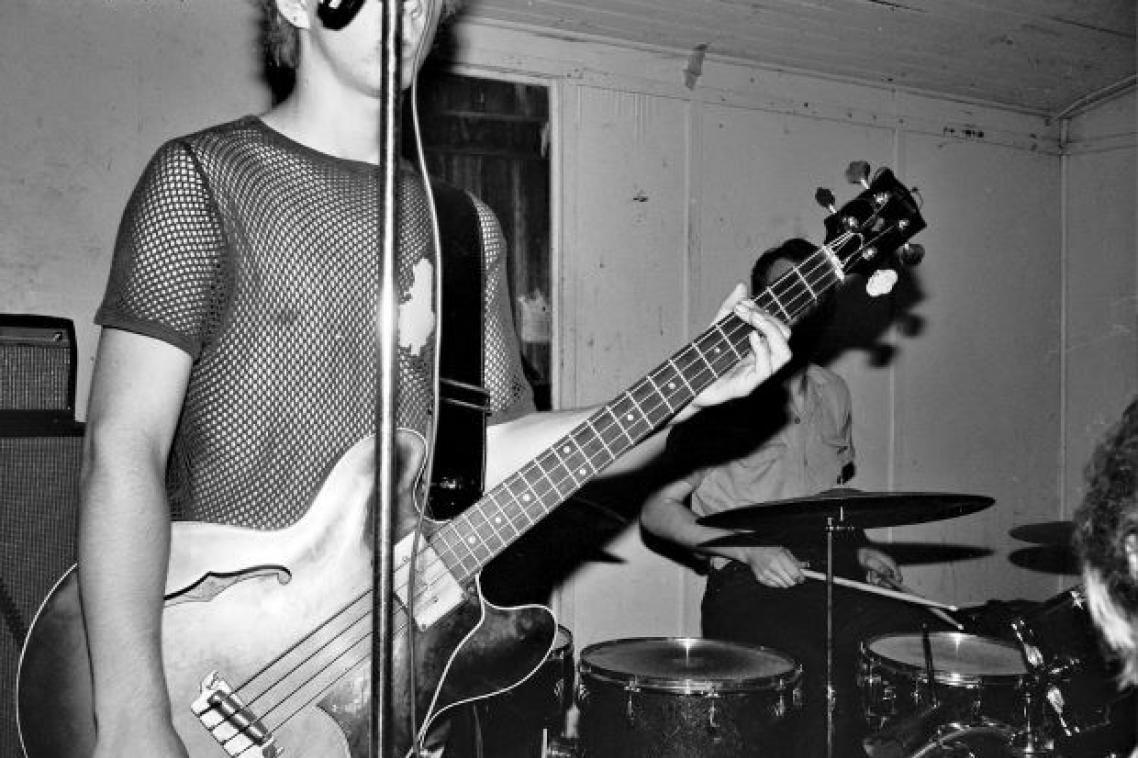
Nevertheless the local underground music scene exploded, with The Saints’ 1976 seminal release, ‘(I’m) Stranded’ opening the floodgates.
Bands formed in suburban bedrooms and garages - The Leftovers and Tex Deadly & the Dumdums from Sandgate; The Hardons, Kicks and Razar from Mt Gravatt while Ipswich produced Colours, Pinups, Toy Watches and Skeletones.
“A lack of regular venues played a big part in how Brisbane’s punk scene developed,” Dr Willsteed said.
“Bands couldn’t get booked in regular pub venues, but they found a way to claim space.
“Early gigs were staged underneath old Queenslander houses or in tiny suburban community halls and later there were select places like The Curry Shop and 279 Club in the city and Romeo’s and The Silver Dollar in the Valley.”
As industrial estates grew in the outer suburbs, warehouses in the city and Fortitude Valley emptied and became available as practice rooms and squats.
“There were lots of bands like the ones I was in, renting half a massive warehouse floor for $25 a week or something ridiculous,” Dr Willsteed recalls.
With a noisy live music scene, non-conformist dress code and political activism, Brisbane’s punks began to attract more attention from authorities.
“Raids by police and arrests at some of the shows reinforced the tightness of the Brisbane scene,” Dr Darchen said.
“Punks, and others in emerging subcultures, started to carve out safer places for themselves.”
University campuses became a beacon.
“Universities operated under the jurisdiction of federal authorities, with Queensland police needing permission to enter,” Dr Darchen said.
“They were safe places, not just for punks but women, the queer community and students leaning left in a right-wing city.”
UQ and Griffith University hosted live music, including The Cure at the UQ Refectory in 1980 as part of their first Australian tour.
“The band Zero I played in was the support for that gig, but have almost no memory of it at all,” Dr Willsteed said.
“There’s a photo of me on stage, that’s how I know I was there!”
4ZZZ, then based at The University of Queensland, was also pivotal to the dynamic, championing alternative music not played on mainstream radio.
By the early 1980s, the punk movement globally had splintered with several alternative genres emerging including Gothic Rock.
The goth aesthetic was ritualistic, transcendent, other-worldly and dark.
“In Australia there was a grungy ‘swampie’ look early on before the local goth scene took more of its cues from the UK,” Dr Darchen said.
The look took commitment in a Brisbane summer - head-to-toe black clothes with no visible skin, big hair, white face and kohl-lined eyes.
Musically, foundational goth bands included Siouxsie and the Banshees, The Birthday Party, UK Decay, Joy Division and Bauhaus.

While Brisbane’s punk scene was primarily built around live music, the goth scene was more of a ‘club’ culture.
“Rather than a live performance at a fixed venue, ‘goth nights’ involved DJs playing recorded music at various venues,” Dr Darchen said.
“People would dance, talk and drink, building a community.
“These nights were advertised by flyers which were typically hand-made and are a valuable piece of Brisbane’s cultural history.”
Some of the most popular goth nights in the 1980s included ‘Hades’ at the Land Office Hotel, ‘Club Vortex D’Junk’ at 409 George Street and ‘Morticia’s’ at the Treasury, Belfast, Hacienda and Orient hotels.
The ongoing gentrification of the inner-city has taken a toll on Brisbane’s alternative music scene.
There are fewer spaces for live music and club nights with the commercialisation of venues and poker machines in spaces once taken up by a stage.
But the punk and goth subcultures are remarkably resilient.
“There is still a core group of Brisbane punk devotees,” Dr Willsteed said.
“Events like Punkfest, created by Cathy Kerlin and Chris Converse and going for almost 20 years, are also very popular.”
Brisbane’s goth scene is also smaller but has remained an enduring fixture over the past 40-odd years.
“There are goth events held every month, but you need to be a part of that community to know about them,” Dr Darchen said.
“The scene is reinventing itself with social media, with goths now able to connect anywhere in the world on pages and in forums.”
The researchers said it was still important for Brisbane to have venues open to alternative music.
“Urban planners and policy makers need to make sure the next generation of transgressive, rebellious noise makers has somewhere to go,” Dr Darchen said.
“These subcultures aren’t mainstream, but they’re an ongoing part of Brisbane’s cultural heritage.”
Dr Willsteed, preparing for a gig with his band in a small Valley bar, agreed.
“It’s really important to research and record these moments, so people don’t forget.”
The research has been published in Cities.
Image above: Zero perform at the UQ Relaxation Block, August 1979, with Dr John Willsteed at far right. Image: Paul O'Brien Collection, John Oxley Library, State Library of Queensland.
Image above: Paddington Hall, 1979. Image: Paul O'Brien Collection, John Oxley Library, State Library of Queensland.
Related articles

UQ’s QARC wins at Engagement Australia Awards
