Skip to menu Skip to content Skip to footer
News

Giant new snake species identified in the Amazon
20 February 2024
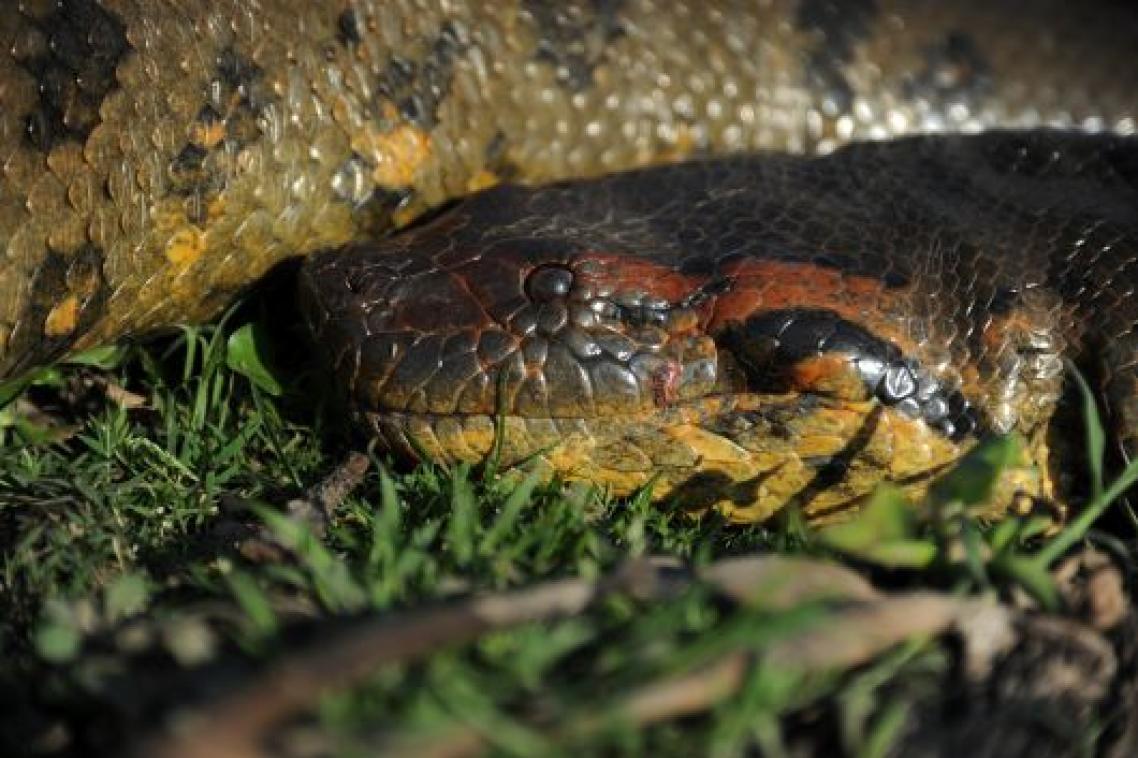
A Northern Green Anaconda slithering in the grass.

Northern Green Anaconda (Eunectes akayima).

(Photo credit: Jesus Rivas. )

A team of scientists on location with a film crew in the remote Amazon has uncovered a previously undocumented species of giant anaconda.

Professor Bryan Fry from The University of Queensland led a team which captured and studied several specimens of the newly named northern green anaconda (Eunectes akayima), located in the Bameno region of Baihuaeri Waorani Territory in the Ecuadorian Amazon.

“Our team received a rare invitation from the Waorani people to explore the region and collect samples from a population of anacondas, rumoured to be the largest in existence,” Professor Fry said.

“The indigenous hunters took us into the jungle on a 10-day expedition to search for these snakes, which they consider sacred.

“We paddled canoes down the river system and were lucky enough to find several anacondas lurking in the shallows, lying in wait for prey.

“The size of these magnificent creatures was incredible – one female anaconda we encountered measured an astounding 6.3 metres long.

“There are anecdotal reports from the Waorani people of other anacondas in the area measuring more than 7.5 metres long and weighing around 500 kilograms.”

Professor Fry said the northern green anaconda species diverged from the southern green anaconda almost 10 million years ago, and they differ genetically by 5.5 per cent.

“It’s quite significant – to put it in perspective, humans differ from chimpanzees by only about 2 per cent,” he said.

“This discovery is the highlight of my career.”

The new anaconda species was found while filming with National Geographic for their upcoming Disney+ series Pole to Pole with Will Smith, on which Professor Fry, a National Geographic Explorer, was the expedition’s scientific leader.

“Our journey into the heart of the Amazon, facilitated by the invitation of Waorani Chief Penti Baihua, was a true cross-cultural endeavour,” he said.

“The importance of our Waorani collaborators is recognised with them being co-authors on the paper.”

The scientists also set out to compare the genetics of the green anaconda with specimens collected elsewhere by world-leading anaconda expert Dr Jesus Rivas from New Mexico Highlands University, and use them as an indicator species for ecosystem health.

Professor Fry said the Amazon continues to face alarming ecological threats.

“Deforestation of the Amazon basin from agricultural expansion has resulted in an estimated 20-31 per cent habitat loss, which may impact up to 40 per cent of its forests by 2050,” he said.

“Another increasing problem is habitat degradation from land fragmentation, led by industrialised agriculture and heavy metal pollution associated with spills from oil extraction activities.

“Forest fires, drought and climate change are also notable threats.

“These rare anacondas, and the other species that share this remote ecosystem, face significant challenges.”

Professor Fry said his next research project would focus on heavy metal pollution in the Amazon.

“It’s not only these gigantic snakes that are facing environmental threats, but almost all living things in the region,” he said.

“The discovery of a new species of anaconda is exciting, but it is critical to highlight the urgent need to further research these threatened species and ecosystems.

“Of particular urgency is research into how petrochemicals from oil spills are affecting the fertility and reproductive biology of these rare snakes and other keystone species in the Amazon.”

The research paper is published in MDPI Diversity.

Additional coverage of the discovery can be found on National Geographic.

Related articles

Students sit under the Jacaranda trees in the Great Court

UQ leads Australasia for commercialisation revenue and startup equity value

The University of Queensland has been ranked the leading Australasian university for commercialisation revenue and the value of equity held in startups and spinouts in the latest Survey of Commercialisation Outcomes from Public Research (SCOPR).
15 October 2026
Three researchers wearing blue protective lab gowns stand among rows of potted chickpea plants inside a controlled-environment plant research facility.

Turning up the heat on chickpea yield

A University of Queensland study has outlined a practical pathway for accelerating the development of heat adapted chickpeas using data from new ‘omic’ technologies. PhD candidate Callum Jamie said the suite of technologies offered tremendous opportunities to understand how a complex trait like heat tolerance works. “The narrow genetic diversity in the elite chickpea gene pool has limited conventional breeding’s effectiveness for stress tolerance,” Mr Jamie said. “These technologies have improved our capacity to dissect trait architecture and phenotype secondary traits but their use in chickpeas has been limited.” The technologies include genomics, epigenomics, transcriptomics, proteomics, metabolomics, phenomics and enviromics, and help provide a comprehensive picture of biological systems. Epigenomics helps understand what controls gene activity; transcriptomics considers gene expression; proteomics protein production; metabolomics looks at biochemical processes; phenomics observes traits; and enviromics considers environmental factors influencing outcomes. Mr Jamie said previous studies had focused on just 1 to 2 -omic datasets, a small number of genotypes, and single tissues. This has meant it was hard to infer what results meant for trait architecture and mechanisms and the ability to extrapolate the information to breeding populations was limited. There have also been challenges around cost, scalability and integrating very different types of data to make the technologies useful. To overcome the hurdles, Mr Jamie’s research at the Queensland Alliance for Agriculture and Food Innovation has resulted in a proposed staged approach. It would start with genomic prediction and phenotyping, before adding -omic layers as costs fall and unknowns were resolved. “These technologies are novel and we still don’t know which information provides added value and how best to integrate all of this data to achieve an outcome,” Mr Jamie said. His PhD is supported by the Grains Research and Development Corporation (GRDC) and the International Research Training Group (IRTG) Accelerating Crop Genetic Gain and is aligned to a project which aims to fast-track the development of chickpea varieties adapted to high temperatures. Project leader Dr Millicent Smith said heat stress causes severe yield implications through flower and pod loss, reduced pollen viability and impaired grain filling. “Late sown chickpea is particularly in the firing line across most of Australia's crop in southern Queensland and northern New South Wales,” Dr Smith said. “We want to ensure that Australian growers maintain their competitive edge. “New varieties with improved genetics to cope with heat stress are essential for the future. “This work, suggesting a staged approach to utilising the new -omic technologies, is an exciting frontier.” The research was published by Food and Energy Security. Callum Jamie’s PhD is supported by the Grains Research and Development Corporation (GRDC) and the International Research Training Group (IRTG) Accelerating Crop Genetic Gain.
15 October 2026

Media contact

Subscribe to UQ News

Get the latest from our newsroom.