Skip to menu Skip to content Skip to footer
News

Thousands of tonnes of microplastics found in Moreton Bay
25 March 2024
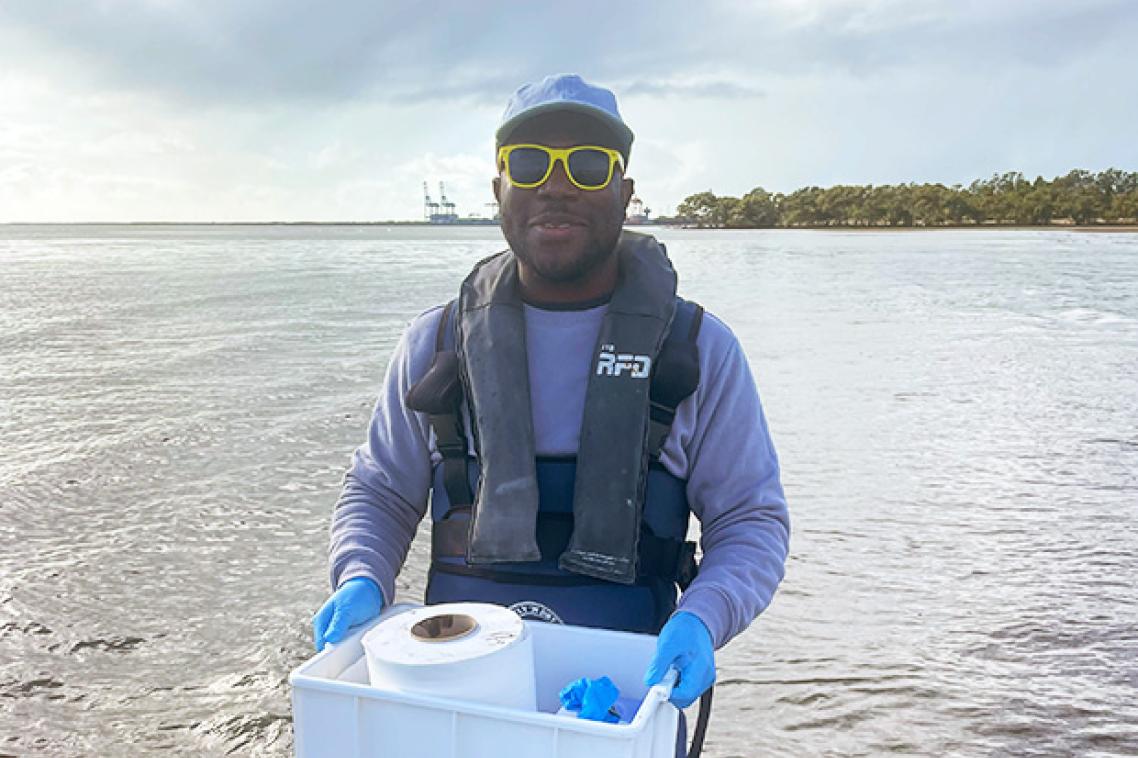
a man stands in water holding a plastic container
Dr Elvis Okoffo has tested samples of mud from Moreton Bay for microplastics.

University of Queensland researchers estimate there could be up to 7000 tonnes of microplastics polluting vital ecosystems in Brisbane’s Moreton Bay.

Dr Elvis Okoffo from UQ’s Queensland Alliance for Environmental Health Sciences said the team measured plastic stored within 50 surface sediment samples collected across Moreton Bay.

“The level of plastic contamination we found is equivalent to three Olympic swimming pools full of plastic or 1.5 million single use plastic bags,” Dr Okoffo said.

“The main types of plastic detected were polyethylene (PE) and polyvinyl chloride (PVC).

“PE is used for single-use items such as plastic food wrapping, bags and bottles and PVC is used in pipes, building materials, electronics, and clothing.

“These were the most used types of plastics in Australia between 2019-2020 and our findings suggest a direct link between the use of these plastics and their prominence in the coastal environment.”

The UQ research team used a mass based quantitative method to measure the concentration of seven common plastic types in the bay and its ecosystems, including mangroves, seagrasses and mud.

Associate Professor Helen Bostock Lyman from UQ’s School of the Environment said sediment samples were collected from across the bay using a small metal grabber lowered to the sea floor.

“The samples were put into glass jars, dried in the lab and analysed for plastic polymers using a solvent extraction and mass spectrometry technique which looks at the chemical signature of the different polymers,” Dr Bostock said.

“The advantage of this method is that we can quantitatively measure plastic concentrations of any size range.

“Understanding the types of plastic polluting coastal environments and the scale of the issue is critical to informing strategies to reduce future pollution.

“This is the first study to quantify plastic in Moreton Bay and one of the few studies that has quantified microplastic pollution in coastal areas around Australia.

“We are currently investigating how plastic has changed over time in Moreton Bay from sediment cores from the centre of the bay and we will be looking at the level of plastic contamination in organisms that live there.”

The research paper was published in Science of the Total Environment.

Media contact

Faculty of Health and Behavioural Sciences Communications
habs.media@uq.edu.au
+61 412 307 594

Related articles

Three researchers wearing blue protective lab gowns stand among rows of potted chickpea plants inside a controlled-environment plant research facility.

Turning up the heat on chickpea yield

A University of Queensland study has outlined a practical pathway for accelerating the development of heat adapted chickpeas using data from new ‘omic’ technologies. PhD candidate Callum Jamie said the suite of technologies offered tremendous opportunities to understand how a complex trait like heat tolerance works. “The narrow genetic diversity in the elite chickpea gene pool has limited conventional breeding’s effectiveness for stress tolerance,” Mr Jamie said. “These technologies have improved our capacity to dissect trait architecture and phenotype secondary traits but their use in chickpeas has been limited.” The technologies include genomics, epigenomics, transcriptomics, proteomics, metabolomics, phenomics and enviromics, and help provide a comprehensive picture of biological systems. Epigenomics helps understand what controls gene activity; transcriptomics considers gene expression; proteomics protein production; metabolomics looks at biochemical processes; phenomics observes traits; and enviromics considers environmental factors influencing outcomes. Mr Jamie said previous studies had focused on just 1 to 2 -omic datasets, a small number of genotypes, and single tissues. This has meant it was hard to infer what results meant for trait architecture and mechanisms and the ability to extrapolate the information to breeding populations was limited. There have also been challenges around cost, scalability and integrating very different types of data to make the technologies useful. To overcome the hurdles, Mr Jamie’s research at the Queensland Alliance for Agriculture and Food Innovation has resulted in a proposed staged approach. It would start with genomic prediction and phenotyping, before adding -omic layers as costs fall and unknowns were resolved. “These technologies are novel and we still don’t know which information provides added value and how best to integrate all of this data to achieve an outcome,” Mr Jamie said. His PhD is supported by the Grains Research and Development Corporation (GRDC) and the International Research Training Group (IRTG) Accelerating Crop Genetic Gain and is aligned to a project which aims to fast-track the development of chickpea varieties adapted to high temperatures. Project leader Dr Millicent Smith said heat stress causes severe yield implications through flower and pod loss, reduced pollen viability and impaired grain filling. “Late sown chickpea is particularly in the firing line across most of Australia's crop in southern Queensland and northern New South Wales,” Dr Smith said. “We want to ensure that Australian growers maintain their competitive edge. “New varieties with improved genetics to cope with heat stress are essential for the future. “This work, suggesting a staged approach to utilising the new -omic technologies, is an exciting frontier.” The research was published by Food and Energy Security. Callum Jamie’s PhD is supported by the Grains Research and Development Corporation (GRDC) and the International Research Training Group (IRTG) Accelerating Crop Genetic Gain.
15 October 2026
A teenage girl consulting with a female doctor.

Global guidelines needed to address inequities in endometriosis care

Adolescents, gender-diverse people and those with lived experience are underrepresented in endometriosis guidelines worldwide, a University of Queensland study has found.
15 October 2026

Media contact

Subscribe to UQ News

Get the latest from our newsroom.