Replacing kerbside carparking with bike lanes: a Robin Hood planning idea
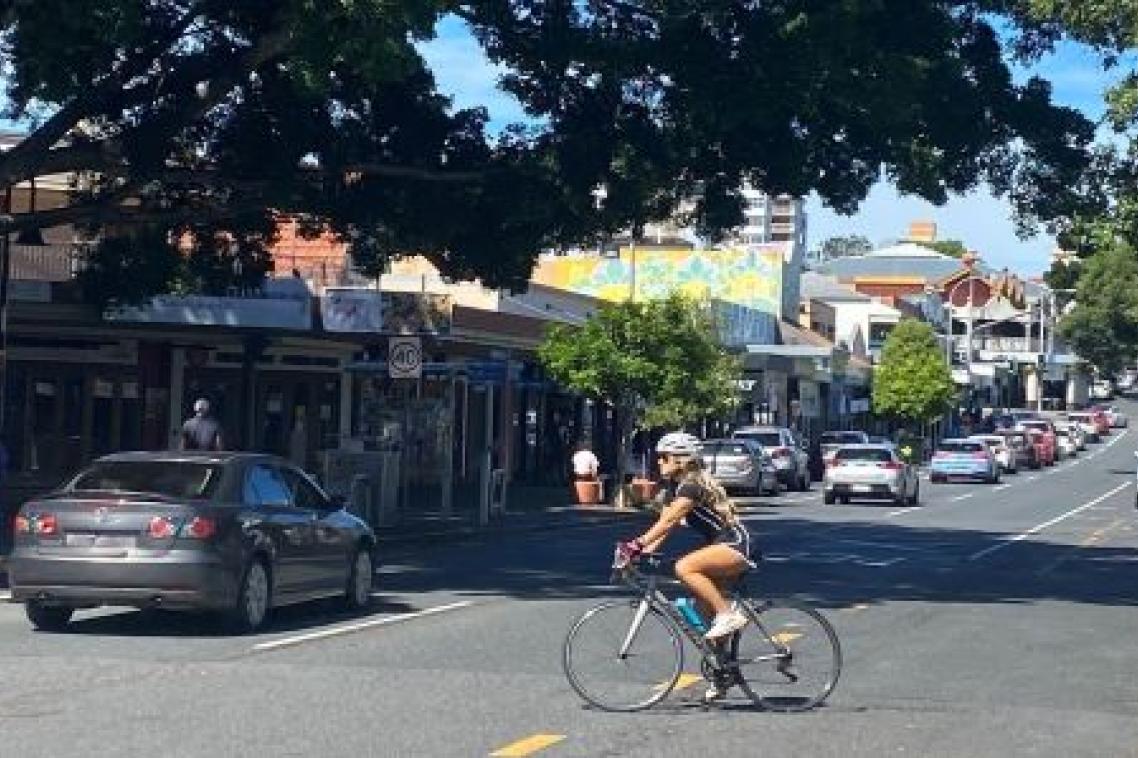
Turning kerbside carparks into cycling lanes could improve city accessibility and liveability without affecting business revenue, University of Queensland research has found.
The research team used Boundary Street in Brisbane’s West End as a case study to investigate if the ‘Robin Hood planning’ tactic of reassigning kerbside parking for bike riders would hurt local business.
Associate Professor Dorina Pojani, from the School of Architecture, Design and Planning, said surveys and observations showed it would be beneficial to turn at least one on-street parking lane into a cycling lane on Boundary Street.
“This is one of very few studies in Brisbane to examine the impact of parking and cycling options on local businesses,” Dr Pojani said.
“Contrary to popular perceptions, we found the parking occupancy rate on Boundary Street was mostly under 60 per cent during the week, mainly because 42 per cent of visitors walked to the destination.
“Forty per cent of the 214 people surveyed said they drove or were driven to the area, while only 16 percent said they cycled or used public transport.
“We also found most visitors to Boundary Street travelled less than 10 kilometres – within the maximum accepted cycling range.”
Previous studies have shown prioritising cycling and walking usually boosts both retail sales and property values, and more people would choose those options over driving if there was a safe and direct cycling infrastructure network.
“Businesses benefit from foot, bike, and bus traffic more than car traffic because of the higher and more frequent flow of customers, Dr Pojani said.
“This is why reassigning parking from one side of the road to a cyclist lane would make better use of that space.”
While the study focused on one street in Brisbane, Dr Pojani said it was relevant to other cities in Australia and globally.
“It helps us understand the relationship between on-street parking and the needs of the local residents and economies,” she said.
“The ideal solution is to not have on-street parking at all, but instead have multi-storey and underground parking lots, and repurpose kerbside parking space for walking, cycling, scooters and trees.
“Not only is this better visually, but it also improves accessibility and keeps the streets cooler.
“This is something local planning consultants and governments need to consider, and it is particularly relevant for South East Queensland as we head into the 2032 Brisbane Olympic and Paralympic Games.”
Dr Pojani said the study was the last piece in a major four-year research project into the transition of mobility and parking, which was funded by the Australian Research Council.
“In that larger study in Brisbane, Sydney and Melbourne, we found that a ‘predict and provide’ approach to parking policy was failing and outdated, and that we need more innovative approaches,” she said.
The research was published in Australian Planner, the flagship journal of the Planning Institute of Australia.
Related articles

Anyone can be a hacker with AI – so what does that mean for the cyber defence industry?