
Great Barrier Reef facing catastrophic damage
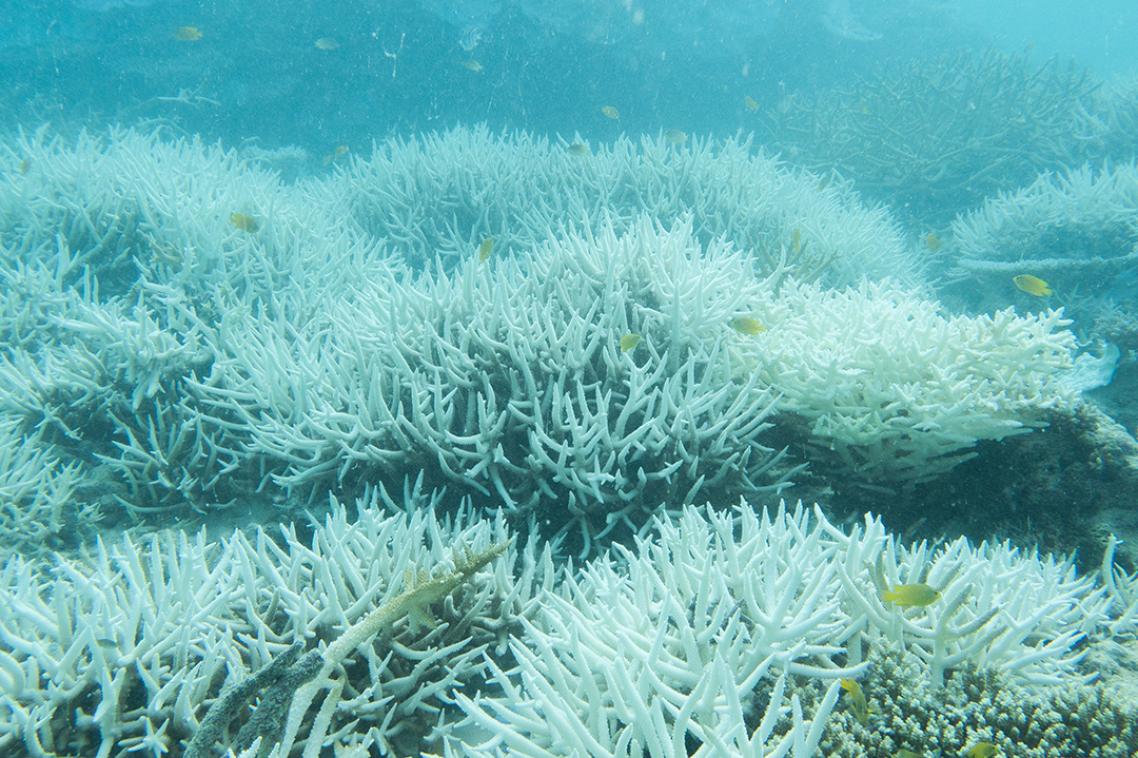
Bleached coral off the reef slope at UQ's research station on Heron Island, March 2024.
(Photo credit: Ove Hoegh-Guldberg. )
Leading scientists have found that sea surface temperatures on the Great Barrier Reef have reached a 400-year critical level, with human-induced climate change to blame.
In a collaborative research project involving The University of Queensland’s Professor Ove Hoegh-Guldberg and led by University of Wollongong and University of Melbourne researcher Dr Benjamin Henley, scientists confirmed human-induced climate change was responsible for rapid ocean warming in recent decades.
The team reconstructed centuries’ sea surface temperatures in the Coral Sea for the January–March period and found the hottest temperature in 400 years was recorded in 2024, followed by 2017 and 2020.
Professor Hoegh-Guldberg said the findings confirmed extreme ocean warming had led to mass coral bleaching and mortality on the Great Barrier Reef.
“The recent mass coral bleaching events coincide with five of the six hottest years in the new 400 year-long record,” Professor Hoegh-Guldberg said.
“The world’s largest coral reef is under critical pressure, with warming sea temperatures and mass coral bleaching and mortality threatening to destroy its critically important ecology and biodiversity and its value to culture, business and communities.
“This paper provides several new lines of evidence which together demonstrate that mass coral bleaching will likely devastate the ecological function of the Great Barrier Reef in the coming decades.
“This finding shows we must double down on reducing greenhouse gas emissions as an absolute necessity.”
The research team used climate modelling to assess how human influence had impacted ocean temperatures.
“When assessing natural trends without human impacts, the ocean temperature would have warmed by less than 0.01 degree Celsius per decade,” Professor Hoegh-Guldberg said.
“However, when considering human impacts, we found the ocean warmed by more than one degree Celsius.
“This confirms human impacts on the climate are the primary driver of this longer-term warming in the Coral Sea.”
The study also highlighted that even if the world were to limit global warming to the Paris Agreement’s target of 1.5 degrees Celsius, 70 to 90 per cent of corals on reefs would still be lost.
“Without urgent intervention, our iconic Great Barrier Reef is at risk of experiencing temperatures conducive to near-annual coral bleaching, which would have catastrophic consequences for coral reef ecosystems,” Professor Hoegh Guldberg said.
“This research has profound implications for marine ecosystems globally with similar sensitivities to rising sea temperatures.
“Almost every part of the ocean, from kelp forests to the deep sea, is changing in response to thermal stress and mass mortalities, highlighting the serious link between the long-term trajectory of extreme ocean temperatures and the ecological health and biodiversity of the Ocean.
“We must take action now before it is too late,” he said.
The research was published in Nature.
Related articles

From UQ reef science to national action in Fiji
